
Prune Apple Tree Australia: A Perth Homeowner's Guide

Imagine stepping into your Perth backyard and seeing an apple tree absolutely buzzing with life, its branches heavy with crisp, sun-ripened fruit. This isn't just a happy accident; it's the result of smart pruning. To properly prune an apple tree in Australia, you need to see the cuts you make as a crucial investment in your tree’s health and vitality, especially in Perth’s unique climate.
Why Pruning Your Apple Tree In Perth Is A Game Changer
Many Perth gardeners think of pruning as just another chore—a quick trim to tidy things up. The real magic, however, happens when you move beyond basic snipping and start making thoughtful, strategic cuts. When you make that shift, pruning transforms from simple maintenance into the single most impactful thing you can do for your apple tree's future.
Pruning is an essential part of robust apple tree health, and it's a critical component of comprehensive tree and plant care. Here in Perth, our mild winters can encourage rampant, leafy growth. It looks lush, but that often comes at the expense of fruit. A well-pruned tree redirects its energy away from making excess wood and channels it into growing bigger, sweeter apples.
Unlock Your Tree's Full Potential
Think of your apple tree's energy like a budget. Without pruning, that energy is spread thin across countless branches, many of which are unproductive, shaded out, or just growing in the wrong direction. Strategic pruning guides the tree, telling it exactly where to invest its resources for the best possible return.
By removing the right branches, you accomplish several key goals at once:
Improved Airflow: Thinning the canopy lets air circulate freely, which is a huge deal for reducing the fungal diseases that thrive in our sometimes-humid coastal conditions. For example, a more open structure can dramatically reduce the likelihood of powdery mildew.
Better Sunlight: More sun reaching the inner branches means better ripening, richer colour, and a much sweeter flavour in your apples. Sun exposure is what creates those desirable sugars.
A Stronger Structure: Getting rid of weak, crossing, or poorly angled limbs prevents them from breaking under the weight of a heavy crop and builds a sturdy framework for the future. You’re aiming for strong, 45-degree angles from the trunk, not narrow, weak V-shapes.
More Fruit: The right cuts actively stimulate the growth of new fruiting wood, helping you get a reliable harvest year after year.
It's a common mistake to think that more branches mean more apples. The opposite is often true. A crowded, unpruned tree might give you lots of small, sour fruit, while a carefully pruned one yields fewer but far superior apples.
Ultimately, pruning isn’t about making your tree smaller; it’s about refining it. It’s a bit like having a conversation with your tree, guiding it toward a healthier, more productive life. For complex jobs or trees that have been neglected for a few years, the expert touch of a professional can really set them back on the right path.
The Best Time To Prune Apple Trees In Perth
Timing is everything with apple trees, especially in Perth’s unique Mediterranean climate. Get it right, and you’re setting your tree up for a brilliant harvest. Get it wrong, and you could be stressing the tree and rolling out the welcome mat for disease.
Thankfully, the Perth pruning calendar is refreshingly straightforward.
The prime season for any major structural work is during winter dormancy, which for us is typically from June to August. During this time, your apple tree is essentially asleep. Its sap has pulled back, the branches are bare, and all its energy is in reserve. This makes it the perfect window for significant cuts without shocking the tree.
Pruning a dormant tree means that when spring finally rolls around, it can throw all that stored energy into a powerful burst of new growth—healthy shoots, fresh leaves, and most importantly, the new wood that will bear next season's fruit.
Why Winter Is King For Structural Pruning
Winter pruning is all about shaping the future. This is your chance to create a strong, open framework that can support a heavy crop and let that beautiful WA sunlight penetrate deep into the canopy. It’s when you make the big, bold decisions.
Tackle Crossing Branches: Get rid of any limbs that are rubbing against each other. This prevents wounds that act as open doors for pests and disease. A practical example is finding two branches that have grown to touch and removing the weaker or more poorly positioned one entirely.
Build a Strong Framework: Correct any poor angles and remove weak, spindly growth. You want to build a robust structure that won’t snap under the weight of all those delicious apples.
Manage Tree Size: If your tree is getting a bit out of hand, winter is the best time to reduce its overall height and spread, bringing it back to a manageable size for your backyard.
Here in Perth, I find that aiming for mid-winter, around July, is often the sweet spot. It helps you dodge the wettest parts of early winter, which lowers the risk of fungal spores getting into fresh pruning cuts. For a deeper dive into timing your cuts throughout the year, have a look at our seasonal guide on when to prune trees in Australia.
The Lighter Summer Snip For Control And Quality
While winter is for the heavy lifting, a bit of summer pruning offers a more nuanced, finishing touch. This lighter prune, usually done from December to February, is the secret weapon of savvy Perth gardeners. It’s not about hacking off big branches, but rather a delicate trim to manage growth and boost your fruit quality. This is a fashionable insight among modern gardeners looking to maximise yield in smaller spaces.
Summer pruning is fantastic for keeping vigorous trees in check, making it a great strategy for smaller suburban backyards. By snipping away excessive leafy growth, you achieve two things: you keep the tree compact and you tell it to stop wasting energy on making leaves and instead focus on ripening the apples already on the branches. A practical example is removing the soft, leafy shoots known as 'water sprouts' that shoot straight up from main branches.
Think of summer pruning as a finishing touch. It's like a final edit that opens up the canopy, allowing that gorgeous WA sun to reach the developing fruit, boosting sugar content and improving colour for the perfect harvest.
For a clearer picture, here’s a quick breakdown of how the two seasons compare for your Perth apple tree.
Seasonal Pruning Guide For Perth Apple Trees
This table gives you a quick-reference guide to help you decide when and why to pick up the tools.
Pruning Season | Best Months (Perth) | Primary Goal | Impact On Tree | Ideal For |
|---|---|---|---|---|
Winter Pruning | June – August | Structure, shape, and stimulating growth | Encourages vigorous new shoots in spring | Establishing a strong framework, removing large branches, and renovating old trees. |
Summer Pruning | December – February | Controlling size and improving fruit quality | Slows vegetative growth, redirects energy to fruit | Maintaining tree size, improving sunlight exposure to apples, and removing water sprouts. |
Ultimately, understanding how to use both pruning seasons gives you complete control over your tree’s health, shape, and productivity.
In the sun-drenched orchards of Western Australia, especially around Perth, getting your pruning timing right is absolutely critical. Local experts and historical data from Aussie growers confirm it: winter pruning can boost fruit quality by up to 25% simply by improving light and air circulation.
If you’re feeling a bit uncertain about making the right cuts at the right time, the experienced team at Swift Trees Perth is here to help. We can provide expert guidance or handle the professional pruning for you to ensure your apple tree absolutely thrives.
Mastering The Pruning Cuts Every Gardener Should Know
So, you've got your clean tools and the timing is right. Now it's time to make the first cut.
This can feel like the most intimidating part, but the good news is you only need to master a few simple cuts to completely transform your apple tree. Let's forget the confusing jargon and focus on building your confidence with techniques that actually work.
Your first move, before anything else, should always be tackling the 'Three Ds'. This is the non-negotiable starting point for any pruning job, whether it's your first time or you've been doing this for years. Think of it as a quick health check that instantly improves your tree's wellbeing.
Dead: Look for any branches that are brittle, grey, and completely lifeless. They'll often snap easily. These aren't doing anything for your tree except taking up space and potentially harbouring pests.
Diseased: Scan the wood for cankers, weird growths, or discoloured patches of bark. Getting this stuff out quickly is crucial to stop any infection from spreading through the rest of the tree.
Damaged: Any branches that have been cracked or broken—by wind, pests, or just plain bad luck—need to go. These weak spots are an open invitation for disease to get in.
Once you clear out the Three Ds, you'll have a much clearer picture of the tree's real structure. This makes all the next steps a whole lot easier.
Thinning Versus Heading Cuts
With the basic cleanup done, your pruning will boil down to two main types of cuts: thinning and heading. Getting your head around the difference is the key to shaping your tree effectively.
A thinning cut is where you remove an entire branch right back to where it started—either at the main trunk or a larger supporting limb. This is your go-to move for opening up the tree's canopy and creating space. For example, if a branch is growing back into the centre of the tree, a thinning cut removes it at its base, instantly improving light and airflow.
On the other hand, a heading cut is all about shortening a branch, not removing it completely. You make your cut just back from a healthy, outward-facing bud. This technique actually stimulates new growth, encouraging the branch to get bushier and produce more lateral shoots just below where you cut. A practical use for this is on a young tree, shortening the main 'leader' branches to encourage a stronger, more compact form.
For most backyard apple trees here in Perth, you'll find you're making far more thinning cuts than heading cuts. The goal is usually to create an open, vase-like shape to combat our humid conditions, and thinning is the best way to get that airy structure.
This simple flowchart breaks down the different goals for pruning throughout the year.
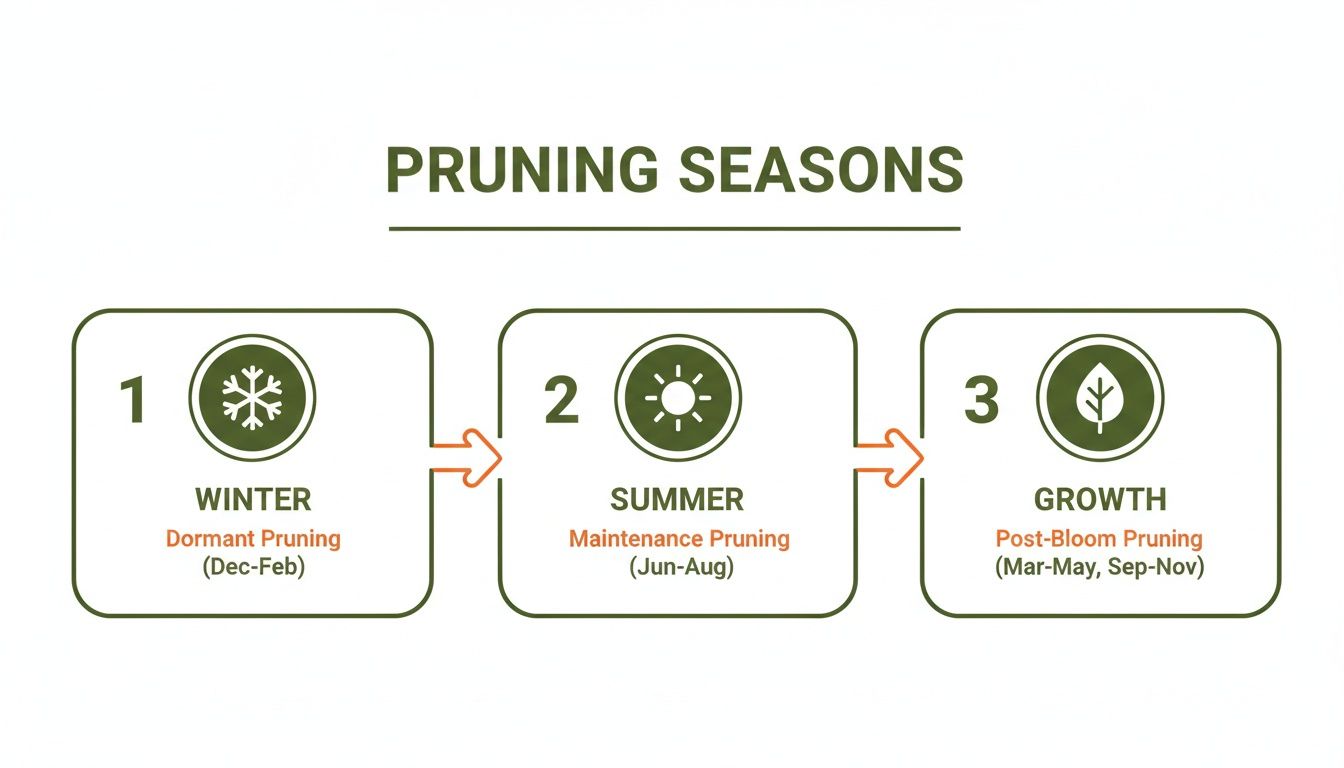
As you can see, winter is reserved for the major structural work, while summer pruning is more about fine-tuning the new growth and improving your fruit quality.
By combining these cuts, you can guide your tree with real precision. You might use thinning cuts to get rid of branches that are crossing over each other or growing inwards towards the centre. Then, you could follow up with a few careful heading cuts on some outward-growing branches to encourage more fruiting spurs to develop. It's a bit of a mantra among modern gardeners that less is often more; a few smart, well-placed cuts will always beat dozens of random snips.
Feeling a bit out of your depth or dealing with a tree that’s been left to its own devices for years? The friendly, knowledgeable team at Swift Trees Perth can handle all your tree maintenance needs.
How To Manage Tree Growth And Boost Your Fruit Harvest
Once you’ve mastered the basic cuts, it's time to get into the real art of pruning: managing your tree's energy. This all comes down to a concept called vigour—basically, how much new growth the tree puts on each year. Getting this balance right is the secret to turning a frustratingly barren tree into one that reliably heaps apples on you.
Have a good look at your tree. Is it covered in long, upright, leafy shoots but giving you hardly any fruit? That's a classic sign of a tree that's too vigorous. It's pouring all its energy into growing wood and leaves, with very little left in the budget for making apples. Our goal is to use smart pruning to redirect that energy.
On the flip side, a tree that barely grows at all each year is said to have low vigour. It might look a bit stunted or tired and often struggles to produce a decent crop. For this kind of tree, the pruning approach is completely different; we need to make careful cuts to kickstart new, healthy growth.
Taming Vigour For Fruit Production
If you’re dealing with an overly energetic tree, your winter pruning needs to be strategic. You want to calm it down without accidentally triggering an even bigger explosion of growth.
Focus on Thinning Cuts: Make thinning cuts your priority, not heading cuts. Removing entire branches that are crowding the centre or shooting straight up helps to open up the tree's structure without stimulating a frenzy of new shoots in response.
Embrace Summer Pruning: A light summer prune is your best friend for managing vigour. Snipping off the soft, new growth around December or January sends a clear signal to the tree to slow down on making leaves and instead focus on ripening the fruit it's already carrying.
Bend Branches, Don't Cut: Here's a clever and highly effective trick: gently tie down some of those vigorous, upright branches to a more horizontal angle (around 60 degrees is ideal) using soft ties and a stake. This simple action slows the sap flow and sends a hormonal signal to the branch, telling it to switch from 'grow' mode to 'fruit' mode. This is a fashionable technique used by professional orchardists to bring young trees into production faster.
Solving Biennial Bearing For Good
One of the most common frustrations for backyard apple growers is biennial bearing. This is when a tree produces a massive, tree-breaking crop one year, and then almost nothing the next. It happens because the tree completely exhausts its energy reserves in that heavy "on" year, leaving nothing in the tank for the following "off" year. The solution? Strategic pruning.
Managing vigour is a key part of successful apple growing in Australia, where both high and low vigour can be a real headache. Ideally, you want to see annual shoots of about 20-30cm. For biennial bearers, pruning just before the big 'on' year can help smooth out the cycle, preventing the 20-30% crop drop you often see in the 'off' years. You can learn more about the science behind vigour and fruit tree care.
By carefully thinning out some of the fruit buds during the winter before a massive "on" year, you're essentially tricking the tree into saving some energy. This makes sure it has enough reserves to produce fruit buds for the following season, finally breaking that frustrating boom-and-bust cycle.
Learning how to read your tree's vigour lets you make precise, effective cuts that lead directly to a better, more consistent harvest.
If your tree’s growth seems out of control or you're stuck in a biennial bearing rut, sometimes getting an expert eye on it can make all the difference.
Your Essential Toolkit For Safe And Clean Pruning
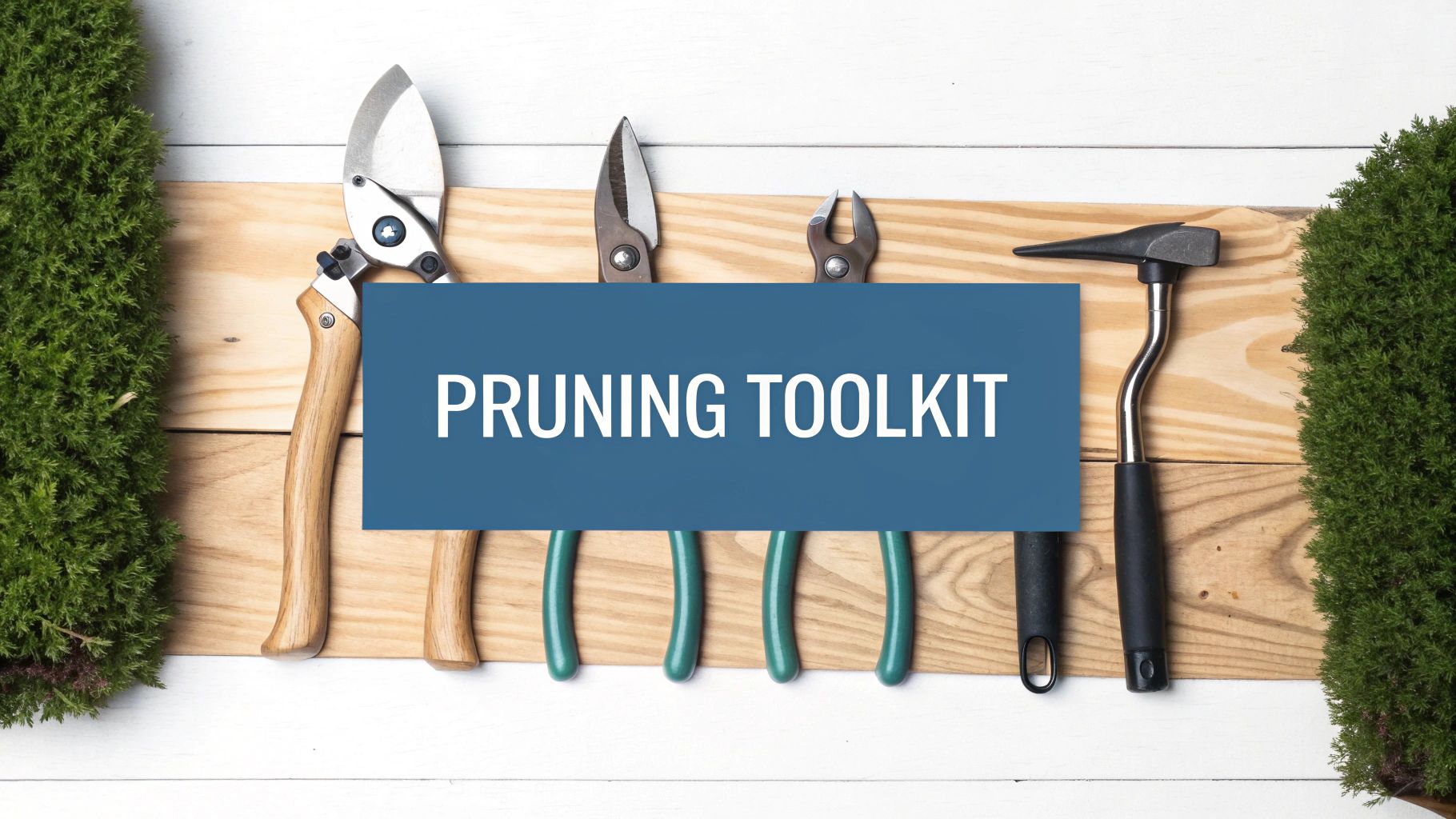
Stepping out to prune your apple tree without the right gear is like trying to cook a gourmet meal with a butter knife—you might get there eventually, but the result won't be pretty.
Using the correct tools isn't just about making the job easier and safer. It's about giving your tree the best chance to heal. Clean cuts mend faster and are far less likely to invite disease. A small investment in quality equipment will pay you back for many seasons to come.
Think of it this way: if you try to force a small tool to cut a big branch, you risk damaging both the tool and your tree.
The Must-Have Pruning Tools
You don't need a whole shed full of gear, but the tools you do have must be sharp and fit for purpose. Here’s what every home orchardist needs.
Bypass Secateurs: These are your workhorse for small twigs and branches up to about the thickness of your thumb. Their scissor-like cutting action creates a clean, precise cut that's perfect for delicate work. Find a pair that feels solid and comfortable in your hand.
Loppers: For anything too beefy for your secateurs but not big enough for a saw (generally up to 5cm in diameter), loppers are the answer. The long handles give you the leverage needed to slice through branches cleanly without a struggle.
Pruning Saw: When you come up against a mature branch that loppers can't handle, a good pruning saw is non-negotiable. Its curved blade and sharp teeth are designed to cut efficiently on the pull stroke, which gives you much better control. And for reaching those higher branches safely, a sturdy set of the best extendable ladders is an absolute must.
Tool Hygiene: The Non-Negotiable Step
Now for the part that many gardeners skip—and it's arguably the most important. Cleaning your tools.
This simple act is what separates a good pruning session from one that could accidentally spread disease through your trees. Pathogens like fire blight or apple scab are invisible, and they can easily hitch a ride from one branch to another on a dirty blade.
Sterilising your tools isn't just some fussy tip from professional arborists; it's your single best defence against spreading disease. A quick wipe-down is all it takes to protect your tree's long-term health.
Make it a habit. Before you start pruning, and especially when moving between different trees, sterilise your blades. All you need to do is wipe them down with a rag soaked in methylated spirits or a diluted bleach solution (1 part bleach to 9 parts water). It’s a two-minute job that ensures your hard work leads to a healthier, happier apple tree.
If the job feels a bit much for your toolkit or you’d rather have an expert handle it, our team is ready to help.
Knowing When to Call in a Professional Arborist
Getting out in the garden and pruning your own apple tree is one of life’s great satisfactions. But there are definitely times when it pays to put down the secateurs and call in an expert. Knowing your limits is the most important part of keeping both yourself and your tree safe.
It's time to get a professional on the phone when you're dealing with large, mature trees that demand serious ladder work or climbing. If you've got branches creeping dangerously close to powerlines, or if the tree is showing signs of significant disease, the risks of a DIY approach are just too high. Likewise, trying to perform a major overhaul on a tree that's been neglected for years can easily do more harm than good without an expert's touch. A practical example is a tree that has grown into a dense thicket; an arborist knows exactly how to renovate it over several seasons without killing it.
A qualified arborist doesn’t just show up with a bigger saw. They bring specialised equipment, rigorous safety training, and a deep understanding of tree biology that can often save a tree you might think is a lost cause. Think of it as an investment in your property's safety and long-term value.
You'll find that an experienced arborist can also offer advice on more advanced techniques suited to our Australian climate. For example, summer pruning is becoming more common, especially in warmer spots like Perth, as it helps manage the vigorous growth our mild winters can encourage. This is fantastic for keeping trees a manageable size in suburban backyards. For a deeper dive, you can explore how summer pruning is used by Australian growers.
It's also worth understanding the different skills professionals bring. If you're curious, we break down the specific roles of arborists versus tree surgeons in our detailed article.
For total peace of mind and a job done right, our insured, qualified arborists have the expertise to handle any challenge, leaving your property safe and your apple trees looking their absolute best.
Common Apple Tree Pruning Questions
Even with the best guide, there are always a few lingering questions. Let's tackle some of the most common ones we hear from Perth homeowners, reinforcing a bit of what we've covered.
Can I Prune My Apple Tree At Any Time Of Year In Perth?
While it’s always a good idea to snip off a dead or broken twig the moment you spot it, the major structural work has a very specific window.
This kind of pruning should always be done in winter (that's June-August for us here) when the tree is dormant. This minimises stress and sets it up for strong spring growth. A lighter summer prune (December-February) is a fantastic technique for controlling the tree's size and getting more sun onto the ripening fruit, but it serves a completely different purpose to a full winter structural prune.
How Much Should I Cut Off My Apple Tree At Once?
It can be tempting to go hard, but restraint is your best friend here. A safe, widely followed guideline is to never remove more than 25% of the tree's total canopy in a single year.
The goal is to create an open, airy structure, not to shock the tree into survival mode. Zero in on branches that are crossing, rubbing, or growing downwards, along with any obviously dead or diseased wood. If you're looking at a seriously overgrown tree, it's far healthier to spread the rejuvenation pruning out over two or three seasons.
It's a classic mistake to think one aggressive session will fix years of neglect. Patience really is key. Spreading the work over several winters allows the tree to recover properly and respond with healthy, fruit-bearing growth rather than a panic response of weak, leafy shoots.
My Apple Tree Only Fruits Every Other Year. Can Pruning Help?
Absolutely. This frustrating cycle is called 'biennial bearing,' and your secateurs are the most effective tool to fix it.
This happens when a tree throws all its energy into producing a massive crop one year (the "on" year), leaving no reserves to form fruit buds for the next. By strategically thinning out fruit buds and managing the tree's overall structure during the winter before an "on" year, you can encourage it to produce a more balanced and consistent harvest, every single year.
What Should I Do With The Prunings When I’m Done?
Healthy branches are a great garden resource! You can chop them up for your compost bin or run them through a chipper to use as mulch around your garden beds.
However, and this is critical, any wood showing signs of disease must be disposed of properly. Do not compost diseased wood, as this can spread nasty pathogens throughout your garden. The safest and best option is to pop it straight into your green waste bin for council collection.
Whether your apple tree needs a simple seasonal tidy-up or a complete structural overhaul, trusting the professionals guarantees a safe and beautiful result. For expert tree maintenance tailored to Perth's unique conditions, the experienced and qualified team at Swift Trees Perth is ready to help you achieve the healthy, productive trees you've always wanted.
Don't let pruning puzzles hold you back from a perfect harvest. Contact us today for a free, no-obligation quote!
Comments