
When to Trim Apple Trees: Pruning Timelines and Tips

Getting the timing right is probably the single most important part of keeping an apple tree healthy and productive. For any major structural pruning in Perth, the best time is hands-down the winter dormant season, which for us is usually from June to August. There's also a second, much lighter pruning window in late summer for a bit of a tidy-up.
The Best Time to Prune Your Apple Tree in Perth
Timing your pruning isn’t just a random chore on the to-do list; it’s more like having a conversation with your tree's natural growth cycle. If you get it wrong, you can invite disease, wreck your fruit yield for the season, and put the tree under a lot of stress.
But when you get it right? You're setting the stage for strong, healthy growth and a bumper crop of apples. It’s all about knowing the perfect moment to step in and gently guide your tree towards its best self. It's the fashionable secret behind those stunning, open-structured trees you see in glossy gardening magazines – they haven't just been pruned, they've been sculpted with timing in mind.
Here in Perth, with our unique Mediterranean climate, this timing is even more critical. Our mild, damp winters and scorching, dry summers create very specific windows of opportunity. That's why the two-season approach—a big prune in winter and a small trim in summer—is what all the local arborists and savvy gardeners swear by.
Why Winter is the Prime Time
The main window for any serious pruning work is during winter dormancy. Once the leaves have dropped, you can see the tree’s entire structure—its "skeleton." This clear view is a game-changer, letting you make precise, strategic cuts that will shape the tree for years to come.
During this deep sleep, the tree's energy is stored down in its roots, not flowing through the branches. This means making major cuts is far less of a shock to its system. In suburbs across Perth, from Bassendean to Scarborough where we're working every day, the absolute sweet spot for trimming apple trees is during this dormant winter period, typically from mid-June to late August.
This strategic winter work is more than just a haircut. It's a foundational health treatment that nips future problems in the bud and encourages the growth of strong, fruit-bearing wood for the upcoming season.
The Role of Summer Pruning
You can also do a secondary, much lighter prune in late summer, usually between February and early April. This isn't for making big structural changes. Think of it more as a bit of fine-tuning.
This trim helps to:
Remove those vigorous, upright shoots (often called 'water shoots') that don't produce fruit.
Let more sunlight in to help ripen the apples still on the tree.
Improve air circulation through the canopy, which cuts down the risk of fungal diseases.
This two-pronged seasonal approach is the best way to keep your apple tree healthy, structurally sound, and highly productive. By working with Perth's climate, you’re giving your tree its best shot at thriving.
To give you a quick reference, here’s a simple breakdown of the pruning seasons for apple trees in the Perth area.
Perth Apple Tree Pruning at a Glance
Pruning Season | Best Months (Perth) | Primary Goal | Key Benefit |
|---|---|---|---|
Major Pruning (Dormant) | June – August | Structural Shaping & Health | Promotes vigorous spring growth and strong fruit wood. |
Minor Pruning (Summer) | February – April | Fine-Tuning & Fruit Ripening | Improves sunlight exposure and air circulation. |
This simple calendar helps align your pruning with the tree’s natural rhythm, ensuring you’re helping, not hindering, its growth and fruit production.
If you’re ever unsure about the timing, what to cut, or if a job looks a bit too complex, getting professional advice is always the right move. For more general tips, you can explore more about pruning fruit trees in our detailed guide.
Mastering Winter Pruning for Structure and Health
This is where the real magic happens for your apple tree. During winter, with the branches bare and the tree dormant, you get a perfect, unobstructed view of its entire framework. Think of it like an architect studying a building’s skeleton before the walls go up; this is your chance to make the bold, structural decisions that will define the tree’s health and productivity for years to come.
This isn’t just a simple tidy-up. It's a calculated process to encourage strength, prevent disease, and set the stage for a massive harvest. Every single cut you make during winter has a specific purpose, contributing to the long-term vitality of your tree.
The Architect's Approach to Pruning
When you step back and look at your leafless apple tree, your main goal is to create an open, balanced structure. A well-pruned tree lets sunlight and air reach every part of the canopy, which is absolutely crucial for ripening fruit and stopping fungal diseases that thrive in damp, stagnant conditions. The latest trend in orchard management isn’t about forcing a shape, but about enhancing the tree's natural form to create a "living sculpture" that's both beautiful and incredibly productive.
As you can see, winter pruning is all about the tree's fundamental health and shape. Get this right, and you're well on your way to a great crop.
Identifying Your Primary Targets
Your winter pruning checklist should zero in on removing branches that are holding the tree back. We often talk about the "three Ds"—dead, diseased, and damaged wood. These branches are useless freeloaders and can become entry points for pests and infections. Get them out.
Beyond the three Ds, you should also be looking for:
Crossing Branches: Spot any branches that are rubbing against each other? That friction creates wounds that invite disease. As a rule, pick one—usually the weaker or more poorly placed of the two—and remove it.
Water Shoots: These are those super vigorous, ruler-straight shoots that rocketed upwards last season. They almost never produce fruit and just suck energy from the tree, so taking them out redirects that power to more productive areas.
Downward-Growing Branches: Any branch growing downwards or back towards the centre of the tree is going to be shaded out and unproductive. Pruning them off improves the tree's overall shape and efficiency.
A great way to think about winter pruning is not as removing wood, but as "sculpting with light." Every branch you take away opens up a pathway for sunlight to energise the remaining wood, fuelling the growth of next season's apples.
Practical Examples of What to Cut
Let's get practical. Imagine you see two branches of a similar size growing too close and crossing over each other. One is growing cleanly outwards, while the other is angled awkwardly back towards the trunk. The choice is clear: you remove the inward-growing branch to stop the rubbing and improve the tree's overall structure.
Here's another one. You spot a branch that looks discoloured, brittle, or has peeling bark compared to the healthy branches around it. That's a classic sign of dead wood. Removing it right back to the main limb not only cleans up the tree's appearance but also removes a hazard before it can weaken and fall.
This foundational work in winter is the key to a productive and safe tree in your backyard.
For complex structural problems or large, established trees where the decisions aren't so clear-cut, it's always wise to get an expert opinion. The team at Swift Trees Perth has the experience to make the right structural cuts safely, ensuring your tree is perfectly prepared for the growing season. If your tree's architecture looks more like a puzzle than a project, contact Swift Trees Perth for professional tree maintenance that sets you up for success.
Using Summer Pruning for Better Fruit Quality
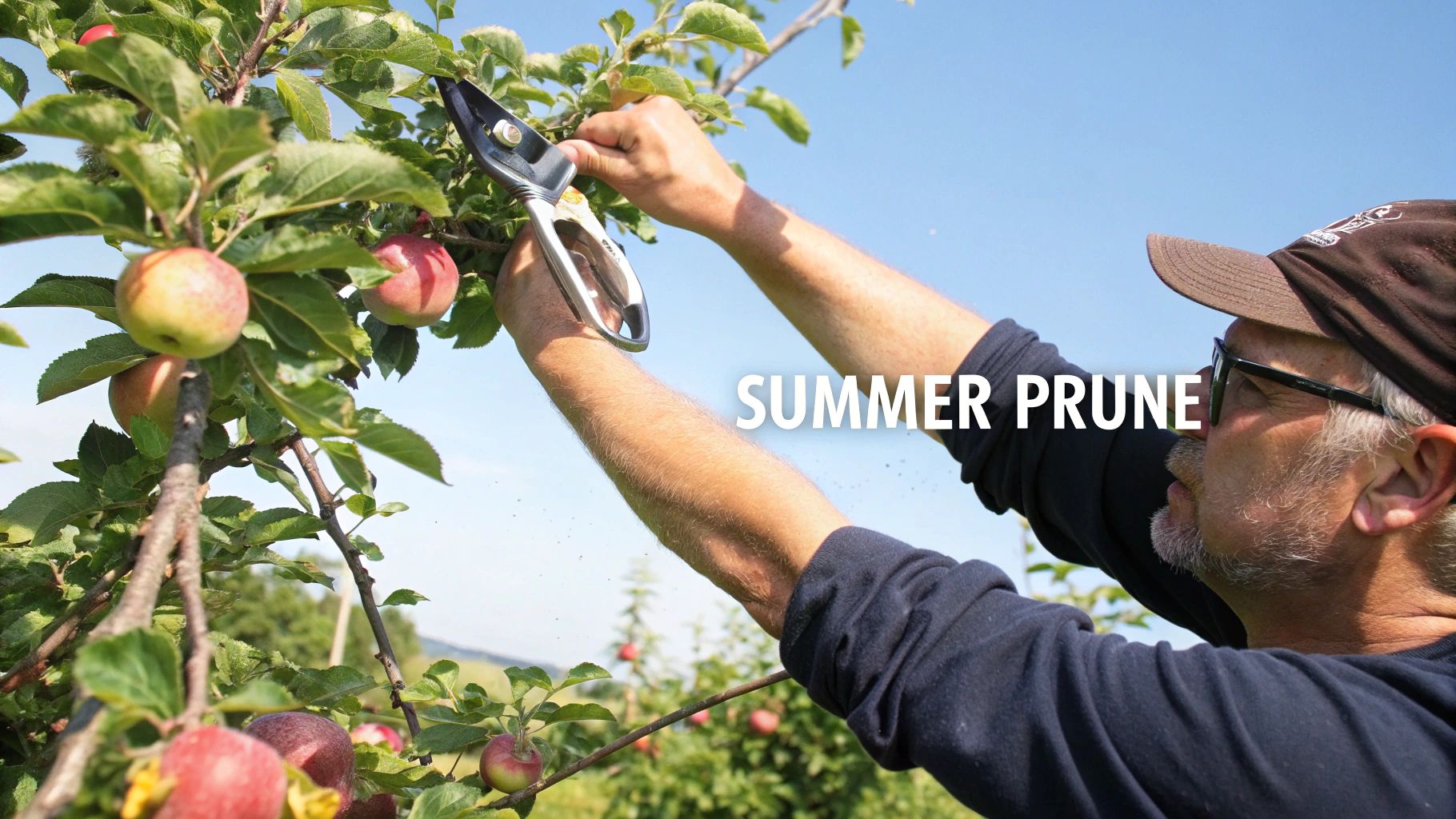
If winter pruning is the big structural renovation for your apple tree, think of summer pruning as the clever, final touch-up. This much lighter trim isn't about the tree's architecture; it's about steering its energy toward producing fantastic fruit, both this season and the next.
You're not making drastic changes here. Instead, you're refining what already exists. A good summer prune, usually done after the main harvest rush, lets you get a handle on the tree's explosive growth and channel all that energy into something more productive.
Redirecting the Tree's Energy
The main targets for a summer trim are those notorious ‘water shoots’ or 'suckers'. You know the ones—they’re the vigorous, leafy stems that shoot straight up from the main branches or trunk. They look impressive, but they're freeloaders, soaking up huge amounts of energy and nutrients while almost never producing a single apple.
When you snip these off, you’re doing more than just tidying up. You're essentially running an energy audit on your tree, telling it to stop wasting resources on useless foliage. That power then gets funnelled into two key areas:
Ripening the remaining apples by letting more sunlight reach them.
Developing strong, healthy fruit buds for next year’s harvest.
Think of it like this: your tree has a finite energy budget for the year. Removing water shoots is like cancelling unwanted subscriptions, freeing up funds to spend on what truly matters—delicious, high-quality apples.
While winter is king for structural cuts, summer pruning from late February to early April in Perth suburbs—like Greenwood or Mount Lawley—is a proven winner for controlling vigour and boosting your fruit set. In WA's warm, dry climate, this post-harvest trim removes the upright water shoots that plague an estimated 60% of unmaintained apple trees. This simple act can slow unwanted growth by 50% and redirect that energy into next season's fruit buds. To see this in action, check out how this technique boosts fruit production on YouTube.
A Practical Approach to Tree Health
Beyond better fruit, summer pruning gives you a practical leg-up on tree health, especially in Perth’s climate. Our occasional humid spells can be a perfect breeding ground for fungal diseases like powdery mildew. By thinning out some of that dense summer growth, you massively improve airflow through the canopy.
This natural ventilation helps leaves dry out faster after rain or morning dew, making it much harder for fungal spores to get a foothold. It's a simple, organic way to keep your tree healthier. This openness also makes your tree a less inviting home for pests like fruit flies, which love hiding out in sheltered, dense foliage.
Practical Examples of Summer Cuts
Knowing when to trim apple trees is half the battle; knowing what to cut is the other. Let’s walk through a couple of clear examples.
Example 1: The Obvious Water Shoot
You see: A long, unbranched green stem growing straight up from the top of a main, horizontal branch. It has big leaves and is clearly fresh growth from this season.
Your action: Grab your sharp secateurs and cut it off completely flush with the branch it’s growing from. Don't leave a stub—that can just encourage more shoots to pop up from the same spot.
Example 2: A Cluster of Upright Growth
You see: A crowded spot in the canopy where several smaller, upright shoots are blocking sunlight from getting to the apples hanging below.
Your action: Thin them out. Remove the weakest or most poorly positioned shoots entirely. Your goal is to create dappled sunlight throughout the canopy, not to clear it out completely.
For a deeper dive into techniques, our guide on how to prune fruit trees for a better harvest is a great next step to complement your summer strategy.
If your tree is a tangled mess of water shoots or you just feel a bit lost on where to begin, a professional touch can make all the difference. The team at Swift Trees Perth can perform a precise summer prune to get your tree’s health and fruit quality back on track. Contact Swift Trees Perth today for expert tree maintenance that ensures your hard work pays off.
How Pruning Changes with a Tree's Age
Knowing when to prune your apple trees is half the battle. The other half is understanding that how you prune has to change as the tree gets older. You just can't use the same approach on a sapling as you would on a grand old fruit-bearer. Think of it as an ongoing conversation with your tree – the topics change over its lifetime.
A young tree needs guidance to build a strong frame. A mature tree needs a bit of maintenance to stay productive and healthy, like a seasoned athlete staying in form. And an old, neglected tree? It needs a gentle, patient hand to bring it back from the brink.
Training Young Trees for a Strong Future
For the first one to three years, your pruning goals have almost nothing to do with getting apples. It's all about training and structure. You’re the architect, laying the foundation for a structure that needs to stand strong for decades, laden with heavy fruit. Your job is to create a solid, well-spaced framework of branches that won't snap under pressure.
During this early stage, you're looking to select a strong central leader (the main, upright trunk) and three to five main "scaffold" branches. Ideally, these should be spaced evenly around the trunk, almost like spokes on a wheel, and at different heights to give each one its own space.
Let's make it practical: Imagine your two-year-old tree has a couple of branches growing very close together at the same height, forming a tight 'V' shape. That's a classic weak point just waiting to happen. Your job during winter pruning is to pick the stronger, better-angled branch and remove the other one completely. One simple cut now prevents a major branch splitting off ten years down the track.
Maintaining Mature and Fruitful Trees
Once your tree is well-established and giving you fruit every year (usually from year four onwards), your focus shifts from building structure to maintenance and renewal. The foundation is set; now you're just keeping the house in good nick. The main goals are to keep the tree healthy, productive, and at a manageable size.
Here's what you're trying to achieve with a mature tree:
Controlling its size: Keeping the tree at a height where you can actually pick the fruit without needing a cherry picker.
Letting the sun in: Thinning out the canopy allows sunlight to get to the inner branches. This is vital for ripening fruit and encouraging new fruiting wood to grow.
Removing old wood: Getting rid of tired old branches that aren't producing good fruit anymore. This makes way for younger, more energetic growth.
A general health check: You'll continue to remove any dead, damaged, or diseased branches, along with any limbs that are rubbing or crossing over each other.
Pruning a mature tree isn't about making dramatic changes. It's more of a yearly edit, a continuous cycle of renewal. You're taking out what's old and unproductive to encourage fresh, fruit-bearing growth for the seasons ahead.
Reviving Old and Neglected Trees
Walking up to an old, overgrown apple tree can be intimidating. It's usually a chaotic tangle of crossing branches, dense growth, and dead wood. The biggest mistake people make is getting too enthusiastic and cutting it all back at once. This will shock the tree, causing it to send up a forest of weak, vertical "water shoots" that are a nightmare to manage.
Restoring an old tree is a gentle, multi-year project. The golden rule is simple: never remove more than 25-30% of the tree's living canopy in a single year. Think of it as a two-to-three-season plan.
Year 1: The Tidy-Up Start with the absolute basics. First, remove all the dead, damaged, and diseased wood. This is the most important step and, honestly, might be all you do in the first year. This clean-up alone drastically improves the tree's health and lets you see its true structure.
Year 2: Let There Be Light Now you can start thinning things out. Tackle the worst of the crossing branches and begin opening up the centre of the tree to let in more light and air. You might identify a few big, badly-placed branches to remove, but don't take them all in one go.
Year 3: Shaping and Refining Continue the thinning process and start thinking about reducing the tree's overall height. By now, the tree should be responding with healthier, more controlled growth, allowing you to fine-tune its shape.
This patient approach brings an old tree back to life without stressing its system. Figuring out exactly which branch to cut on a complex restoration can be tricky. If you're staring at an old tree and feeling out of your depth, the experienced team at Swift Trees Perth can develop a safe, multi-year plan to revitalise it. Contact Swift Trees Perth for your tree maintenance needs and let our experts take on the challenge for you.
Your Essential Toolkit for Clean and Safe Pruning
Knowing when to prune your apple trees is half the battle, but using the wrong tools can quickly turn a helpful trim into a harmful one. The right gear not only makes the job faster and easier, but it’s absolutely critical for the health of your tree. It all comes down to making clean cuts that heal properly and don't invite disease.
Think of it like surgery; you wouldn't want the surgeon using a blunt, rusty instrument. Your apple tree deserves that same level of care. Sharp, clean tools slice through wood smoothly, leaving a wound the tree can easily seal. Dull blades, on the other hand, crush and tear the plant tissue, creating ragged edges that are an open invitation for pests and diseases to move in.
Building Your Pruning Arsenal
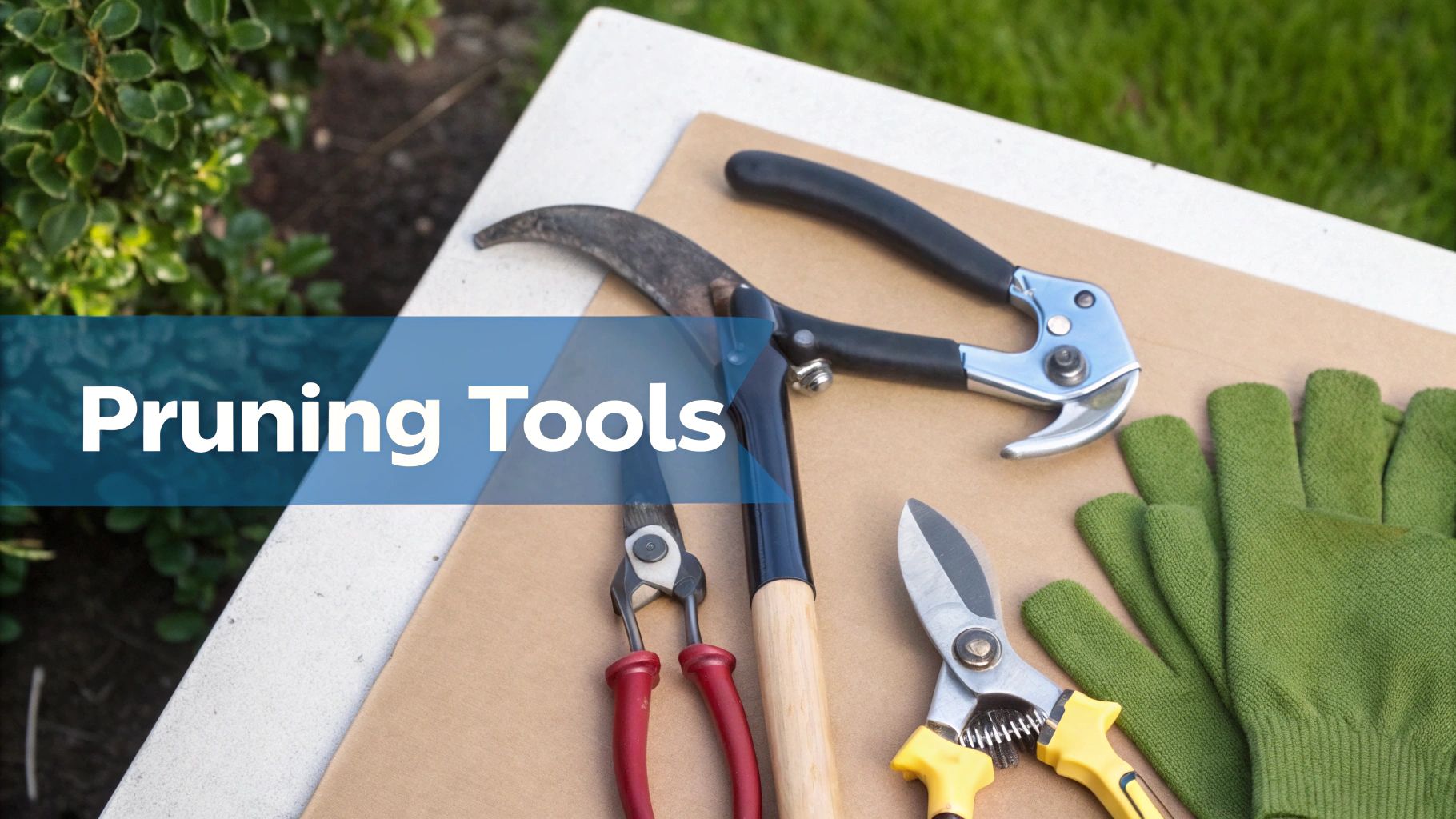
You don’t need a whole shed full of equipment. In fact, just three core tools will handle almost anything your apple tree can throw at you. If you invest in quality from the get-go, they’ll last you for years with a bit of care.
Bypass Secateurs: These are your go-to for all the small jobs. They're perfect for snipping off thin branches and twigs up to about 2cm in diameter. They work just like scissors, with one blade bypassing the other to make a really precise, clean cut.
Loppers: Think of these as long-handled secateurs. Loppers give you the leverage needed to tackle medium-sized branches, usually up to 5cm thick. That extra reach is also a huge help for getting into the tree’s canopy without stretching yourself into a pretzel.
A Curved Pruning Saw: When a branch is just too beefy for your loppers, the pruning saw is your best friend. Its curved blade and sharp teeth are designed to cut efficiently on the pull stroke, letting you make quick work of larger limbs without damaging the tree.
Here’s a pro tip that really separates the amateurs from savvy gardeners: tool hygiene. Always sterilise your blades between cuts with rubbing alcohol or a diluted bleach solution, especially when you move from one tree to another. It sounds fussy, but this simple step is the single most effective way to stop the spread of unseen diseases like fire blight or canker through your garden.
Safety First Non-Negotiables
Let's be honest, pruning involves sharp tools and the potential for falling branches. Safety gear isn't just a suggestion—it's essential. Protecting yourself means you can keep enjoying your garden for years to come without any preventable mishaps.
Your basic safety kit should include:
Sturdy Gardening Gloves: These will protect your hands from blisters, scratches, and sticky sap.
Safety Glasses or Goggles: An absolute must. They'll shield your eyes from sawdust, falling twigs, and branches that can whip back when you least expect it.
Knowing When to Pause the DIY
Confidence is great, but knowing your limits is even better. Some pruning jobs come with risks that just aren't worth taking on yourself. It’s time to put the tools down and call a professional if the work involves:
Climbing a ladder, particularly on uneven ground.
Removing large, heavy branches that could fall unpredictably.
Pruning anywhere near power lines. Seriously, don't even think about it.
These situations demand specialised equipment, training, and the right insurance—things only a professional arborist has. Your safety, and the integrity of your property, should always come first.
If your apple tree needs work that you can't safely reach from the ground, that's your cue to get some expert help. For peace of mind and a job done right, contact Swift Trees Perth for all your complex tree maintenance needs.
When to Call a Professional Arborist
Getting your hands dirty and pruning your own apple tree is one of the most rewarding jobs in the garden. It connects you directly to the health of your tree and the fruit it’ll hopefully produce. But there's a piece of wisdom every seasoned gardener learns, often the hard way: knowing your limits is just as important as knowing how to make a clean cut.
For some jobs, calling in a professional arborist isn’t just a good idea—it’s the smartest, safest move you can make for yourself and your tree.
DIY pruning is fantastic for smaller, younger trees where you can keep your feet firmly on the ground. The moment the job calls for more than a small step stool, however, the risk factor skyrockets. A big part of being a responsible tree owner is recognising when a task has moved beyond your skillset and into professional territory.
Situations That Absolutely Demand a Pro
Some pruning scenarios come with risks that just aren't worth the satisfaction of doing it yourself. These are the clear red flags telling you it's time to get an expert on the phone. A professional brings not just the right tools, but crucial safety training, specialised equipment, and the right insurance to protect you and your property.
Here are a few classic examples of when you should call for backup:
Working at Height: Simple as this: if the job requires you to get up on a ladder, it’s a job for a pro. Arborists use proper rigging and climbing gear to move safely through the canopy, something that’s just not possible for the average homeowner.
Large or Heavy Branches: That branch might not look too beefy from the ground, but it can be deceptively heavy and awkward. Removing big limbs needs precise cutting techniques to stop them from crashing down and taking out your fence, garden shed, or even the house.
Proximity to Hazards: This is the non-negotiable one. If there are any branches near or touching powerlines, do not even think about tackling it yourself. This is an incredibly dangerous task that requires a certified arborist trained to work safely around live electrical hazards.
Complex Health Issues: Is your tree showing signs of serious disease, big hollow cavities, or worrying structural weaknesses like deep cracks? A proper diagnosis is key. An arborist can spot problems that aren't obvious and map out the right way to fix them. You can learn more about what goes into their work by understanding what an arborist does in our quick guide.
Calling a professional isn't admitting defeat; it's making a strategic investment in the long-term health of your tree and the safety of your property. It's about getting the right expertise for the right job.
The team here at Swift Trees Perth has the skills, insurance, and on-the-ground experience to handle these challenging jobs safely and properly. We can accurately assess your tree's condition, carry out complex structural pruning, and make sure the work is done right the first time.
If you’re looking at a pruning job that seems too big, too high, or just plain too risky, don’t hesitate. Contact Swift Trees Perth for a no-obligation quote and let our professional team give your tree the expert care it needs.
Got Questions About Trimming Apple Trees?
Even with the best intentions, it's easy to second-guess yourself when you're standing in front of your tree, secateurs in hand. Knowing the right time to trim an apple tree can feel a bit tricky, but these quick answers cover the most common questions we get from Perth homeowners.
Can I Prune My Apple Tree in Spring in Perth?
It’s so tempting to get out there and do a big tidy-up in spring when the garden is bursting with life. For apple trees, however, this is probably the worst time to do a major prune. Why? Because you'll be snipping off the very flower buds that were destined to become your delicious apples, which means a much smaller harvest.
On top of that, fresh cuts in spring encourage a sudden rush of weak, leafy growth that’s an absolute magnet for pests like aphids. For the best results in our Perth climate, stick to a structural prune in winter when the tree is dormant, and a light trim in late summer if you need to.
How Much Can I Safely Cut Off at Once?
This is a big one. As a rule of thumb, never remove more than 25-30% of the tree's living canopy in a single year. Hacking off more than that can send the tree into shock.
When a tree is over-pruned, it kicks into survival mode and throws out a dense mess of fast-growing, unproductive shoots called ‘water shoots’. If you’ve got an old, overgrown tree that needs a serious renovation, patience is your best friend. It’s far better to spread the pruning out over two or three years. A professional arborist can help you map out a safe, multi-year plan that won't stress your tree.
Think of it like a savings account. You can't just withdraw all your tree's energy reserves in one hit without facing some serious consequences. A measured approach ensures it stays healthy and productive for years to come.
What’s the Difference Between a Thinning Cut and a Heading Cut?
Getting your head around these two basic cuts is the key to good pruning. They do very different things and are used for different reasons.
Thinning Cut: This will be your go-to cut for most apple tree maintenance. It involves removing an entire branch right back to where it joins a larger limb or the trunk. This opens up the tree, letting in more light and air, and it doesn't trigger that wild burst of regrowth.
Heading Cut: This is simply shortening a branch by trimming it back to a bud. It’s used to encourage the tree to become denser and bushier just below the cut. You’ll use heading cuts far less often, mainly when shaping very young trees to build a strong main framework.
For almost all work on a mature tree, you’ll be using thinning cuts to keep the structure open, healthy, and ready for a great harvest.
Figuring out the right cuts for your tree's age, health, and your specific goals can be a challenge. If your apple tree is looking like a complex puzzle or the job seems a bit risky, getting an expert eye on it can make all the difference. For professional, safe, and effective tree maintenance across the Perth metro area, you can trust the experienced team at Swift Trees Perth.
Don't leave your tree's health and your next harvest to chance. Contact us today for a free, no-obligation quote and let our expert arborists help your apple trees thrive.
Comments