
Hedge Trimmer for Thick Branches What It Can Cut

You're standing in front of a Perth hedge that used to be a quick Saturday trim. Now the outside is shaggy, the inside is dark, and hidden among the green shoots are stiff brown stems that feel more like small branches than hedge growth. You start the trimmer, squeeze the trigger, and the blade bites once before stopping hard.
That moment is the clue. A hedge trimmer for thick branches isn't mainly a question of finding a stronger motor. It's a pruning decision. The branch diameter, blade tooth spacing, hedge height, access, nearby powerlines and local rules all tell you whether the trimmer is suitable or whether you should change tools.
A standard hedge trimmer is designed to shear manageable growth cleanly. It isn't a small chainsaw, and forcing it through woody stems can leave ragged cuts, strain the motor and create a dangerous jam.
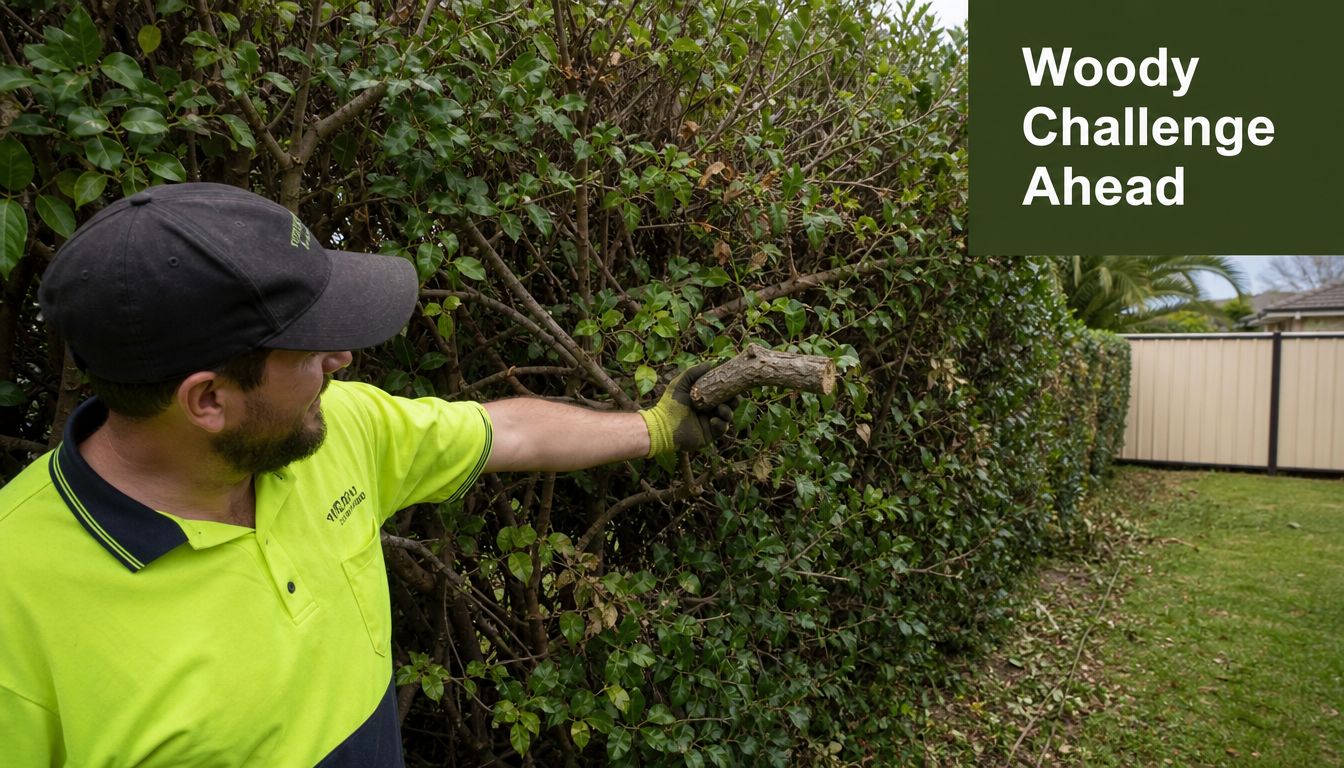
For a suburban hedge, though, the useful question is simpler: which stems can the trimmer handle, which need loppers or a saw, and which jobs should be left to an arborist?
By the end, you'll be able to inspect your hedge, understand the limits printed on a tool, choose a sensible two-pass method and recognise when DIY trimming is reasonable. You'll also know when thick wood, height or electrical hazards make professional help the smarter option.
Introduction Why Thick Branches Change Everything
What Thick Branches Really Mean for Your Hedge
The word “thick” can be misleading. A stem that looks substantial in a dense hedge may still be within a trimmer's intended range, while a smaller-looking dry branch can be hard enough to stall the blade. Start by separating the growth into three practical groups.
Soft green shoots are flexible, fresh and easy for the teeth to capture. They bend slightly when you press them and usually leave a clean clipped surface. This is the everyday material hedge trimmers handle best.
Semi-woody stems feel firmer, often resemble a pencil or a finger, and resist bending. They may pass through a capable blade set, but only if the tool's published cutting capacity and tooth spacing support them. Australian consumer guidance notes that some hedge trimmers have tooth spacing around 18 mm, associated with a maximum branch thickness of roughly three-quarters of an inch, while other Australian retail guidance places intended cutting around 15 mm.
Hard woody branches are rigid, dry or mature. If a stem resembles a broom handle, don't treat it as ordinary hedge growth. It may require a pruning saw, loppers or a planned reduction by someone experienced with woody plants.
Read the blade before you read the branch
A hedge trimmer cuts by passing moving teeth over a fixed blade. The teeth need to capture the stem and shear it between the blades. If the stem is wider than the gap, or too rigid to sit properly in the blade path, the machine may catch rather than cut.
Look at the trimmer's stated maximum cutting diameter, then inspect the hedge rather than guessing from the tool's power rating. A thicker branch creates more resistance because the blades must sever a larger cross-section. That extra resistance is why a tool can sound powerful yet still be unsuitable for large woody material.
A simple hands-on check helps:
Bend test: Fresh green growth bends. Hard wood stays rigid.
Surface test: Green bark and flexible shoots usually indicate maintenance growth. Dry, cracked or barked stems suggest pruning.
Diameter test: Compare the stem with a pencil, finger or broom handle, then check the manufacturer's specification.
Access test: A stem at shoulder height is different from the same stem above your head or beside a fence.
The important distinction is not whether the branch is technically small enough to enter the teeth. It's whether the trimmer can cut it smoothly, without repeated impact, vibration or pressure from the operator.
How Hedge Trimmers Differ by Blade and Power
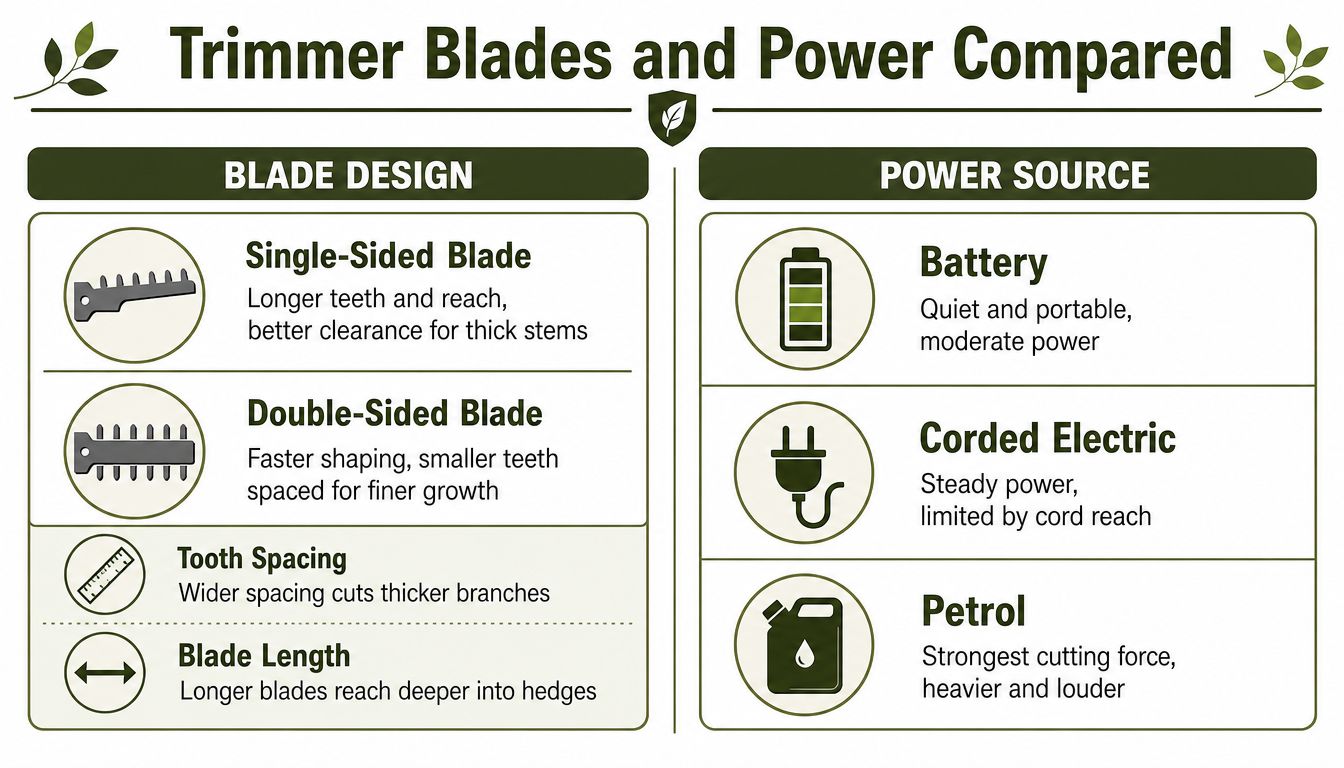
Two trimmers can have similar-looking motors and behave very differently in a woody hedge. The blade design controls how branches enter the cutting zone, while the power source affects mobility, weight, runtime and sustained performance. None of these features removes the need to respect the tool's cutting limit.
Blade design changes control
A single-sided blade can offer useful clearance and reach along a straight boundary. Its arrangement may feel more predictable when you're working from one direction, particularly on a long fence-line hedge. A double-sided blade is convenient for shaping because it cuts as you move in either direction, making it popular for rounded shrubs and routine surface work.
Tooth spacing is more important than a dramatic power label. Wider spacing generally allows thicker stems to enter the cutting path, while closer teeth suit fine, leafy growth. Blade length also changes the job. A longer blade can cover more hedge surface in one sweep, but it can feel awkward in a tight courtyard and becomes tiring during overhead work.
For a small Perth courtyard with a regularly maintained lilly pilly hedge, a manageable battery trimmer with close control may be more useful than a heavy commercial model. On a broad suburban boundary, a longer blade can make shaping faster, provided the stems remain within the machine's stated range.
Power source is a trade-off
Battery models are quiet, portable and convenient around gates, corners and rear gardens. They're a practical match for homeowners who want to avoid fuel and cords, although dense woody growth places more demand on the battery and operator.
Corded electric trimmers provide steady power while connected to a suitable outlet. They work well near the house, but the cord becomes a movement and safety concern as the hedge extends around the property.
Petrol trimmers can provide strong cutting force for demanding maintenance and larger work areas. They're also heavier, louder and more involved to maintain. More force doesn't mean the blade can safely remove a limb that belongs in a pruning workflow.
A useful buying principle is to match the whole tool to the hedge, not just the motor. Consider blade spacing, balance, handle position and your ability to keep both hands in control. For guidance on the broader relationship between branch removal, tree health and finished shape, Swift Trees Perth's tree trimming and pruning information is a useful reference.
Realistic Cutting Limits and What Happens When You Push Them
Australian product information shows a fairly narrow practical range for handheld hedge trimmers. Some manuals warn against branches thicker than 10 mm, while other Australian guidance describes models intended for about 15 mm material or tooth spacing around 18 mm. Makita Australia lists 21.5 mm maximum cutting diameter on several 18V brushless models, and a Bunnings product sheet warns against stems or twigs larger than 28 mm. These figures come from Makita Australia specifications and the Bunnings hedge-trimmer product sheet.
Those numbers are maximum design references, not an invitation to push every branch at the limit. As the diameter approaches the tooth pitch and blade stroke envelope, the tool has to shear more wood in each cut. Motor load, vibration and the likelihood of binding rise with it.
Why a jam is a stop signal
If the blades jam, release the trigger, switch the trimmer off and wait for all movement to stop. Before inspecting the blades, touching the trapped branch or trying to clear the jam, isolate the power.
Corded trimmer: Unplug it from the power outlet.
Battery trimmer: Remove the battery if it’s removable. For a built-in battery, follow the manufacturer’s instructions for making the tool safe before inspecting or clearing the blades.
Petrol trimmer: Stop the engine and follow the manufacturer’s instructions for preventing an accidental restart before inspecting or clearing the blades.
Keep your fingers away from the cutting teeth. A trapped branch can spring back when released. Follow the manual’s instructions for clearing a jam. If you can’t clear it safely or the blades look damaged, leave the trimmer out of use and have it serviced.
Forcing the trimmer through a thick stem can tear the bark and make you lose your balance or grip.
The boundary between trimming and pruning is therefore practical. If you're shaping green growth, trim. If you're removing established woody stems, reduce them with a tool designed for that job, then return to the trimmer for the finish.
Smarter Tools and Techniques for Thicker Wood
The cleanest approach for an overgrown hedge is usually a two-pass method. First reduce the large stems with hand tools or a saw. Then use the hedge trimmer to shape the remaining flexible growth. This prevents the trimmer from acting like a rough pruning saw and gives the hedge a more even finish.
Match the hand tool to the wood
Loppers are suited to stems that fit cleanly between their blades and can be reached from stable ground. They give you an advantage without asking the hedge trimmer motor to absorb the whole load.
A pruning saw handles harder, larger wood that loppers can't close around cleanly. Use controlled strokes and support the branch where possible so it doesn't tear away as the cut finishes.
A pole pruner can help with high branches when it allows you to work from the ground. Safe Work Australia's tree-trimming guidance recommends an adjustable cutter bar for hedge tops rather than relying on a ladder. That keeps the task centred on stable footing and controlled reach.
The two-pass sequence
Assess: Find the hard stems and decide the intended final outline.
Reduce: Use loppers, a pruning saw or a pole pruner for the woody framework.
Clear: Remove cut material from inside the hedge so it doesn't obstruct the blade.
Shape: Run the hedge trimmer over the remaining green and flexible growth.
Inspect: Step back, check both sides and make small finishing cuts rather than scalping the surface.
Battery tool systems are a popular choice in Perth gardens because one battery platform can support a trimmer, lopper or pruning saw. The convenience is useful, but it doesn't change the sequence. The hand tool does the reduction, and the trimmer does the presentation work.
Here's a visual demonstration of a practical hedge-maintenance workflow:
Safety Maintenance and Perth Rules You Should Know
A thick hedge deserves a pre-cut checklist, especially when it's tall, close to a boundary or growing beneath overhead services. Put on eye protection, gloves, hearing protection where appropriate and footwear with reliable grip. Check the weather before starting, and avoid rain or strong wind that can make footing, visibility and branch movement less predictable.
Keep both hands on the trimmer and don't overreach. Safe Work Australia's guidance supports using an adjustable cutter bar for hedge tops rather than a ladder. If you can't maintain a balanced stance while keeping the blade under control, the hedge has moved beyond a comfortable handheld job.
Maintain the tool before it meets the hedge
Inspect the teeth: Look for damage, bent sections or debris before connecting the battery or starting the engine.
Clean the blade: Remove sap and plant residue after use so the teeth can move freely.
Lubricate correctly: Apply a suitable blade lubricant or machine oil according to the manufacturer's instructions.
Check the controls: Confirm the safety switch, trigger and brake function before cutting.
Stop safely: Switch off the engine or disconnect the power before clearing a jam or servicing the blade.
Choosing the Right Option and When to Call Swift Trees Perth
Choose the tool after you've assessed the hedge, not before you've looked at it. A low, regularly clipped hedge with soft growth may suit a light battery or corded trimmer. A hedge with finger-sized stems may need loppers first. A tall boundary hedge, dense woody interior or growth near electrical lines deserves a more cautious plan.
Use this decision filter:
DIY trimming: The hedge is reachable from stable ground, the growth is flexible and the stems sit comfortably within the manufacturer's cutting capacity.
DIY reduction with hand tools: The hedge is accessible, but established stems need removal before the trimmer can shape the surface.
Professional pruning: The hedge is tall, close to powerlines, difficult to access, heavily overgrown or contains branches that would require substantial reduction.
Buying a more powerful hedge trimmer may help with the maintenance pass, but it won't remove the need for a saw, loppers, traffic control or powerline-safe planning. For strata properties, shops and managed sites, commercial hedge maintenance also benefits from an organised schedule, access plan and clear site responsibilities. Swift Trees Perth outlines this kind of service through its commercial hedge-trimming information.
Swift Trees Perth handles hedge trimming, overgrown branch reduction and related tree-maintenance work across Perth and the metropolitan area.
Contact the team when the job involves height, thick woody growth, structures or electrical hazards, and ask for an honest assessment before choosing equipment.
Contact Swift Trees Perth for hedge trimming, woody branch reduction and safe tree maintenance across the Perth metro area. Their team can assess the hedge, choose the right pruning method, manage difficult access or powerline concerns, and leave the site tidy.
Comments