
A Guide to Identifying Trees Australia

Learning to put a name to the trees you see every day is a fantastic skill. It’s like being let in on a secret, where you start to notice the finer details—the shape of the leaves, the texture of the bark, the scent of the flowers—and piece them together to solve a puzzle.
This guide to identifying trees in Australia is all about giving you the practical tools to do just that, so you can confidently identify the trees in your own backyard or local park.
Why Bother Identifying Australian Trees?
Getting to know your local trees is more than just a neat party trick; it connects you to the incredible environment we live in. Australia boasts an astonishing diversity of plant life, with around 24,000 native species. To put that in perspective, our iconic Eucalypts cover a staggering 77% of the country's total forest area, making them the kings of our canopy. You can dive deeper into these incredible stats over at treesdownunder.com.au.
When you can correctly identify a tree, you're not just appreciating biodiversity—you're also equipped to make smarter decisions for your own property. It’s the foundation of good tree management.
The Real-World Payoffs of Knowing Your Trees
Pinpointing the exact species of a tree on your property or street has some seriously practical benefits.
Smarter Care and Maintenance: Every tree is different. Some need lots of water, others thrive on neglect. Knowing you have a drought-tolerant Wattle (Acacia) versus a thirsty Swan River Red Gum means you can give it the right care to help it flourish. For example, mistaking a native Marri for an introduced species might lead you to over-fertilise it, causing more harm than good.
Spotting Risks Before They Become Problems: Certain trees are notorious for dropping limbs (I'm looking at you, Marri!) or having aggressive roots that can wreak havoc on plumbing and foundations. Proper identification is your first line of defence in managing these potential hazards.
Staying on the Right Side of Council Rules: Local councils, particularly around Perth, often have strict rules about pruning or removing significant native trees. Identifying a tree before you fire up the chainsaw can save you from a hefty fine.
A tree isn't just a tree. It's a living part of our ecosystem with its own name and needs. The first step to looking after it properly is knowing what you're looking at.
Think of this as your starting point. For an even more comprehensive look, our complete tree identification guide has plenty more to explore.
Of course, when you need absolute certainty—especially if you’re concerned about a tree’s health or planning major work—nothing beats a professional opinion. For expert help with tree maintenance and identification here in Perth, the team at Swift Trees Perth is always ready to provide a no-obligation quote.
Learning to Read the Signs: Your Guide to Tree Identification
Think of yourself as a tree detective. To figure out what kind of tree you're looking at, you need to gather evidence. It's rarely one single thing that gives it away; instead, you build a case by looking at a combination of features.
This is the exact process I use in the field. You start with the most obvious clues, dig a little deeper with more specific details, and then pull it all together to make an identification.
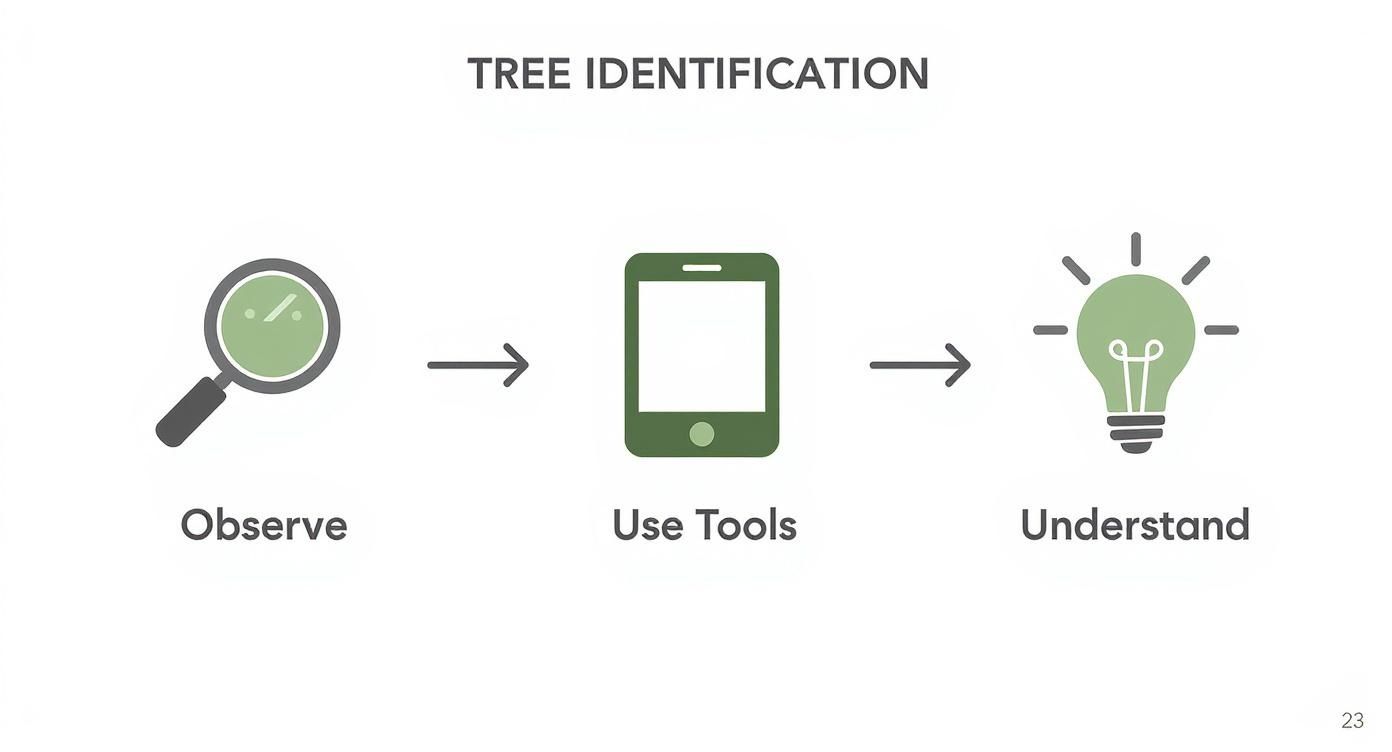
This simple workflow—observe, research, and synthesise—is a reliable method that works just as well for curious homeowners as it does for seasoned arborists.
Start with the Leaves
Leaves are usually the first thing people look at, but they can be tricky. A common mistake is just grabbing a single leaf off the ground. You need more context. Look up at the branch and see how the leaves are arranged—are they paired up opposite each other, or do they stagger up the stem in an alternating pattern?
Then, consider the leaf itself. Is it a single blade (simple), or is it made up of lots of smaller leaflets (compound)? A Jarrah leaf, for example, is simple and spear-shaped. Compare that to a Cape Lilac, whose compound leaves create a much softer, almost fern-like texture.
Read the Story in the Bark
A tree's bark is its fingerprint. It tells you so much about the species, its age, and even what it's been through. Don't just look at it—run your hand over it. Is it smooth, rough, or flaky?
Australian trees have some incredible bark variations:
Smooth Bark: Many gum trees have this. The bark sheds in strips or patches, revealing fresh, often colourful bark beneath. The stunning Salmon Gum (Eucalyptus salmonophloia) is a perfect example with its beautiful pinkish trunk.
Fibrous Bark: This is the classic "stringybark." It feels spongy and can be pulled off in long, stringy pieces. It’s fantastic insulation for the tree, especially against fire.
Ironbark: Just like the name says, this stuff is tough. It’s hard, dark, deeply grooved, and often looks almost black. This rugged coating is the tree's heavy-duty armour.
A tree’s bark often tells you more than its leaves, especially since many Eucalypts have similar foliage. Learning to distinguish between smooth, stringy, and ironbark types is a massive leap forward in your identification skills.
Look for Flowers and Fruits
Flowers and fruit are the jackpot. They are the single most definitive clue you can find. While they’re only around for part of the year, they can instantly confirm what you're looking at. You simply can't mistake the vibrant red blossoms of a Flowering Gum or the big, woody "honkey nuts" of a Marri tree.
Even when the flowers are gone, the gumnuts, pods, or fruits left behind are incredibly helpful. The specific size and shape of a Eucalypt's gumnut are critical for telling similar species apart. For instance, a Tuart gumnut is bell-shaped, whereas a Marri gumnut is more like a small urn. It’s this kind of detail that really narrows it down.
Finally, step back and take in the tree's overall shape (habit) and where it's growing. Is it tall and straight, or has it grown wide and sprawling? Is it thriving on a sandy coastal plain or standing on the banks of a river, like a Swan River Red Gum? The environment is a massive clue.
When you piece all this evidence together—leaf pattern, bark texture, gumnut shape, and overall form—you can build a very strong case. But if the clues don't add up or you have any concerns about a tree’s health, it’s always best to get an expert opinion. For a professional assessment and help with all your tree care needs, contact Swift Trees Perth for a reliable consultation.
Essential Tools for Modern Tree Spotters
Gone are the days of lugging a heavy stack of encyclopaedias into the bush. While I’ll always have a soft spot for a well-thumbed field guide, the digital tools available today have completely changed the game, putting a botanist's knowledge right in your pocket.
The real trick isn't just using one tool, but combining the new with the old. Think of it as a process of confirmation. An app might give you a likely candidate in seconds, but double-checking it against a trusted botanical website or a local field guide is what builds true expertise. It’s how you learn to spot the subtle differences and avoid common mix-ups.
Digital Aids for Tree Identification
Let’s be honest, mobile apps are usually the first thing we reach for these days. They're incredibly convenient when you're standing right in front of the tree you’re curious about. You just snap a picture of a leaf, a flower, or the bark, and let the tech do its thing.
PlantNet: This is a brilliant starting point. It's a citizen science project, so it uses a massive, constantly growing database of photos submitted by users. You upload your photo, and it gives you a list of potential matches, complete with images from other people to compare against.
iNaturalist: I love this one because it’s much more than just an ID tool; it's a genuine community. When you log an observation, other naturalists and experts can chime in to confirm or correct your identification. It's a fantastic way to learn.
Here’s a quick look at how simple the PlantNet app is to use. You just upload a clear photo of one part of the tree to get started.
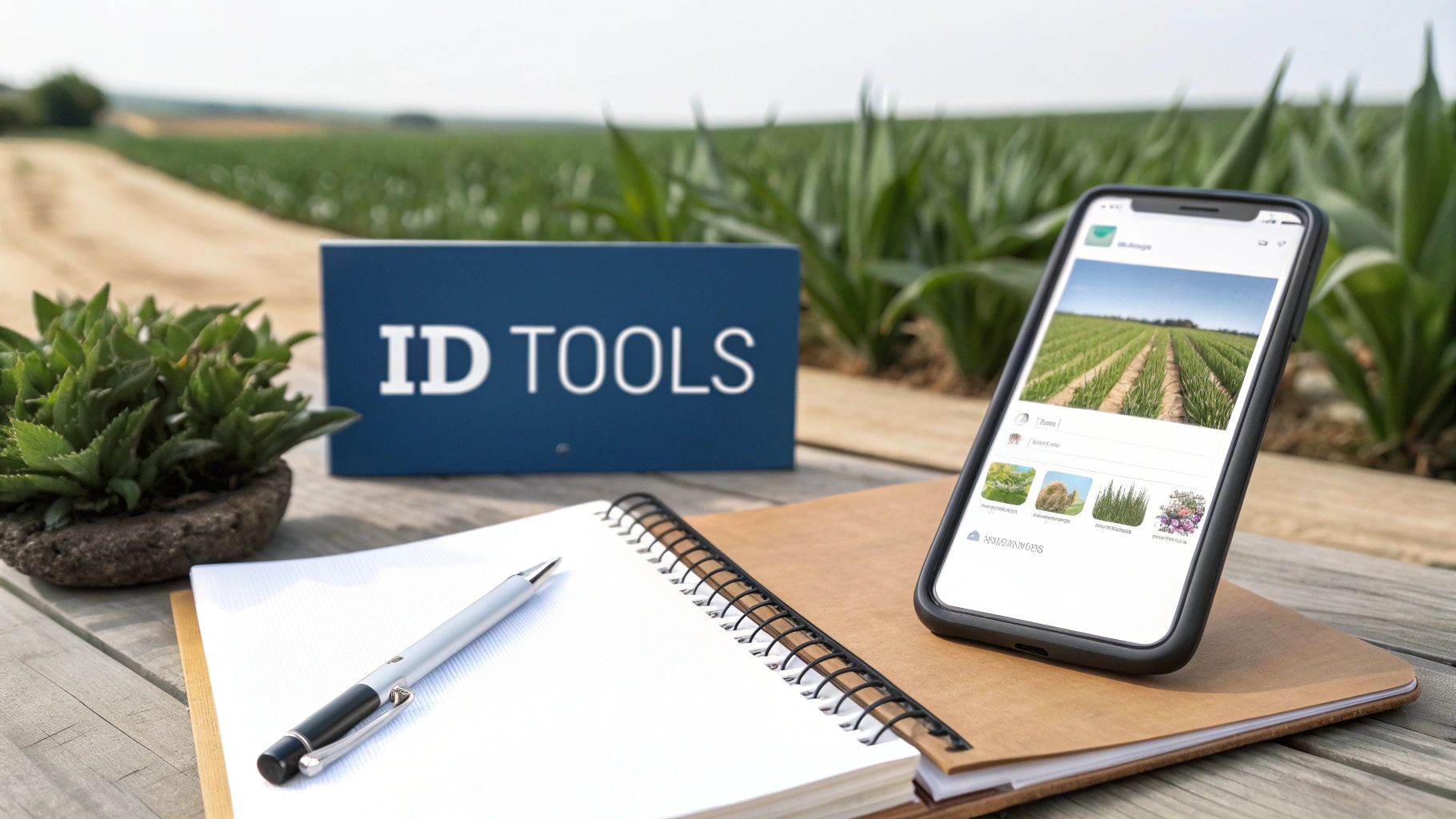
As you can see, the clean interface asks you to specify which part of the plant you've photographed. This simple step massively improves the accuracy of the suggestions it gives you.
Beyond apps, I always recommend digging into online databases from state herbaria or botanical gardens. These are the gold standard—professionally verified and meticulously detailed. Given Australia is a megadiverse country, home to roughly 10% of all species on Earth, technology is playing a vital role. Groundbreaking projects are now combining genome sequencing with biodiversity data, offering incredible new insights into Australia's tree discovery efforts.
The Enduring Value of Field Guides
Even with all this tech, I’d never be without a physical field guide, especially one specific to Western Australia. These books are written by local experts who live and breathe this stuff. They’re packed with nuanced details you just won’t find in a global app—things like subtle variations within a species around Perth or common lookalikes found in the same habitat.
A good field guide does more than just give you a name. It teaches you how to see. It trains your eye to pick up on the little things that instantly separate a Jarrah from a Marri.
Plus, a book never runs out of battery or loses signal when you’re out in the sticks. Building a small collection of local guides is a practical and genuinely rewarding way to deepen your understanding of the trees around you.
Knowing what trees you have is the first, crucial step to looking after them properly. For professional help with pruning, health checks, or any tree care needs, contact Swift Trees Perth for expert advice you can rely on.
Getting to Know the Locals: Common Trees Around Perth
Now that you’ve got the theory down, let’s put it into practice. The best way to get good at identifying trees is to start in your own backyard—or local park. Once you can confidently name the trees you see every day, you’ll find it much easier to tackle unfamiliar ones.
Perth and its surrounds are a special place. Western Australia is a globally recognised biodiversity hotspot, home to a staggering 7,463 native vascular plant species. That's nearly half of the country's entire native flora packed into one state! It makes learning the local lineup both a fun challenge and incredibly rewarding.
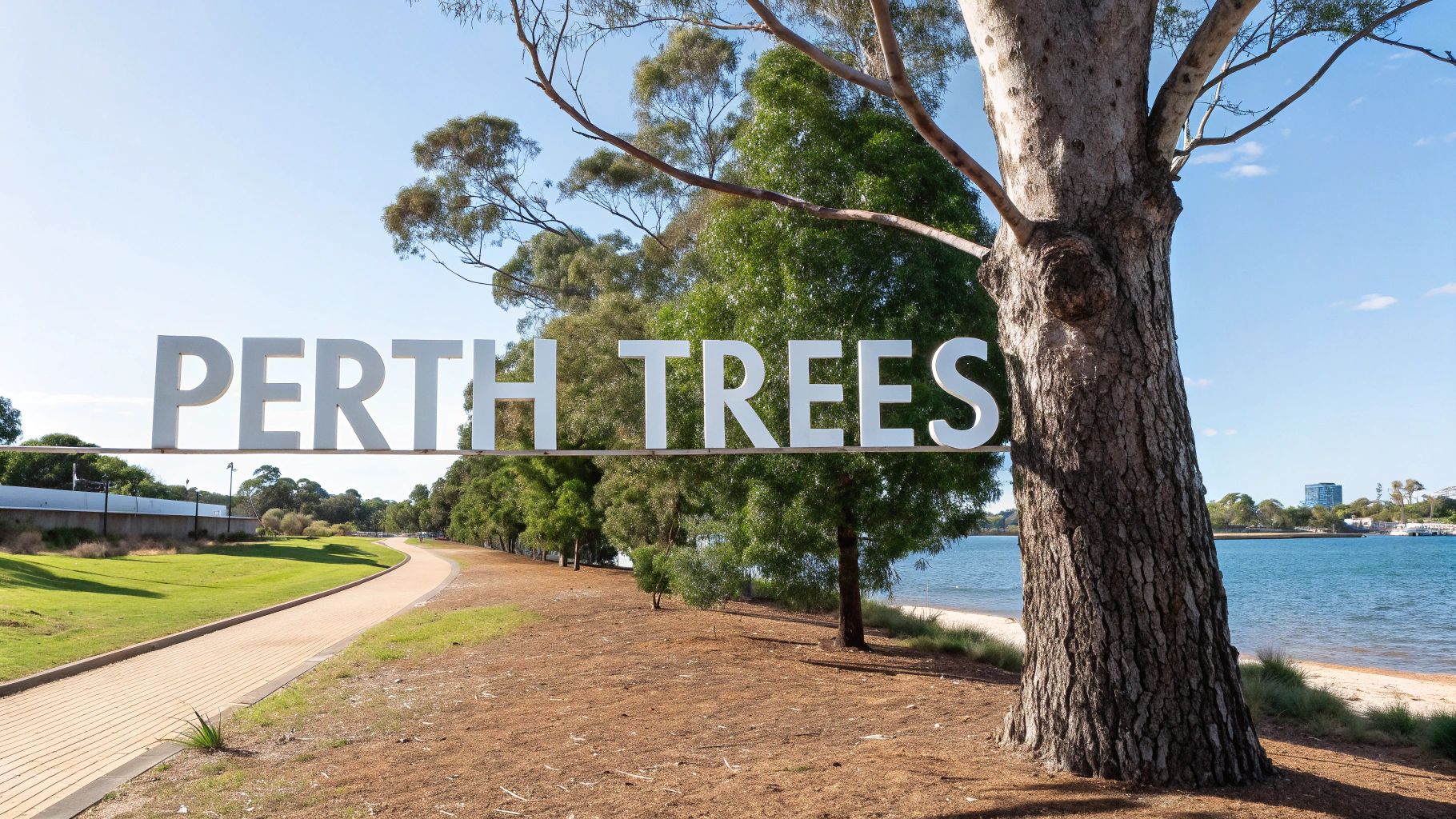
The Majestic Jarrah (Eucalyptus marginata)
You can't talk about Perth trees without starting with the Jarrah. This absolute icon is famous for its beautiful, deep red timber and its towering presence in our forests.
Bark: This is your best clue. Jarrah has classic "stringybark" – it’s rough, deeply grooved, and feels fibrous. The colour is typically a dark grey or reddish-brown.
Leaves: Look for curved, dark green leaves (paler on the underside) that are usually between 8-13 cm long.
Fruit: The gumnuts are the final piece of the puzzle. They are quite small, often barrel-shaped or almost round, which helps tell them apart from their common lookalike.
The Striking Marri (Corymbia calophylla)
Growing right alongside Jarrah, you'll often find the Marri. It's famous for its huge gumnuts, which locals affectionately call "honkey nuts." Telling a Marri from a Jarrah is a classic Perth rite of passage for any budding botanist.
The secret is in the bark. Where Jarrah is stringy, Marri bark is tessellated—broken into small, flaky, rectangular patches. It also has a habit of weeping a dark red sap, which is why it’s also known as a Red Gum.
Pro Tip: Still stumped? Check the ground around the base of the tree. If it’s littered with big, urn-shaped honkey nuts, you’ve found yourself a Marri.
The Graceful Swan River Red Gum (Eucalyptus rudis)
As its name implies, this beautiful tree loves water. You'll spot it lining the rivers and wetlands across the Swan Coastal Plain, often with a more open, spreading canopy than the forest giants.
Its bark is the dead giveaway. It's smooth and beautifully mottled with patches of white, grey, and cream that peel off in flakes. This smooth texture is a world away from the rough, rugged bark of the Jarrah and Marri, making it pretty easy to pick out once you know the difference.
To make things even easier, here's a quick comparison of the two trees that are most often confused.
Quick ID Guide For Common Perth Trees
Tree Feature | Jarrah (Eucalyptus marginata) | Marri (Corymbia calophylla) | Tuart (Eucalyptus gomphocephala) |
|---|---|---|---|
Bark | Rough, fibrous "stringybark", dark grey to reddish. | Tessellated (patchy), flaky, often weeps red sap. | Pale grey over yellow, rough and fibrous on trunk. |
Gumnuts | Small, barrel-shaped or spherical. | Very large, urn-shaped "honkey nuts". | Bell-shaped, ribbed, no stalk (sessile). |
Flowers | Creamy-white, seen late spring to early summer. | Large, creamy-white clusters, seen in summer. | Creamy-white, profuse clusters, seen in summer. |
Habitat | Dominant in forests on lateritic soils. | Found with Jarrah, prefers loamy soils. | Coastal plains, prefers limestone soils. |
This table should help you quickly sort out the key differences when you're out in the field.
Learning to spot these local heroes can completely change how you see your neighbourhood. If you're looking for more ideas on which trees will suit your own garden, have a look at our guide on the https://www.swifttreesperth.com/post/10-key-types-of-trees-in-australia-for-your-2025-garden.
However, if you've got a tree on your property you can't identify, or you're worried about its health, it’s always best to call in an expert.
When to Call a Professional Arborist
While it's fantastic to learn how to identify the trees in your backyard, there are times when you absolutely need a professional eye. Think of it this way: you know how to handle a small cut, but for anything serious, you see a doctor. It’s the same with trees—sometimes, a bit of DIY guesswork isn’t just unhelpful, it can be downright dangerous.
A certified arborist doesn’t just know tree names; they’ve spent years learning the science behind tree health, structure, and biology. They're trained to spot the subtle clues of disease or decay that the rest of us would walk right past.
Assessing Tree Health and Risk
One of the biggest red flags is when you suspect a tree is sick or unstable. An arborist can diagnose problems invisible to the untrained eye, like internal decay, root rot, or the very first signs of a pest infestation that could wipe out a beautiful old tree if ignored.
This becomes critically important for any tree near your house, overhanging a neighbour's fence, or close to power lines. Getting the species wrong might mean you completely misjudge its potential to fail in a storm.
A proper risk assessment goes far beyond just looking for dead branches. An arborist will look at the tree’s species, its lean, the soil it's in, and potential weak spots to give you a true picture of its safety.
Misreading a tree's health isn't a small mistake. It could lead to catastrophic failure during the next big storm, causing thousands in property damage or, even worse, putting people at risk.
Navigating Council Regulations
Here’s another situation where a professional is non-negotiable: dealing with council regulations. Many councils around Perth maintain a significant tree register or have by-laws that protect specific native species. If you try to prune or remove a protected tree without the right permits, you could be facing some seriously hefty fines.
In these cases, a casual ID just won't cut it. An arborist provides the formal identification and health assessment required for council applications, making sure everything is above board. It's also useful to know who does what in the world of tree care; we break down the arborists vs tree surgeons in our detailed guide.
Ultimately, knowing when to put the field guide down and pick up the phone is the smartest decision any tree owner can make.
If you have any concerns at all—from a funny-looking leaf to a tree that just doesn't seem right—contact Swift Trees Perth today. Our qualified team is here to provide expert assessments and handle all your tree care needs.
Got Questions About Australian Tree ID? You're Not Alone.
Even with the best field guide in hand, identifying Australian trees can leave you scratching your head. It’s a common experience for anyone starting out, from curious gardeners to new homeowners. Let's dig into some of the questions that trip people up most often.
Getting a handle on these tricky spots is how you go from just looking at a tree to actually seeing it.
What's the Trickiest Part of Identifying a Gum Tree?
If you’re finding Eucalypts tough, you’re in good company. The biggest hurdle is their mind-boggling diversity and their knack for hybridising, which blurs the lines between species.
On top of that, many species look frustratingly similar, and their features can change dramatically as the tree gets older. You might see soft, round juvenile leaves on a young sapling, but the mature tree will have those classic long, sickle-shaped leaves. They can look like two different plants!
So, what's the secret? It often comes down to the fruit, or 'gumnut'.
While you should always look at the whole picture—bark, leaf veins, flowers—the gumnut is often the tie-breaker. Its size, shape, and specific features can give you the most reliable clue for a confident ID.
Can I Eat the Fruit from a Native Tree I Find?
Let's be crystal clear on this one: absolutely not. Not unless you have 100% certainty from a genuine expert.
Many native Australian fruits are toxic, and to make matters worse, some perfectly edible ones have poisonous twins. A simple mistake here isn't worth the risk and can lead to serious illness.
Always, always err on the side of caution. Never eat anything from a wild plant unless you have it positively identified by a qualified botanist or a local Indigenous expert with traditional knowledge. It’s just not worth gambling with your health.
Why Does It Matter If a Tree Is Native or Introduced?
Knowing a tree’s origin story—whether it’s a local or from overseas—is incredibly practical. Native trees are tailor-made for our climate and soilso they're naturally more resilient and require far less fuss. They're also the foundation of our local ecosystem, providing vital food and shelter for native birds, insects, and other animals. This is why you'll see stylish, modern gardens increasingly favouring local species like Banksias and Grevilleas for their architectural look and low-maintenance appeal.
On the flip side, some introduced species can run wild, becoming invasive pests that muscle out native plants and throw the local environment out of balance.
For homeowners, there’s an even more pressing reason. Many local councils have strict protections for significant native trees. This can mean you need a permit for something as simple as pruning, let alone a full removal. Getting the ID right is the very first step in staying on the right side of council regulations and avoiding hefty fines.
When you need to be absolutely certain about a tree’s species, its health, or what your local council allows, it’s time to call in a professional. Whether you need a formal tree assessment for a council permit, expert pruning to keep your natives looking their best, or advice on managing a tree you're concerned about, you can trust the experienced team at Swift Trees Perth. Get in touch today for a free, no-obligation quote and the peace of mind that comes with expert tree maintenance.
Comments