
10 Key Types of Trees in Australia for Your 2025 Garden

Australia’s landscape is defined by its remarkable trees, a testament to resilience and unique beauty shaped by millions of years of evolution. While the iconic Gum Tree often comes to mind, the continent’s true arboreal diversity offers a far richer palette for gardeners, property managers, and landscape designers. Moving beyond the basics, this comprehensive guide provides a curated roundup of ten significant types of trees in Australia, chosen for their distinctive features and suitability for modern landscapes.
We will explore the identification, growth habits, and practical applications of each species, from the ubiquitous Eucalyptus to the hardy Acacia and the architecturally stunning Banksia. This listicle is designed to be an actionable resource, offering fashionable insights into how these native and commonly planted trees can be used to create thriving, beautiful, and sustainable outdoor spaces.
For those in Western Australia, we’ll provide specific advice tailored to Perth's unique climate and soil conditions. Whether you're planning a lush native sanctuary, seeking a low-maintenance screening solution, or selecting a spectacular feature tree to elevate your property's value, understanding these key species is the essential first step. Let's delve into the architectural forms, seasonal colours, and ecological benefits that can transform your garden. This article provides the detailed knowledge you need to make informed decisions for planting and maintenance.
1. Eucalyptus (Gum Trees)
No list of the types of trees in Australia would be complete without starting with the Eucalyptus, or Gum Tree. This iconic genus is synonymous with the Australian landscape, encompassing over 700 species that have adapted to nearly every corner of the continent. From the towering Mountain Ash (Eucalyptus regnans) in Victoria's cool temperate rainforests to the hardy Ghost Gum (Corymbia aparrerinja) of arid Central Australia, their diversity is truly remarkable.
Eucalypts are evergreen trees celebrated for their aromatic, oil-rich leaves, unique "gumnut" fruits, and distinctive bark that can be smooth and shedding, fibrous and stringy, or rough and tessellated. This adaptability makes them a cornerstone of local ecosystems, providing food and shelter for countless native animals.
Quick Reference: Eucalyptus at a Glance
For a visual summary of the vastness of this genus, this infographic highlights its core characteristics.
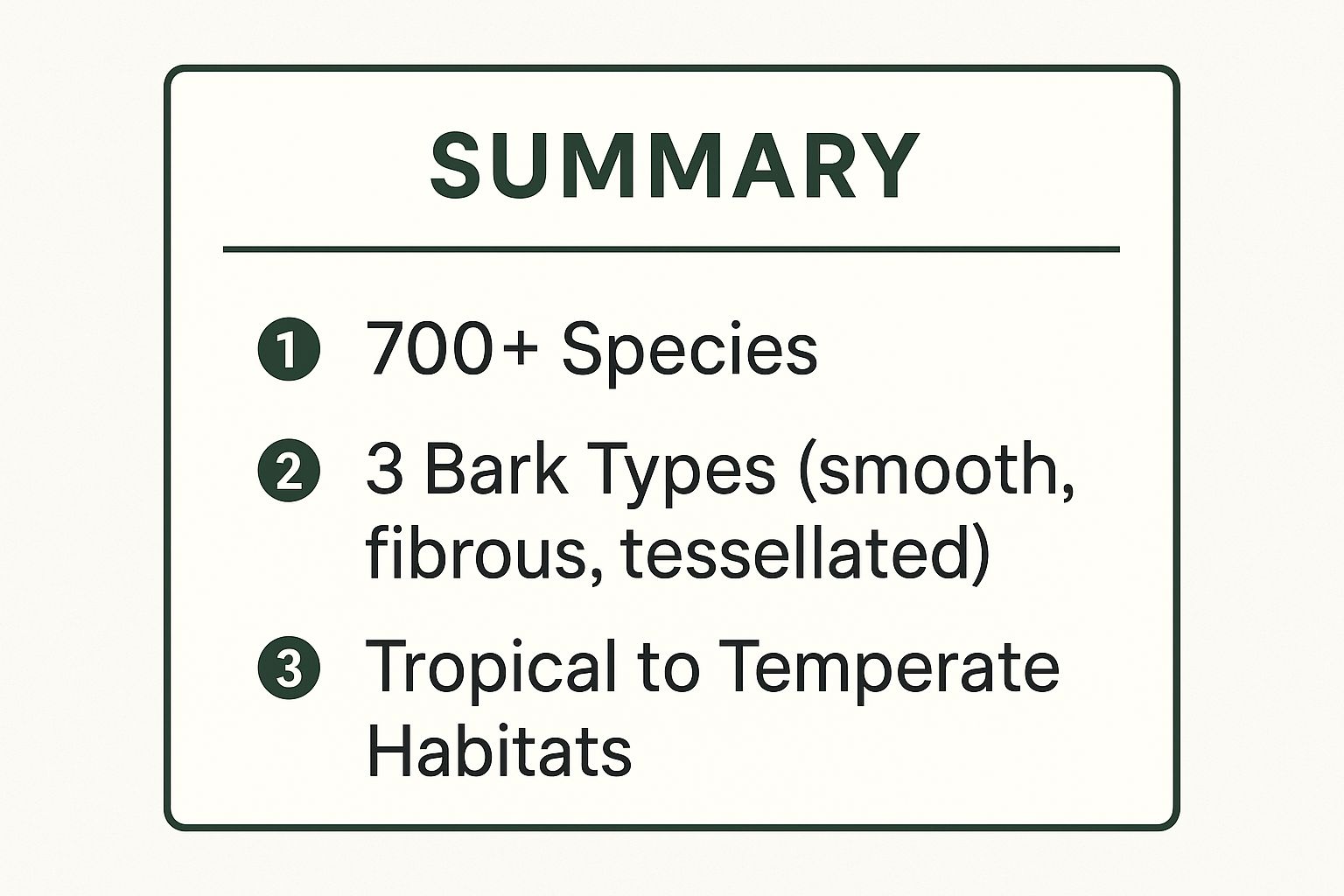
This quick overview underscores why there is a Eucalypt suitable for almost any Australian climate or landscape design.
Choosing the Right Gum Tree for Your Perth Garden
While their dominance is undeniable, selecting the correct species is crucial, especially in urban environments like Perth. The wrong choice can lead to significant issues with root systems interfering with plumbing and foundations, or large limbs dropping unexpectedly.
For Perth gardens, consider smaller, more manageable species like the Silver Princess (Eucalyptus caesia), whose weeping habit and large pink flowers make a stunning feature, or the Illyarrie (Eucalyptus erythrocorys) with its vibrant yellow blossoms emerging from striking red caps. These offer stunning flowers and manageable sizes, perfect for suburban blocks.
Here are some essential tips for planting gum trees:
Site Selection: Plant large species at least 15-20 metres away from buildings, fences, and underground services.
Watering: During establishment, water deeply but infrequently to encourage a strong, deep root system rather than surface roots.
Pruning: Engage a professional arborist to prune young trees. This establishes a sound structure and can mitigate the risk of limb failure in the future.
Mulching: Apply a layer of organic mulch around the base, keeping it clear of the trunk itself to prevent collar rot.
Watch this video to see the diversity and beauty of these Australian icons in their natural habitat:
Proper care and species selection are key to enjoying the beauty of a gum tree without the risks. For more detailed information on species suitable for Perth, you can explore more about Eucalyptus (Gum Trees).
If you need expert advice on selecting, planting, or maintaining a gum tree on your property, contact the qualified arborists at Swift Trees Perth for professional tree maintenance services.
2. Acacia (Wattles)
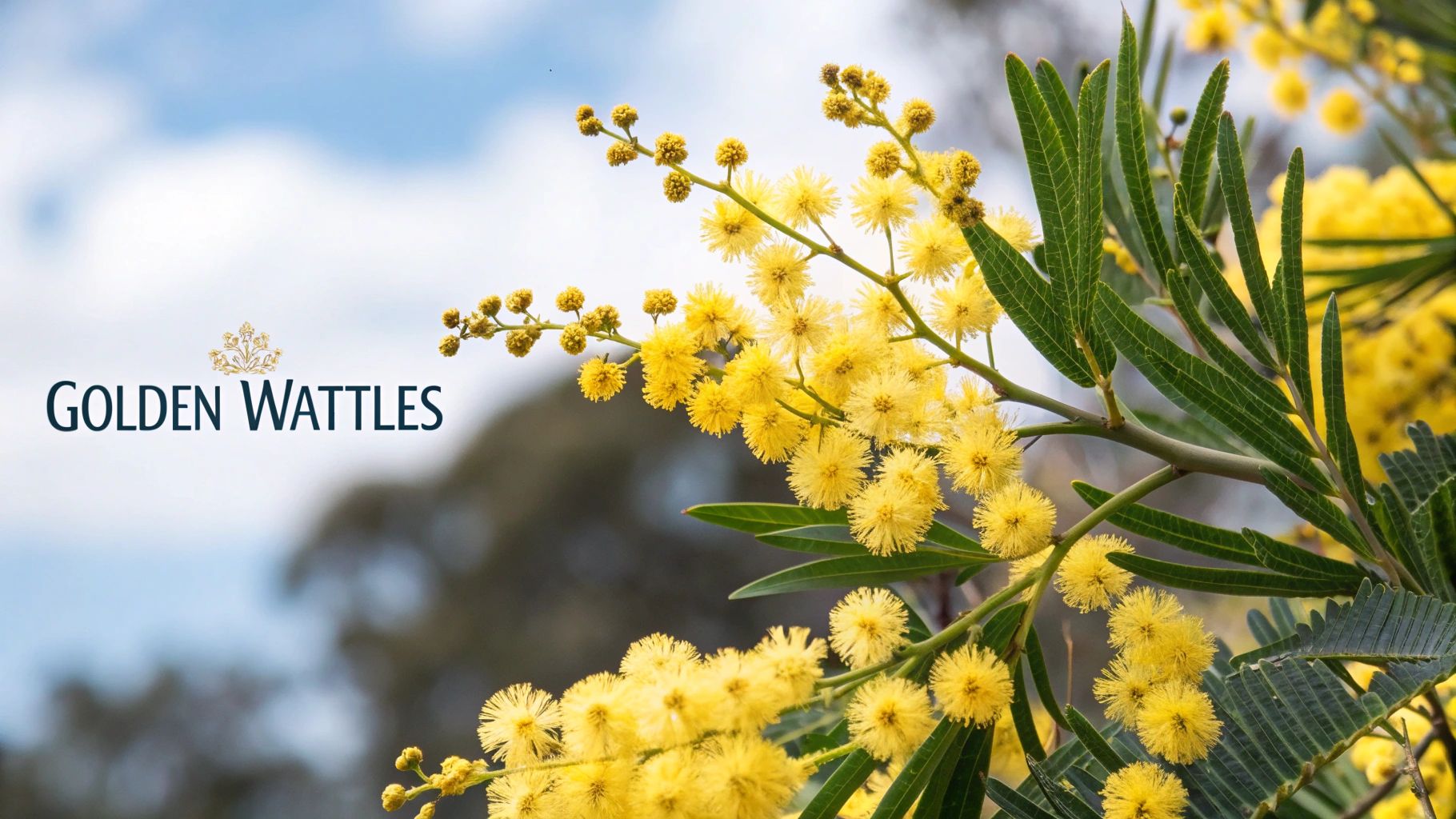
A vibrant and essential part of the Australian bush, Acacia, or Wattle, is the nation's largest genus of flowering plants, boasting nearly 1,000 species. These fast-growing trees and shrubs are famous for their brilliant bursts of golden-yellow flowers, which often signal the arrival of spring. Their significance is cemented in our national identity, with the Golden Wattle (Acacia pycnantha) proudly serving as Australia's floral emblem.
Wattles are masters of adaptation. Many Australian species have evolved phyllodes, which are flattened leaf stalks that function as leaves, to conserve water in harsh climates. As nitrogen-fixing plants, they play a crucial role in improving soil fertility, making them foundational species in many ecosystems. From the valuable timber of Blackwood (Acacia melanoxylon) to the widespread Cootamundra Wattle (Acacia baileyana), their uses are as diverse as their forms.
Growing Wattles in Your Perth Garden
Wattles are an excellent choice for Perth gardens, offering rapid growth, stunning floral displays, and benefits for local wildlife. Their hardiness makes them suitable for a range of conditions, but selecting a local species will ensure it is perfectly adapted to Perth's sandy soils and dry summers.
Consider species like the Raspberry Jam Wattle (Acacia acuminata), known for its distinctive scent, or the Weeping Acacia (Acacia iteaphylla) for a graceful, smaller tree perfect for screening or as a soft feature plant.
Here are some essential tips for planting and caring for wattles:
Soil and Drainage: Plant in well-drained soil to prevent root rot, a common issue for many native species.
Watering: Water regularly during the first year to establish a deep root system, then reduce frequency as they are very drought-tolerant once mature.
Pruning: Lightly prune after flowering to encourage a dense, compact shape and prevent them from becoming "leggy." This also helps manage their size.
Pest Watch: While hardy, they can be susceptible to borers or galls. Regular inspection helps catch issues early. Learn more about how to identify and treat common tree pests and diseases in Perth.
Proper care ensures these beautiful, fast-growing trees remain a healthy and vibrant feature of your garden.
If you're considering adding the iconic gold of a wattle to your landscape or need help maintaining an existing one, contact the qualified arborists at Swift Trees Perth for professional tree maintenance services.
3. Melaleuca (Paperbarks and Tea Trees)
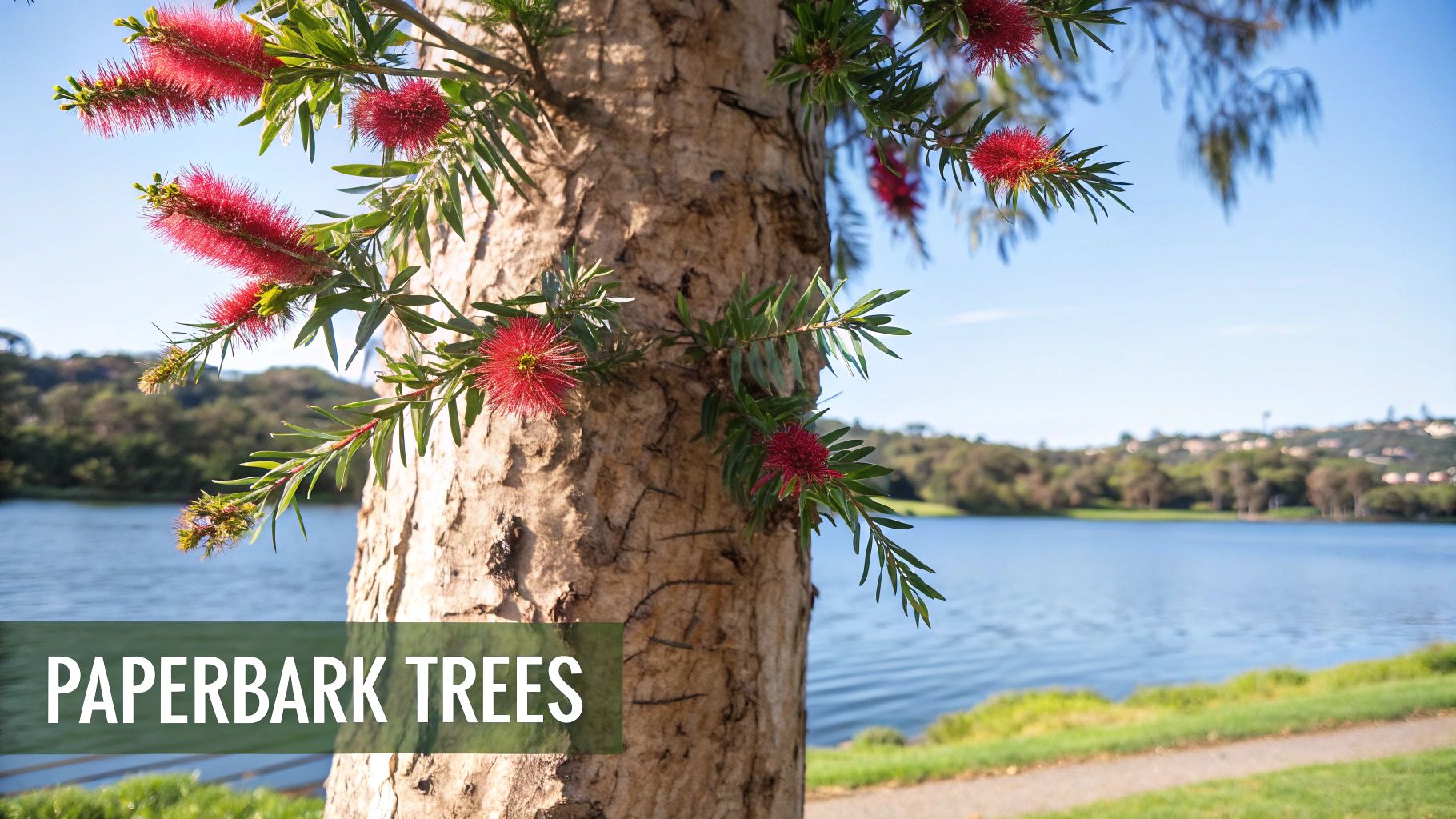
The Melaleuca genus is another quintessential group of Australian trees, renowned for its incredible diversity and adaptability. Comprising around 300 species, these trees, commonly known as Paperbarks or Tea Trees, are celebrated for their distinctive, papery bark that peels away in thin layers. Found in a wide range of habitats, from swamps and riverbanks to coastal heaths, they are a vital part of Australia’s natural ecosystems.
Melaleucas are typically evergreen and produce fluffy, bottlebrush-like flowers that attract a host of native birds and insects. Their resilience and unique appearance make them a popular choice in landscaping, while species like the Tea Tree (Melaleuca alternifolia) are cultivated commercially for their valuable antiseptic oil, a staple in cosmetics and natural medicine worldwide.
Choosing the Right Melaleuca for Your Perth Garden
With their tolerance for damp conditions, Melaleucas are an excellent choice for challenging spots in Perth gardens, particularly areas with poor drainage or heavy clay soils. Their fibrous, non-aggressive root systems generally pose less risk to infrastructure compared to larger eucalypts, making them a safer option for suburban properties.
For Perth landscapes, consider the beautiful Snowy Honey-myrtle (Melaleuca 'nivalis') for its compact size and prolific white flowers, making an excellent informal hedge. The mauve-flowering Melaleuca nesophila (Showy Honey-myrtle) can be shaped into an attractive small tree or dense screen, bringing a pop of colour to any garden design.
Here are some essential tips for planting Melaleucas:
Site Selection: Ideal for rain gardens, bioswales, or low-lying areas that collect water. Plant in full sun to partial shade for best results.
Watering: While adapted to wet conditions, they require regular, deep watering during the first one or two summers to establish a strong root system.
Pruning: Lightly prune after flowering to encourage dense, bushy growth and a more profuse floral display the following season. Larger species can be pruned to maintain a single trunk or a multi-stemmed shrub form.
Soil: Most species are not fussy about soil type, but they will thrive in soils improved with organic matter.
The adaptability and ecological benefits of Melaleucas make them one of the most useful types of trees in Australia for sustainable gardening.
If you need expert advice on selecting, planting, or maintaining a Melaleuca on your property, contact the qualified arborists at Swift Trees Perth for professional tree maintenance services.
4. Banksia
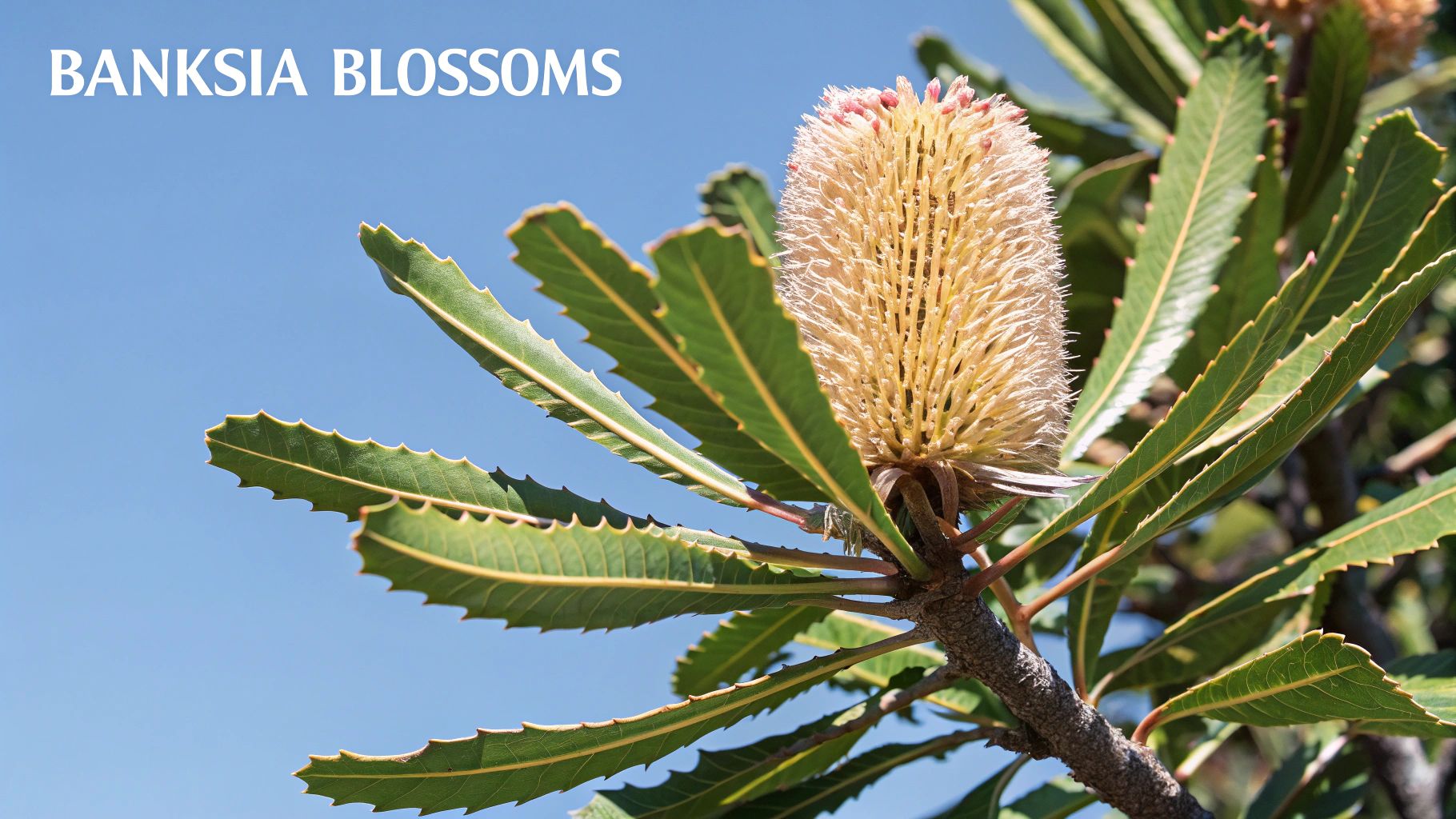
Another truly unique and quintessential Australian tree is the Banksia, a genus named in honour of botanist Sir Joseph Banks who documented them during Captain Cook's 1770 voyage. Instantly recognisable for their iconic, cylindrical flower spikes and distinctive woody "cones" that follow, Banksias are a cornerstone of the Australian bush. The genus features around 170 species, many of which are native to Western Australia, making them perfectly suited to local conditions.
From the robust Bull Banksia (Banksia grandis) with its massive yellow flowers to the popular Coast Banksia (Banksia integrifolia), these trees are famed for their resilience. They have evolved ingenious adaptations to thrive in Australia's nutrient-poor soils and fire-prone environments. The gnarled, character-filled figures of the "Banksia men" from May Gibbs' Snugglepot and Cuddlepie books have cemented their place in Australian culture.
Choosing the Right Banksia for Your Perth Garden
Banksias are an exceptional choice for Perth gardens, offering dramatic floral displays that attract a wealth of native birdlife and beneficial insects. Their diverse forms range from low-growing shrubs to substantial trees, ensuring there is a Banksia for nearly any garden design, from a feature specimen to a screening hedge.
Popular choices for Perth include the Acorn Banksia (Banksia prionotes) for its stunning orange and white flowers that look incredible in floral arrangements, and the compact Showy Banksia (Banksia speciosa) which provides architectural winter interest. These species provide year-round interest and are well-adapted to Perth's sandy soils and dry summers.
Here are some essential tips for growing Banksias:
Fertiliser: This is critical. Never use phosphorus-containing fertilisers, as Banksias have proteoid roots that are highly sensitive and can be killed by it. Use a specialist native, zero-phosphorus formula if you must fertilise.
Drainage: Excellent drainage is non-negotiable. If you have heavy clay soil, plant them on a raised mound to prevent root rot.
Sunlight: Plant in a location that receives full sun for most of the day to ensure prolific flowering.
Pruning: Lightly prune after the main flowering season has finished. This encourages a denser, bushier habit and can stimulate more flower production for the following year.
Watering: Once established, most Banksias are incredibly drought-tolerant, requiring minimal supplementary watering.
If you need expert advice on selecting, planting, or maintaining a Banksia on your property, contact the qualified arborists at Swift Trees Perth for professional tree maintenance services.
5. Callitris (Cypress Pines)
Representing Australia's only native conifers, the Callitris genus, or Cypress Pines, offers a unique and hardy presence in the Australian arboreal lineup. Comprising around 16 species, these evergreen trees are perfectly adapted to the continent's drier inland and semi-arid regions. They are distinguished by their fine, scale-like leaves arranged in whorls of three, which give the branches a distinctive jointed appearance.
Cypress Pines are highly valued for their aromatic, resinous timber that is naturally resistant to termites and rot, making them a durable resource. They produce small, woody cones with six valves that open to release seeds. From the commercially important White Cypress Pine (C. glaucophylla) of eastern Australia to the resilient Rottnest Island Pine (C. preissii) used for coastal stabilisation in Western Australia, their utility and hardiness are undeniable.
Quick Reference: Cypress Pines at a Glance
For a visual summary of this resilient genus, this infographic highlights its core characteristics.
This overview demonstrates why Cypress Pines are an excellent choice for water-wise gardens and farm forestry projects.
Choosing the Right Cypress Pine for Your Perth Garden
The drought tolerance and unique aesthetic of Cypress Pines make them an appealing choice for Perth's climate. Their conical shape and dense foliage provide excellent structure and screening in a garden landscape. Species like the Rottnest Island Pine are particularly well-suited to coastal Perth suburbs, tolerating salt spray and sandy soils with ease, making them a fashionable alternative to traditional exotic conifers for formal hedging or windbreaks.
Their hardy nature means they require minimal intervention once established, making them a low-maintenance option for property owners.
Here are some essential tips for planting cypress pines:
Site Selection: Choose a position with full sun exposure and excellent drainage, as they do not tolerate waterlogged soil.
Watering: Water regularly during the first two years to establish a deep root system, after which they are extremely drought-tolerant.
Fertilising: Avoid phosphorus-rich fertilisers, which can be harmful to many Australian natives. A slow-release, low-phosphorus native fertiliser is best if needed.
Transplanting: Plant them when they are young, as mature cypress trees do not respond well to being moved.
Their dense growth habit also makes them suitable for hedging. For more ideas on fast-growing trees, you can explore our guide to trees for privacy in Australia.
If you need expert advice on selecting, planting, or maintaining a cypress pine on your property, contact the qualified arborists at Swift Trees Perth for professional tree maintenance services.
6. Casuarina and Allocasuarina (She-oaks)
Often mistaken for pines due to their drooping, needle-like branchlets, Casuarina and Allocasuarina, collectively known as She-oaks, are a uniquely Australian group of trees. These distinctive types of trees in Australia are not related to true oaks but were named by early colonists for their hard, oak-like timber. Comprising around 90 species, they are tough, nitrogen-fixing pioneers that play a vital role in stabilising soils and providing habitat.
She-oaks are characterised by their modified stems (cladodes) that function as leaves and their woody, cone-like fruits that follow insignificant flowers. Their ability to thrive in poor soils, coastal salt spray, and arid conditions makes them incredibly versatile. Notable examples include the River She-oak (Casuarina cunninghamiana), essential for riverbank restoration, and the iconic Desert Oak (Allocasuarina decaisneana) of Central Australia.
Choosing the Right She-oak for Your Perth Garden
The hardy nature of She-oaks makes them a fantastic choice for challenging Perth gardens, particularly in coastal suburbs or areas with poor, sandy soil. Their unique texture and the gentle sighing sound they make in the wind add a wonderful sensory element to a landscape. However, like any tree, proper selection and placement are vital to prevent future problems.
For Perth gardens, smaller, more ornamental species are often preferred. The Swamp She-oak (Casuarina obesa) is well-suited to wetter spots, while the Drooping She-oak (Allocasuarina verticillata) offers a graceful, weeping form that works well as a feature tree, providing a soft, elegant silhouette against a modern home.
Here are some essential tips for planting She-oaks:
Site Selection: Their root systems can be extensive. Plant them well away from buildings, paths, and underground services to avoid potential disruption.
Soil and Aspect: Most species prefer full sun and are adaptable to a wide range of soils, especially well-drained, sandy types. They are excellent for exposed and coastal sites.
Male vs. Female: She-oaks have separate male and female plants. If you wish to avoid the "cones" and prolific seed drop, source a male tree.
Pruning: Engage a professional arborist to prune young She-oaks. This helps develop a strong, single leader and a well-balanced canopy, reducing the risk of structural failure later on.
Proper species selection is crucial for integrating these resilient and beautiful native trees into your garden. For more detailed information, you can explore more about Casuarina and Allocasuarina (She-oaks).
If you need expert advice on selecting, planting, or maintaining a She-oak on your property, contact the qualified arborists at Swift Trees Perth for professional tree maintenance services.
7. Araucaria (Australian Pines)
Araucaria represents an ancient genus of coniferous trees, true living fossils that have survived since the age of the dinosaurs. Among the various types of trees in Australia, two native species stand out: the Hoop Pine (Araucaria cunninghamii) and the iconic Bunya Pine (Araucaria bidwillii). These magnificent evergreens are instantly recognisable by their symmetrical, conical form, distinctive whorled branching, and sharp, overlapping scale-like or needle-like leaves.
These trees are not only architecturally stunning but also culturally significant. Bunya Pines, in particular, produce enormous cones weighing up to 10 kilograms, filled with edible seeds that were the focus of large, ceremonial gatherings for Aboriginal peoples for thousands of years. Their primeval appearance and imposing size make them a truly unique feature of the Australian landscape, from the ancient forests of Bunya Mountains National Park to historic avenues in botanic gardens.
Choosing the Right Araucaria for Your Perth Garden
While visually dramatic, the sheer scale and specific characteristics of Araucaria demand careful consideration before planting, especially in a Perth suburban setting. The massive cones of the Bunya Pine pose a significant safety risk, and the extensive root systems and towering height of both species can overwhelm smaller properties.
For larger properties or parklands in Perth, an Araucaria can be a breathtaking feature tree, offering a bold, architectural statement that few other trees can match. However, it is not a suitable choice for a typical residential block. If you have the space, they thrive in deep, fertile, well-drained soil and are best planted where they have ample room to grow to their full, majestic height without interference.
Here are some essential tips for managing Araucaria:
Site Selection: Plant at a significant distance from buildings, paths, driveways, and any public access areas due to the danger of falling cones and branches.
Space: These trees require a large area to accommodate their mature height of 30-50 metres and substantial canopy spread.
Soil: Ensure the planting site has deep, rich soil that drains well. They do not perform well in compacted or waterlogged conditions.
Pruning: Generally, no pruning is required other than to remove dead or damaged branches. Never attempt to top these trees as it will destroy their natural form.
The historic and structural importance of these trees means their care should not be taken lightly. Due to their immense size and the risks involved, any maintenance should be performed by professionals.
If you have a large Araucaria on your property that requires assessment or maintenance, contact the qualified arborists at Swift Trees Perth for expert tree maintenance services.
8. Corymbia (Bloodwoods and Ghost Gums)
Once classified under Eucalyptus, the Corymbia genus now stands on its own, encompassing around 100 species of Bloodwoods and Ghost Gums. These are some of the most visually stunning types of trees in Australia, defined by their unique bark and vibrant flowers. Bloodwoods are named for their dark, rough bark which exudes a deep red sap when cut, while Ghost Gums are famed for their smooth, ghostly white or cream bark.
Corymbias are integral to northern and inland Australian landscapes. The iconic Ghost Gum (Corymbia aparrerinja), immortalised in the paintings of Arrernte artist Albert Namatjira, symbolises the resilience of the arid interior. These trees are highly valued for their ornamental qualities, featuring large, showy flowers in shades of white, pink, or brilliant red, and distinctive urn-shaped seed capsules.
Choosing the Right Corymbia for Your Perth Garden
The dramatic beauty of Corymbia makes them a popular choice, but careful selection is vital for a thriving tree in Perth's climate. The world-renowned Red Flowering Gum (Corymbia ficifolia) is a favourite, but for reliable flower colour and garden suitability, it is essential to choose grafted varieties. These fashionable cultivars, like 'Summer Red' or 'Baby Orange', guarantee a specific flower colour and a more compact size, making them perfect statement trees for modern gardens. The Lemon-scented Gum (Corymbia citriodora) is another popular choice for its graceful form and aromatic leaves.
Here are some essential tips for planting Corymbia trees:
Site Selection: Plant in a position with full sun to encourage the best bark colour and prolific flowering.
Soil: Ensure the soil is well-drained, as these trees, particularly Ghost Gums, do not tolerate waterlogged conditions.
Watering: Water regularly during the establishment phase. Once established, they are relatively drought-tolerant, though a C. ficifolia will appreciate summer watering in Perth.
Pruning: Avoid heavy pruning. Light, formative pruning when the tree is young is all that is required to establish a good structure.
Mulching: Apply a layer of organic mulch around the base to keep the root system cool, but ensure mulch is kept away from the trunk to prevent rot.
Proper species selection and care are critical to successfully growing these magnificent trees. For more detailed information on species suitable for Perth, consider exploring local horticultural resources.
If you need expert advice on selecting, planting, or maintaining a Corymbia on your property, contact the qualified arborists at Swift Trees Perth for professional tree maintenance services.
9. Ficus (Australian Fig Trees)
Among the most impressive and structurally complex types of trees in Australia are the native Ficus species, or Fig Trees. Australia is home to around 45 species, ranging from colossal rainforest giants to tenacious rock-splitting climbers. The most recognisable are the Moreton Bay Fig (Ficus macrophylla) and the Port Jackson Fig (Ficus rubiginosa), famed for their massive buttressed trunks, sprawling canopies, and distinctive aerial roots that can form secondary trunks.
These evergreen trees are architectural marvels and ecological powerhouses. Their dense, shady canopies create unique microclimates, while their figs provide a critical food source for a vast array of wildlife, including birds, bats, and possums. While many species start life as epiphytes that eventually strangle their host, the commonly planted ornamental varieties are self-supporting from germination.
Choosing the Right Fig Tree for Your Perth Garden
The immense scale of Australian fig trees makes them a challenging, and often unsuitable, choice for typical urban gardens in Perth. Their root systems are notoriously aggressive and extensive, capable of causing catastrophic damage to foundations, plumbing, retaining walls, and pavement. Their sheer size, with canopies spreading 40 metres or more, can quickly overwhelm a suburban block.
These magnificent trees are best reserved for parks, large public estates, or rural properties where they have ample room to grow without conflict. The historic Moreton Bay Figs in Brisbane's City Botanic Gardens or the Port Jackson Figs at Sydney's Observatory Park are perfect examples of their majestic potential when given sufficient space. A practical example of misuse is planting one near a swimming pool, where the roots will inevitably seek out and destroy the plumbing.
Here are some essential tips for managing fig trees:
Site Selection: Only plant in large, open areas, a minimum of 20-30 metres away from any buildings, pools, or underground services.
Root Damage: Be aware that even professional root barrier systems are often ineffective against the powerful roots of a mature fig tree.
Constant Monitoring: Regularly inspect surrounding structures for signs of root heave or intrusion. Seeds also germinate readily in gutters and wall cracks, so building maintenance is crucial.
Pruning: Due to their size, pruning should only be undertaken by qualified arborists to maintain structural integrity and safety.
Proper planning is non-negotiable when dealing with these Australian giants. Their potential for damage in residential settings means they are rarely a wise choice for a backyard.
If you have concerns about an existing fig tree or its powerful root system, contact the expert arborists at Swift Trees Perth for a professional assessment and management plan.
10. Grevillea
The Grevillea genus is a quintessential element of the Australian flora, celebrated for its unique and intricate flowers. With over 360 species, this diverse group ranges from low-growing ground covers to tall trees, making it a versatile choice for various garden designs. Most are endemic to Australia, with the greatest concentration found in southwestern Western Australia, making them particularly well-suited to the local climate.
Grevilleas are renowned for their spectacular, nectar-rich flowers that attract a wealth of native birdlife. These blooms, often described as spider-like, toothbrush-like, or bottlebrush-like, appear in a stunning array of reds, pinks, oranges, and yellows. The Silky Oak (Grevillea robusta), one of the largest species, is a prominent feature in many landscapes, while smaller hybrids like 'Robyn Gordon' are among the most popular garden plants in the country.
Quick Reference: Grevillea at a Glance
For a visual summary of this diverse genus, this infographic highlights its core characteristics.
This overview shows why Grevilleas are a fantastic, water-wise choice for bringing colour and wildlife to Australian gardens.
Choosing the Right Grevillea for Your Perth Garden
While Grevilleas are hardy, their success in a Perth garden hinges on understanding their specific needs, particularly their sensitivity to phosphorus. Many Australian natives have adapted to ancient, nutrient-poor soils and can be severely harmed or killed by conventional fertilisers.
For Perth gardens, local Western Australian species are an excellent choice. Consider the vibrant Mangles' Kangaroo Paw (Grevillea manglesii) for a stunning floral display or use ground cover varieties like 'Gin Gin Gem' to suppress weeds and create a living mulch on retaining walls. These fashionable choices add a designer touch while being perfectly suited to the climate.
Here are some essential tips for planting Grevilleas:
Fertiliser: Never use fertilisers containing phosphorus. Opt for a specialised, low-phosphorus native plant food applied in spring.
Drainage: Excellent drainage is non-negotiable. If you have heavy clay soil, plant on a raised mound to prevent root rot.
Pruning: Prune lightly after the main flowering season to encourage dense, bushy growth and more flowers the following year. Avoid cutting into old, hard wood.
Mulching: Apply a layer of organic mulch like wood chips or gravel around the base, but keep it away from the stem to prevent fungal issues.
With the right care, a Grevillea will reward you with year-round interest and a garden full of life. For more detailed advice on species suitable for Perth, you can explore more about Grevilleas.
If you need expert advice on selecting, planting, or maintaining a Grevillea on your property, contact the qualified arborists at Swift Trees Perth for professional tree maintenance services.
Top 10 Australian Trees Comparison
Tree Genus | Implementation Complexity 🔄 | Resource Requirements ⚡ | Expected Outcomes 📊 | Ideal Use Cases 💡 | Key Advantages ⭐ |
|---|---|---|---|---|---|
Eucalyptus (Gum Trees) | Moderate - requires space due to root spread | Moderate water, low maintenance once established | Fast carbon sequestration; erosion control | Land rehabilitation, large gardens, parks | Fast growth; wildlife habitat; essential oils |
Acacia (Wattles) | Low - fast-growing pioneer species | Low water and nutrient needs | Soil improvement via nitrogen fixation | Dry areas, soil rehabilitation, shelter | Nitrogen fixation; drought tolerance; vibrant flowers |
Melaleuca (Paperbarks and Tea Trees) | Moderate - favors wet sites, pruning may be needed | Moderate water, tolerates poor drainage | Wetland stabilization; commercial oils | Riparian zones, rain gardens, coastal areas | Wet soil tolerance; aromatics; erosion control |
Banksia | Moderate to High - needs good drainage and care | Low water; needs specific soil conditions | Attracts birds; fire-adapted regeneration | Native gardens, coastal revegetation | Spectacular flowers; nutrient-poor soil adaptation |
Callitris (Cypress Pines) | Low - slow grower, minimal pruning | Low water; drought resistant | Durable timber; windbreaks; fire-resistant | Dry inland regions, farm forestry | Durable timber; low maintenance; drought tolerant |
Casuarina and Allocasuarina (She-oaks) | Moderate - can be invasive, manage root spread | Low water; tolerates poor soils | Soil stabilization and erosion control | Coastal sites, degraded land rehabilitation | Nitrogen fixation; salt tolerance; fast growth |
Araucaria (Australian Pines) | High - large mature size requires space | Moderate water; needs fertile soil | Long-lived specimen trees; high carbon storage | Large landscapes, parks, timber production | Architectural presence; valuable timber; cultural significance |
Corymbia (Bloodwoods and Ghost Gums) | Moderate - larger species need space | Moderate water; drought tolerant | Ornamental value; wildlife food source | Large parks, gardens, avenues | Ornamental bark; bird attraction; drought tolerant |
Ficus (Australian Fig Trees) | High - very large, aggressive roots | High water during establishment | Exceptional shade; critical wildlife habitat | Parks, large public or rural spaces | Shade provision; keystone wildlife species |
Grevillea | Low to Moderate - pruning advised | Low water; requires good drainage | Long flowering, bird attraction | Gardens, urban landscaping, cut flowers | Extended flowering; diverse sizes; nectar-rich flowers |
Cultivating Your Australian Landscape with Professional Care
This journey through some of the most iconic types of trees in Australia reveals a continent teeming with botanical diversity. From the towering presence of a River Red Gum to the delicate, vibrant blossoms of a Grevillea, each species offers a unique contribution to our landscapes. We have explored how the hardy resilience of Wattles, the textural appeal of Paperbarks, and the architectural form of Australian Cypress Pines can transform a property.
Understanding these trees is the foundational step, but bringing them successfully into a managed landscape like a Perth garden or commercial property is an ongoing commitment. The decision to plant a tree is an investment not just in your property's value and aesthetic appeal, but also in the local ecosystem. It creates shade, supports native wildlife, and contributes to a healthier urban environment.
From Planting to Professional Pruning: The Tree Lifecycle
Choosing the right tree for the right place is paramount. As we've seen, a magnificent Moreton Bay Fig is a poor choice for a small suburban block due to its aggressive root system, while a compact flowering gum like Corymbia ficifolia can provide stunning colour without overwhelming the space. Similarly, a Banksia, while perfectly adapted to Perth's sandy soils, requires careful handling to protect its sensitive roots from disturbance and disease.
However, the real art of arboriculture lies in what happens after the tree is in the ground. Professional care is what separates a thriving, safe, and beautiful specimen from a potential liability.
Formative Pruning: For young, fast-growing species like Acacia, early structural pruning is essential. It encourages a strong, balanced canopy, preventing weak branch junctions that could fail in a storm later in life.
Canopy Management: For mature Eucalyptus and Corymbia varieties, regular canopy thinning and deadwood removal is not just about aesthetics. It is a critical safety measure to mitigate the risk of sudden limb drop, a notorious trait of many large gums. This process improves air circulation and light penetration, enhancing the tree's overall health.
Specialised Care: Trees like Melaleucas may require selective pruning to manage their dense, sometimes messy growth, especially when planted near buildings or pathways. She-oaks, with their vigorous root systems, may need expert assessment to ensure they aren't impacting underground services or foundations.
Key Takeaway: The long-term health, safety, and beauty of your trees depend directly on proactive, skilled maintenance. An arborist's expertise turns a simple planting into a lasting legacy, ensuring your trees grow to be assets, not hazards.
Navigating the Perth Environment with Expert Guidance
For those of us in Perth, our unique climate and soil conditions present specific challenges. The long, dry summers and nutrient-poor sandy soils mean that even native, water-wise trees can come under stress without proper care. An arborist with local experience can provide crucial advice on soil improvement, appropriate watering schedules, and identifying early signs of pest or disease issues common to the Swan Coastal Plain.
Mastering the care of these diverse Australian trees ensures your landscape is not only beautiful but also safe and sustainable. It allows you to enjoy the full benefits of your green assets, from summer shade and enhanced property value to the simple joy of watching native birds flock to your flourishing Banksia or Grevillea. Don't leave the health and safety of your most significant landscape features to chance.
Whether you need formative pruning for a newly planted Wattle, a safety assessment for a towering Tuart, or expert removal of a tree in a confined space, professional care is essential. For comprehensive tree services tailored to Perth's unique environment, trust the experienced team at Swift Trees Perth.
Contact Swift Trees Perth today for a free, no-obligation quote and let our qualified arborists ensure your trees remain healthy, safe, and beautiful for years to come.


Comments