
A Guide to Identifying Australian Trees

Figuring out what kind of Australian tree you're looking at is a lot easier than you might think. It all starts by looking for a few tell-tale features like its leaves, bark, and overall shape.

Once you learn to read these visual clues, you'll start spotting the difference between an iconic gum tree and a wattle in your own backyard. This guide will give you a straightforward way to get started.
Your First Steps to Identifying Australian Trees
Ever stood in a Perth park, staring up at a massive gum tree, and felt that mix of awe and curiosity about what it actually is? You're not the only one. The sheer variety of Australia's plants can feel a bit overwhelming, but learning to identify them is a rewarding skill that connects you more deeply with the world around you. We'll skip the dense botanical jargon and focus on what you can actually see and touch.
Think of it as learning the visual language of the bush. Every tree tells a story through its features—your job is to become a good observer. This is all about building a solid foundation and learning to spot the "ID tags" that nature provides.
Understanding the Scale of Australian Flora
Before we get into the nitty-gritty, it helps to appreciate the incredible diversity out there. Australia is home to roughly 24,000 species of native plants, a staggering number that really shows off the continent's unique evolutionary path.
You'll quickly become familiar with the big names like Eucalyptus (gum trees), Acacia (wattles), and Melaleuca.
To give you some perspective, Eucalyptus forests alone cover about 77% of Australia's national forest land, making them by far the most dominant type. You can find more fascinating stats over at Trees Down Under.
To make things simple, you can break down the process into three basic steps.

Moving from a general look to checking the finer details is the real key to getting it right.
The Observational Mindset
The best tool for identifying trees isn't an app—it's your own attention. Instead of rushing to a conclusion, just take a moment to really look.
What's the tree's overall personality?
Is it tall and slender like a Karri, or dense and weeping like a Peppermint Tree?
This first impression will guide the rest of your investigation.
Start by asking yourself a few simple questions:
Where is it? Location is a massive clue. A tree you find thriving in a sandy coastal suburb like Scarborough will probably be different from one growing up in the Perth Hills.
What's its overall shape (habit)? Is it tall, wide, weeping, or more like a big shrub? This is your first major filter.
What does the bark look like? Is it smooth and peeling, rough and fibrous like stringybark, or dark and rugged like ironbark?
By starting with these broad observations, you create a mental shortlist. This approach stops you from getting bogged down in tiny details too early and makes the whole process more manageable and a lot more fun.
This table gives you a quick reference for the main characteristics to focus on.
Key Features for Quick Tree Identification
Characteristic | What to Look For | Why It's Important |
|---|---|---|
Growth Habit | The overall shape—tall, wide, weeping, shrub-like, or conical. | Provides the first major clue, helping narrow down possibilities from a distance. |
Location/Habitat | Is it in a park, coastal area, forest, or swampy ground? | Many species are adapted to specific environments, so location is a huge filter. |
Bark | Texture (smooth, rough, fibrous, flaky) and colour (white, grey, brown, reddish). | Bark is one of the most reliable year-round identifiers, especially for Eucalypts. |
Leaves | Shape, size, colour, and arrangement on the stem (alternate vs. opposite). | Leaf details are crucial for distinguishing between closely related species. |
Flowers/Fruits | Colour, shape, and structure of flowers, nuts, or seed pods. | When present, these are often the most definitive feature for a positive ID. |
Using this systematic approach makes identifying trees feel less like guesswork and more like solving a satisfying puzzle.
Once you have this foundational knowledge down, you can dive into more detailed profiles. You might find our collection of articles on specific Australian tree species helpful as you get more confident.
Of course, identifying a tree is one thing; looking after it is another.
If the trees on your property need some expert attention, from precision pruning to a full health check, the team at Swift Trees Perth is here to help. Contact us for all your professional tree care needs.
Decoding a Tree's Unique Features
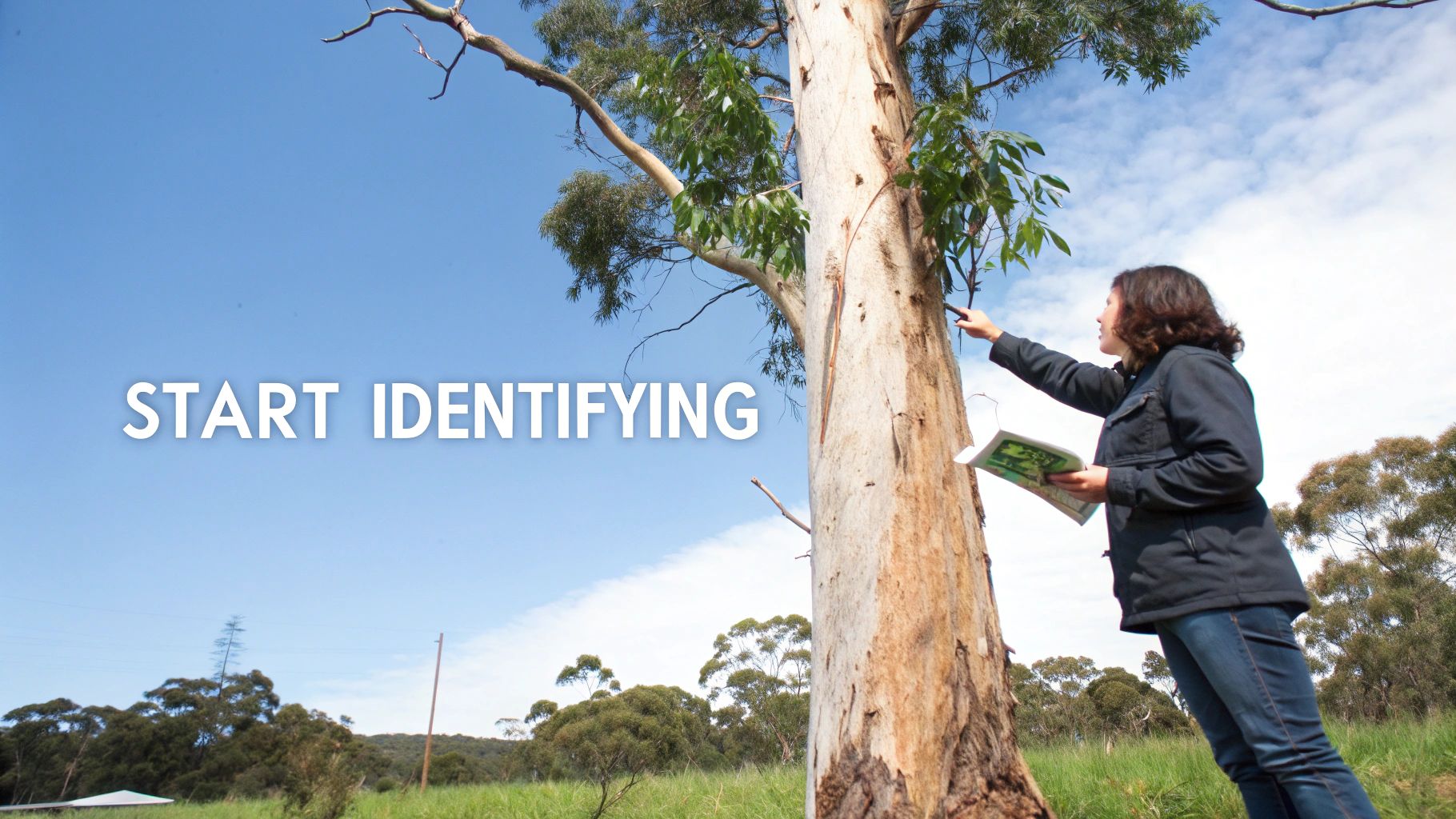
To really get good at identifying Australian trees, you have to become a bit of a detective. All the secrets are there, hiding in plain sight. It’s about moving past a quick glance and learning to see the subtle, unique features that act as a tree’s fingerprint. We'll focus on four critical clues: leaves, bark, flowers or fruit, and the tree's overall shape.
Think of it like reading a story. The leaves are the words, the bark is the texture of the pages, and the overall shape is the plot. Each part contributes to the full narrative, helping you piece together the tree's true identity.
This process gets even more interesting when you realise just how massive our native flora is.
The Australian landscape is dominated by eucalypts and acacias. Eucalypt forests cover an incredible 101 million hectares, making up 77% of our total native forest area, while acacia woodlands cover another 13 million hectares. Learning to spot the details is key to navigating this vast green library.
You can learn more by exploring Australia's forest profiles to really grasp this diversity.
The Secrets Held in Leaves
Leaves are usually the first thing people look at, but there's a lot more to them than just being green. To get an accurate ID, you need to get up close and personal with their specific characteristics.
Shape and Size: Is the leaf long and slender like a spearhead (lanceolate), or is it more rounded and egg-shaped (ovate)? The leaves of a Lemon-Scented Gum (Corymbia citriodora), for example, are distinctly lanceolate. In contrast, a Queensland Bottle Tree (Brachychiton rupestris) can have leaves that vary wildly in shape, even on the same branch.
Arrangement on the Stem: How do the leaves connect to the twig? If they sprout one at a time, zigzagging up the stem, they are alternate. If they grow in pairs directly across from each other, they are opposite. This small detail is a massive clue for many species.
Texture and Scent: Don’t forget your other senses. Some leaves, like those of the Peppermint Tree (Agonis flexuosa), release a sharp minty smell when you crush them. Others might feel waxy, leathery, or even a bit hairy.
A great tip for home gardeners is that leaf texture can completely change a garden's vibe. The glossy, dark green leaves of a Lilly Pilly create a feeling of lushness and privacy, while the fine, silvery foliage of a Coastal Rosemary (Westringia fruticosa) brings a light, airy feel to the landscape.
Bark: A Tree's Fingerprint
If leaves are a tree’s words, then bark is its unmistakable signature. It’s a reliable feature all year round, which makes it one of the most useful clues—especially when you're trying to tell one of the hundreds of eucalypt species from another.
Is the bark completely smooth, shedding in colourful ribbons like a Ghost Gum (Corymbia aparrerinja)?
Or is it deeply cracked and rugged, like the aptly named 'ironbark' eucalypts?
Maybe it’s fibrous and can be pulled off in long strands, a classic trait of 'stringybark' trees like our local Jarrah (Eucalyptus marginata).
Paying close attention to these textures is fundamental.
Flowers and Fruits: The Final Confirmation
While they aren’t always there, flowers and their resulting fruits or gumnuts are often the final, definitive piece of the puzzle. Their colour, shape, and structure can provide the confirmation you need for a positive ID.
The vibrant crimson flowers of a Red-Flowering Gum (Corymbia ficifolia) are impossible to mistake.
Likewise, the unique woody capsules of a Marri (Corymbia calophylla)—often called 'honkey nuts'—are a dead giveaway.
And the fluffy yellow blossoms of a Golden Wattle (Acacia pycnantha) instantly set it apart from everything else in the landscape.
Observing a Tree's Growth Habit
Finally, take a few steps back and look at the tree’s overall form, or its 'growth habit'. This is its personality—the way it presents itself to the world.
Is it a towering giant with a straight, dominant trunk like the majestic Karri (Eucalyptus diversicolor)?
Does it have elegant, weeping branches that droop gracefully, like the popular Agonis flexuosa?
Or does it have a dense, spreading canopy that gives plenty of shade, which is typical of a Moreton Bay Fig (Ficus macrophylla)?
This big-picture view, combined with the finer details of leaves and bark, completes your identification toolkit. By training your eye to see these features, you’ll go from being a casual observer to a knowledgeable naturalist.
Of course, identifying a tree is just the first step. Proper care and maintenance ensure these natural assets stay healthy and safe.
If you have trees on your Perth property that need pruning, a health check, or any other professional attention, contact Swift Trees Perth today for expert advice and service you can trust.
Alright, you’ve got the basics down for playing tree detective—leaves, bark, growth habits. Now, let's put those skills to work right here in our own backyard.
While Australia has a mind-boggling number of tree species, your local Perth neighbourhood has a familiar cast of characters you'll see again and again.
This is your field guide to the icons of Western Australia.
We'll help you put a name to the familiar faces in your local park, on your street, or right outside your window. By the end of this, you'll be confidently pointing out a Jarrah, spotting a towering Karri, and appreciating the unique personality of a Weeping Peppermint on your next walk.
The Resilient Jarrah
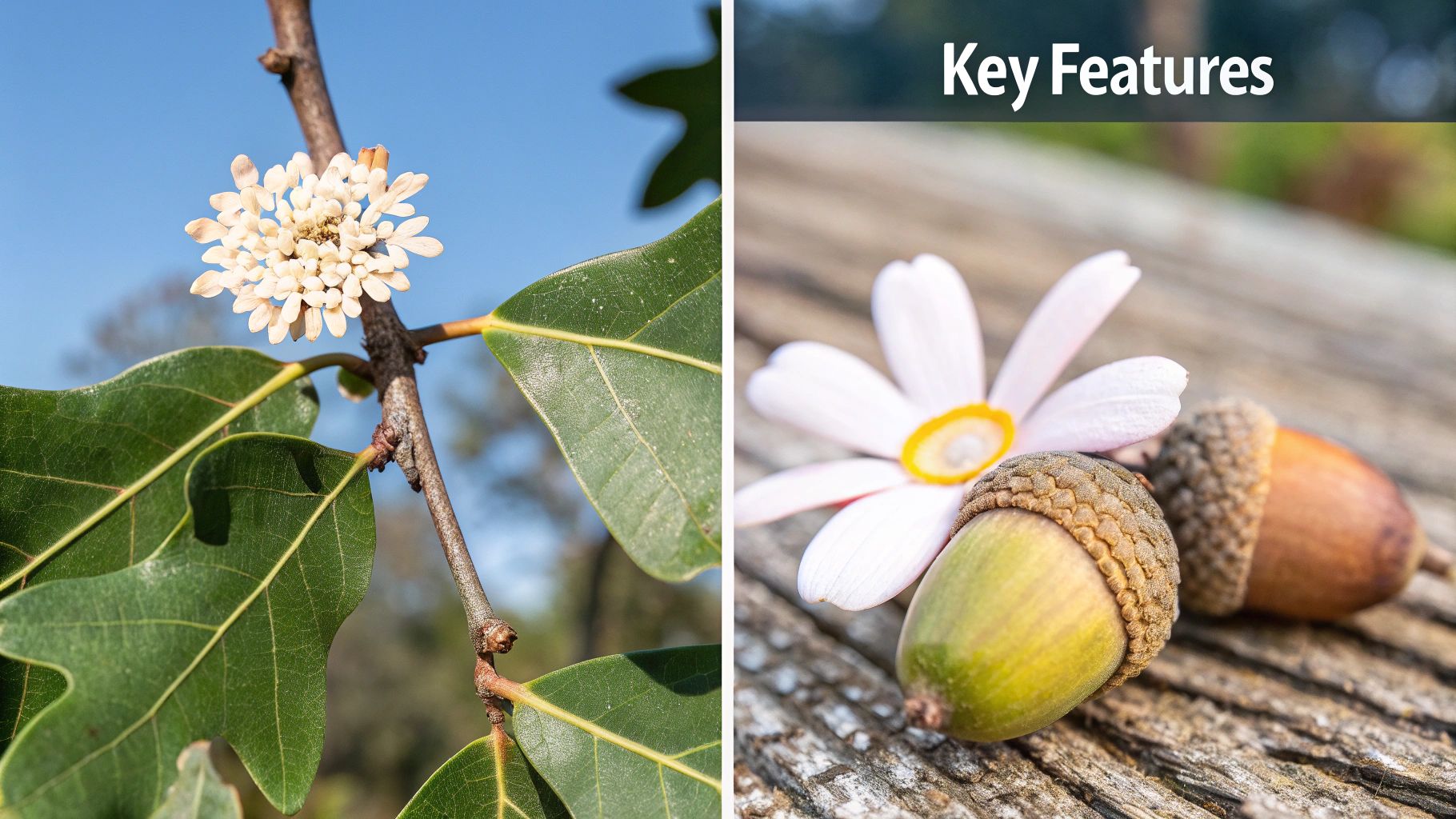
If there’s one tree that defines the Perth region, it’s the Jarrah (Eucalyptus marginata). It’s tough, resilient, and woven into WA’s history. Once you know what to look for, you’ll start seeing it everywhere, from the Darling Scarp forests to established suburban gardens.
Its most telling feature is the bark. Jarrah has a classic 'stringybark' that’s dark, fibrous, and deeply furrowed. You can often pull off long, stringy pieces with your hands. Its leaves are dark green and lance-shaped, hanging downwards to create that perfect dappled shade for our hot summers.
Here’s a tip for the gardeners: a healthy Jarrah often signals well-drained, gravelly soils—a natural clue for what other native plants will thrive nearby. And of course, its rich, reddish timber is famous for its incredible durability and resistance to termites.
The Majestic Karri
Head a bit further south into WA's magnificent forests, and you’ll meet the Karri (Eucalyptus diversicolor), one of the tallest hardwood trees on the entire planet. It's less common in Perth suburbs, but its sheer scale makes it absolutely unforgettable.
The Karri’s signature is its stunningly smooth bark. It sheds in patches, revealing a beautiful mosaic of colours from white and grey to salmon pink and soft orange. This clean trunk towers skyward, often reaching heights of over 70 metres. Unlike the Jarrah, Karri prefers deep, loamy soils, which is why it completely dominates the wetter forests of the southwest.
The Red-Flowering Gum
A spectacular favourite in gardens all over Perth is the Red-Flowering Gum (Corymbia ficifolia). While its natural range is more coastal and southern, its dazzling flower displays have made it a horticultural superstar.
This tree is a breeze to identify in summer. It simply erupts in a breathtaking show of vibrant flowers, ranging from deep crimson and scarlet to orange and even pink. The bark is rough and tessellated (broken up into small squares), and it produces large, urn-shaped gumnuts that are much bigger than those of a Jarrah or Marri.
In modern garden design, the Red-Flowering Gum is often used as a 'hero' or feature tree. Its explosive colour provides a stunning focal point, attracting native birds and creating incredible visual impact against contemporary architecture.
The sheer dominance of Eucalypts across Australia can make identification a real challenge. T
hey are by far the most prominent tree in our native forests, accounting for a massive 77% of the total area, with Acacias a distant second at 8%.
This really underscores why learning to tell key species like Jarrah and Karri apart is so valuable. You can discover insights about Australia's forests and explore more data on our unique forest makeup.
The Weeping Peppermint Tree
For a completely different vibe, look no further than the WA Peppermint Tree (Agonis flexuosa). Its graceful, weeping foliage brings a soft, gentle presence to coastal parks and gardens, and it's perfectly suited to Perth's sandy soils.
Its growth habit is the dead giveaway. The long, slender leaves hang downwards from drooping branches, creating a curtain-like effect. For a quick ID test, crush one of the leaves in your hand—it will release a sharp, refreshing peppermint scent. The bark is fibrous and brown, and it often produces clusters of small, white, tea-tree-like flowers in spring. To see how it fits in with other popular choices, check out our guide on 10 key types of trees in Australia for your 2025 garden.
Identifying the trees around you turns a simple walk into an engaging journey. But knowing a tree's name is just the first step. Understanding its health, structure, and potential risks is where professional expertise becomes crucial.
If you have trees on your property that need a skilled prune, health check, or safe removal, contact Swift Trees Perth for professional and reliable tree maintenance.
Helpful Tools and Resources for Identification
You don't have to be a lone botanist on your quest to identify Australian trees. These days, a powerful toolkit is available right at your fingertips, blending modern technology with classic field resources to help solve even the trickiest tree mysteries.
Think of it as building your personal identification library. You can mix and match digital tools with traditional guides to create a method that works for you, whether you’re in your own garden or deep in the bush. The key is knowing which resource to turn to for the right situation.
Modern Tech in Your Pocket
Mobile apps have become incredibly useful for getting a quick, on-the-spot suggestion. They use image recognition to analyse photos of leaves, bark, and flowers, giving you a list of potential matches in seconds.
Apps like PlantNet are surprisingly good, even with our unique Australian species. But getting an accurate ID from an app is all about the photo you give it.
Isolate the Feature: Take a clear, close-up shot of a single leaf against a neutral background like the sky or a plain piece of paper.
Capture Multiple Clues: Don't just snap the leaves. Take separate, focused photos of the bark, any flowers or gumnuts, and the tree's overall shape. More images mean more data for the app to work with.
Check for Quality: Make sure your photos are sharp and well-lit. Blurry or dark images are the number one reason for a misidentification.
The results are presented with a confidence score, helping you see which species is the most likely match based on the visual data you provided.
Digging Deeper with Online Databases
Once an app gives you a starting point, invaluable online databases help you confirm it. These resources provide the detailed botanical information you need for a confident identification.
Websites like the Atlas of Living Australia are fantastic digital libraries, offering maps, photos, and scientific data on thousands of species. For super local info, the websites of state herbariums—like Western Australia's Florabase—are indispensable. They provide detailed descriptions and distribution maps specific to our region.
These databases are a step beyond simple identification; they offer a deeper understanding of a tree's ecological role and significance. This level of detail is crucial for industries that depend on accurate tree management.
For instance, Australia's forestry sector provides direct employment for around 52,000 people and contributes approximately $24 billion to the national economy each year. This whole industry relies on data collected from over 17,000 ground plots nationwide, which informs the very tools and guides we use. You can learn more about the economics of our forests and see how this research supports sustainable management.
The Timeless Value of Field Guides
For those who love the feel of a book, a high-quality field guide is still an unbeatable tool. A well-written guide tailored to Western Australian flora is perfect for taking into the field, especially where you might not have a phone signal.
Look for books with clear photographs or illustrations, detailed descriptions of bark, leaves, and flowers, and distribution maps. They often contain insights and identification keys that you simply won't find in an app. Having a physical guide encourages a slower, more methodical approach that can seriously sharpen your observation skills.
Building your toolkit is an ongoing process. By combining the speed of an app with the depth of online databases and the reliability of a field guide, you'll be well-equipped to tackle any tree identification challenge that comes your way.
But identifying a tree is one thing; knowing how to care for it is another. If you have trees on your property that need professional pruning, a health assessment, or safe removal, don't leave it to guesswork. Contact Swift Trees Perth today for expert, reliable tree maintenance services.
When to Call a Professional Arborist
Getting good at identifying Australian trees is a fantastic way to connect with your local environment. But with that skill comes the responsibility to know your limits—recognising when a situation needs a professional eye rather than a DIY fix.
An arborist does far more than just put a name to a tree. Think of them as a tree doctor. They diagnose health issues, assess structural integrity, and make sure your trees and property are safe.
Knowing when to make that call is crucial. You might correctly identify a magnificent Marri, but only a qualified arborist can tell you if its internal decay is a genuine risk to your home. They’re trained to spot the subtle signs of trouble that an enthusiastic amateur will almost always miss.
Recognising Red Flags and Potential Hazards
Some warning signs should immediately have you reaching for the phone. Ignoring them can lead to serious property damage, personal injury, or the needless loss of a beautiful, mature tree. A proactive assessment is always cheaper and safer than an emergency call-out after the fact.
Keep an eye out for these clear indicators that a tree needs an expert evaluation:
Deep Cracks or Splits in the Trunk: Big fissures, especially those that go deep into the wood, are a major red flag for the tree's structural integrity. It could be a sign of imminent failure.
Large Dead or Hanging Branches: Often called 'widow-makers' for a good reason. These are a serious falling hazard and require specialised rigging to be removed safely.
Sudden or Unexplained Leaning: If a tree that once stood straight suddenly starts to lean, particularly after a storm, its root system might be failing.
Fungal Growth at the Base: Seeing mushrooms or fungal brackets on the trunk or near the roots is often the only external sign of serious internal decay.
A common mistake homeowners make is underestimating the weight and force of falling timber. A branch that looks small from the ground can easily cause thousands of dollars in damage to a roof or car. Arborists are trained in risk assessment and use controlled techniques to dismantle hazardous trees safely.
Beyond Identification: A Deeper Assessment
Professional arborists bring a scientific approach to tree care. They can diagnose problems that are invisible from the outside, like soil compaction, nutrient deficiencies, or the early stages of a pest infestation.
For example, you might notice some leaves are looking a bit off-colour. An arborist can identify it as a specific fungal disease and lay out a targeted treatment plan. You can learn more about spotting common issues in our guide on tree pests and diseases in Perth.
This expert knowledge is vital, especially given the sheer diversity of Australia’s flora. Our native forest composition is incredibly varied, with eucalypt forests alone covering around 127 million hectares—that's roughly 77% of our native forest area. With Acacia, Melaleuca, and rainforests making up the rest, a one-size-fits-all approach to tree care just doesn’t cut it. An arborist understands the unique needs and common ailments of each species.
Your trees are valuable assets that add so much to your property and quality of life. Entrusting their health to a qualified professional is a wise investment. If you've spotted any of the warning signs we've discussed, or you just want an expert opinion on the health of your trees, don't hesitate.
For reliable, professional tree maintenance and expert assessments in the Perth area, contact Swift Trees Perth. Our experienced team is ready to help ensure your trees are safe, healthy, and beautiful for years to come.
Common Questions About Identifying Trees
Even with a good system, you're bound to run into a few tricky spots when identifying Australian trees. It happens to everyone. Let's tackle some of the most common questions that pop up.
Getting these queries sorted can really boost your confidence and help you push through those moments when a tree has you stumped.
What Is the Hardest Part About Identifying Eucalypts?
The single biggest challenge with eucalypts is their sheer, mind-boggling number—there are well over 800 species! To the untrained eye, many look almost identical. To make things even more complicated, they often hybridise in the wild, creating trees with mixed features that blur the lines completely.
You just can't rely on one feature. The secret is to think like a detective and gather multiple pieces of evidence before making a call.
Combine Clues: Look at the bark (is it smooth gum, stringy, or a rugged ironbark?), the leaf shape (and don't forget juvenile leaves often look totally different from adult ones!), and the specific shape of the gumnuts and flower caps (the operculum).
Location is Key: A tree's location gives you a massive hint. A Jarrah won't be growing in a Pilbara gorge, for instance.
It's a process of elimination that can challenge even seasoned botanists, so don't get discouraged. It's all part of the fun.
Are There Poisonous Trees to Watch Out For in WA?
While Western Australia doesn't have a long list of highly dangerous native trees (unlike some toxic shrubs), there are a few with parts you should definitely handle with care. The seeds of the native Kurrajong (Brachychiton populneus), for instance, are covered in fine, irritating hairs that you don't want on your skin.
More often than not, it’s the exotic species planted in gardens that pose a real risk. Oleander, often grown as a pretty shrub or small tree, is highly toxic if any part of it is ingested.
The best advice is also the simplest: never ingest any part of a plant unless you are 100% certain of its identity and edibility. When in doubt, especially with curious kids and pets around, the only safe assumption is that it's not for eating.
How Reliable Are Phone Apps for Tree Identification?
Modern plant ID apps are a fantastic starting point and they're getting smarter every year. They're brilliant for getting a quick suggestion out in the field, but it’s best to treat them as a helpful guide rather than a definitive expert.
They can sometimes get tripped up by the subtle differences between very similar Australian species. To get the best results, you need to give the app good intel to work with.
Provide Clear Photos: Snap sharp, well-lit images of several parts of the tree. A blurry photo is a useless photo.
Capture Key Features: Get a close-up of a single leaf, a clear shot of the bark's texture, and any flowers, buds, or fruits you can find.
Cross-Reference the Result: Always try to double-check the app’s suggestion against a trusted field guide or an online botanical database to be sure.
How Does the Season Affect Tree Identification?
Seasonality plays a massive role—it can make identification a breeze or a real head-scratcher. Many of our most iconic trees are easiest to name when they're putting on a show.
Wattles (Acacia) in late winter and spring, or a flowering gum (Corymbia) in summer, are unmistakable when they're in full bloom. The flowers are a dead giveaway. Outside of their flowering season, you have to rely more on the persistent features like bark, gumnuts, leaf shape, and overall growth habit.
A great habit to get into is to keep an eye on a specific tree you want to identify throughout the entire year. Watching it through all its stages—from new leaf growth to flowering and setting fruit—makes a positive ID much more certain and rewarding.
Identifying the trees on your property is a satisfying skill, but ensuring their long-term health and safety requires professional expertise. Whether you need precision pruning for a prized flowering gum, a health assessment for a mature Jarrah, or the safe removal of a hazardous tree, trust the experienced team at Swift Trees Perth.
Comments