
How to Prune a Plum Tree in Australia for a Perfect Harvest

Pruning a plum tree is hands-down the most important thing you can do to get a huge harvest of big, juicy fruit. It’s not just about hacking away at branches; it’s a strategic process. With each cut, you're improving the tree's health, telling it to put energy into growing plums instead of more leaves, and building a strong, open shape that will serve it well for decades. For gardeners here in Australia, getting a handle on a few key techniques is the real secret to a happy, productive tree. Think of it as horticultural haute couture—shaping your tree not just for health, but for style and peak performance.
Why Pruning Your Plum Tree Is an Art and a Science
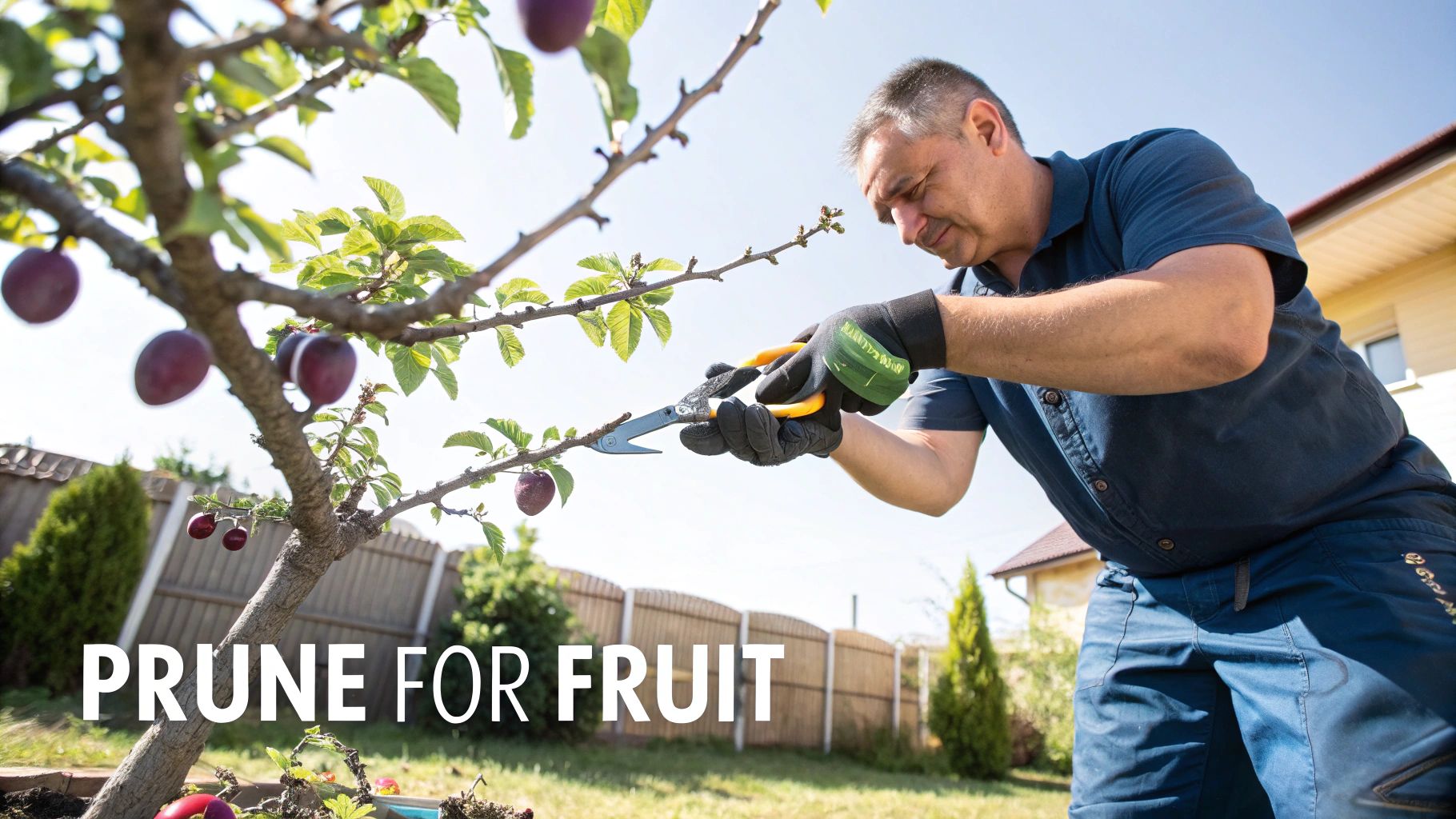
I get it—the thought of taking sharp tools to your precious plum tree can be intimidating. A lot of gardeners worry they’ll do more harm than good. But trust me, leaving a plum tree to its own devices is far worse. An unpruned tree quickly becomes a tangled, chaotic mess of weak branches that’s prone to disease and only gives you small, disappointing fruit.
Think of pruning as a conversation you're having with your tree. You’re guiding its growth, playing to its strengths, and helping it overcome weaknesses. This mix of horticultural know-how and creative shaping is what makes it both an art and a necessity. At the end of the day, the goal is simple: channel the tree's limited energy into what matters most—producing top-quality plums.
The Core Benefits of Pruning
Every single cut you make should have a purpose. It’s this strategic approach that directly impacts your tree’s health and the quality of your harvest.
We have a few primary goals in mind when we start pruning, which we've summarised below.
Pruning Objectives at a Glance
This table breaks down the main goals of pruning and how each one contributes to a healthier tree and a better harvest.
Pruning Goal | Benefit for Your Plum Tree | Impact on Harvest |
|---|---|---|
Improve Air Circulation | Reduces moisture on leaves, creating an environment hostile to fungal diseases like brown rot. | Healthier fruit with less chance of disease spreading from plum to plum. |
Increase Sunlight Penetration | Allows light to reach the inner branches, promoting even ripening and better fruit development. | Sweeter, more flavourful plums that ripen uniformly across the entire tree. |
Strengthen Tree Structure | Develops a strong framework of scaffold branches capable of supporting a heavy fruit load without breaking. | Prevents branch failure, ensuring you don't lose a significant portion of your harvest. |
Focus the Tree's Energy | Directs resources into fruit production instead of excessive vegetative growth. | Fewer, but significantly larger and higher-quality plums. |
Remove Unproductive Wood | Eliminates dead, diseased, or crossing branches that drain energy and harbour pests. | A more vigorous tree that can dedicate all its energy to producing healthy fruit. |
Ultimately, a well-pruned tree isn't just about looks; it's about setting the stage for the tree to perform at its absolute best, year after year.
Here’s a bit more on how those benefits play out:
Disease Prevention: By cutting out crowded and crossing branches, you open up the canopy. This simple change dramatically improves airflow, helping leaves dry out faster after rain. It makes the tree a much less welcoming place for fungal diseases like brown rot, which can be a real headache for Perth plum growers.
Bigger, Better Fruit: A tree only has so much energy to go around. Pruning reduces the total number of branches, concentrating that energy into growing fewer, but much larger and more flavourful, plums. It’s a perfect example of quality over quantity.
Sunlight is Everything: Sunlight powers fruit production. A well-pruned, open structure lets light penetrate deep into the tree, ensuring fruit ripens properly on the inside branches, not just on the sunny outer edges.
A well-pruned tree is not just about aesthetics; it's a fundamental practice for vigour and productivity. You are essentially setting the stage for the tree to perform at its absolute best, season after season.
Shaping Your Tree for Success
Here in Australia, there are two main shapes we aim for when pruning plum trees, and the one you choose often comes down to your garden space and what you prefer. The look of a beautifully pruned tree has become a fashionable garden feature, turning a functional plant into a living sculpture.
The ‘open vase’ (or ‘open centre’) shape is the most popular choice for plums. This involves removing the central main trunk early on to create a bowl-like structure with three to five main scaffold branches radiating outwards. This form is fantastic for maximising sunlight and airflow—perfect for encouraging a heavy crop and creating a stunning, architectural focal point in your garden.
The other option is the ‘central leader’ shape, which creates a more conical, Christmas tree-like form with one dominant upright trunk. This is often used in commercial orchards and works really well in tighter spaces.
Understanding these basic principles is your first step. If the job seems too big, or if your tree has been neglected for a few years, don't be afraid to call in a professional. The expert team at Swift Trees Perth can handle all your tree maintenance needs, ensuring your plum tree is healthy, safe, and ready for a spectacular harvest. Contact us today for a professional consultation.
Getting the Timing Right for Australian Climates
When you're learning how to prune a plum tree, getting the timing right isn't just a suggestion—it's everything. This is especially true here in Australia. For years, the old wisdom was to get out the saw in winter while the trees were dormant. But we know better now. Modern arboriculture has flipped that advice on its head, particularly for stone fruits like plums, all to minimise the risk of disease.
The biggest enemies of plum trees in our climate are nasty fungal and bacterial diseases, like silver leaf and bacterial canker. These pathogens absolutely love the damp, cool conditions of a typical Perth winter. Making fresh cuts on your tree during this time is like rolling out the welcome mat for infection, as the wounds are slow to heal.
That’s why the advice has changed so dramatically. The absolute best time to prune most plum varieties is in late summer, right after you've picked the last of that delicious fruit.
Why Late Summer is the New Standard
Pruning on a warm, dry day is the secret weapon every savvy gardener should have. The warmth and low humidity help the cuts dry out and seal over incredibly fast, sometimes within just a few hours. This rapid healing forms a natural barrier, slamming the door shut on pathogens trying to get a foothold.
This is especially critical for popular Japanese plum varieties like 'Satsuma' and 'Mariposa', which you'll find in backyards all over Australia. These trees fruit on wood that grew the previous year. Pruning them straight after you’ve finished harvesting ensures you don't accidentally chop off the very branches that will give you next season's crop.
European plums can be a little more forgiving, but sticking to that late summer window is still your safest bet for keeping diseases at bay. Of course, if you spot any dead, damaged, or diseased wood, you can—and should—cut it out any time of year. But save the main structural pruning for that post-harvest sweet spot.
The science is clear: shifting from traditional winter pruning to a post-harvest, late-summer approach has been shown to dramatically reduce disease incidence in stone fruit orchards. This simple change in timing is your best defence against common plum tree ailments.
According to leading Aussie fruit tree experts, this timing is paramount. The goal is to prune on a warm, dry day with a bit of a breeze—it helps the cuts dry out and can slash the infection rate. This modern approach is a world away from the old winter-pruning advice, with trials showing disease reduction of 40-50% when pruning is moved to summer. It also opens up the canopy to better light and airflow, which can boost your yield by up to 25% in the seasons that follow.
Tailoring Your Schedule to Perth's Climate
Even across the Perth metro area, there can be slight differences in timing. If you’re gardening in the cooler, more humid Perth Hills, you’ll want to be extra careful about picking a truly dry, breezy day. Down on the warmer coastal plain, you’ll find your pruning cuts probably dry out even faster. The key is simply to pay attention to the weather.
Here’s a quick reference for your pruning calendar:
Main Structural Pruning: Late summer is your go-to. In Perth, this is usually February to March, right after the final harvest.
Target: All the healthy branches that need shaping, thinning, or shortening.
Deadwood Removal: Do this whenever you see it. A dead or broken branch should be removed as soon as you spot it.
Weather Check: Always, always aim for a dry, sunny day with low humidity. Don't prune if there's rain in the forecast for the next 24-48 hours.
Understanding why you’re pruning at a certain time is just as important as knowing when. For a deeper look at the specifics for different fruit trees, our detailed guide on when to prune fruit trees in Perth is a great place to start.
Making this one simple shift in your gardening calendar is one of the most powerful things you can do to keep your plum tree healthy, strong, and productive for many years.
Getting Your Pruning Toolkit Ready
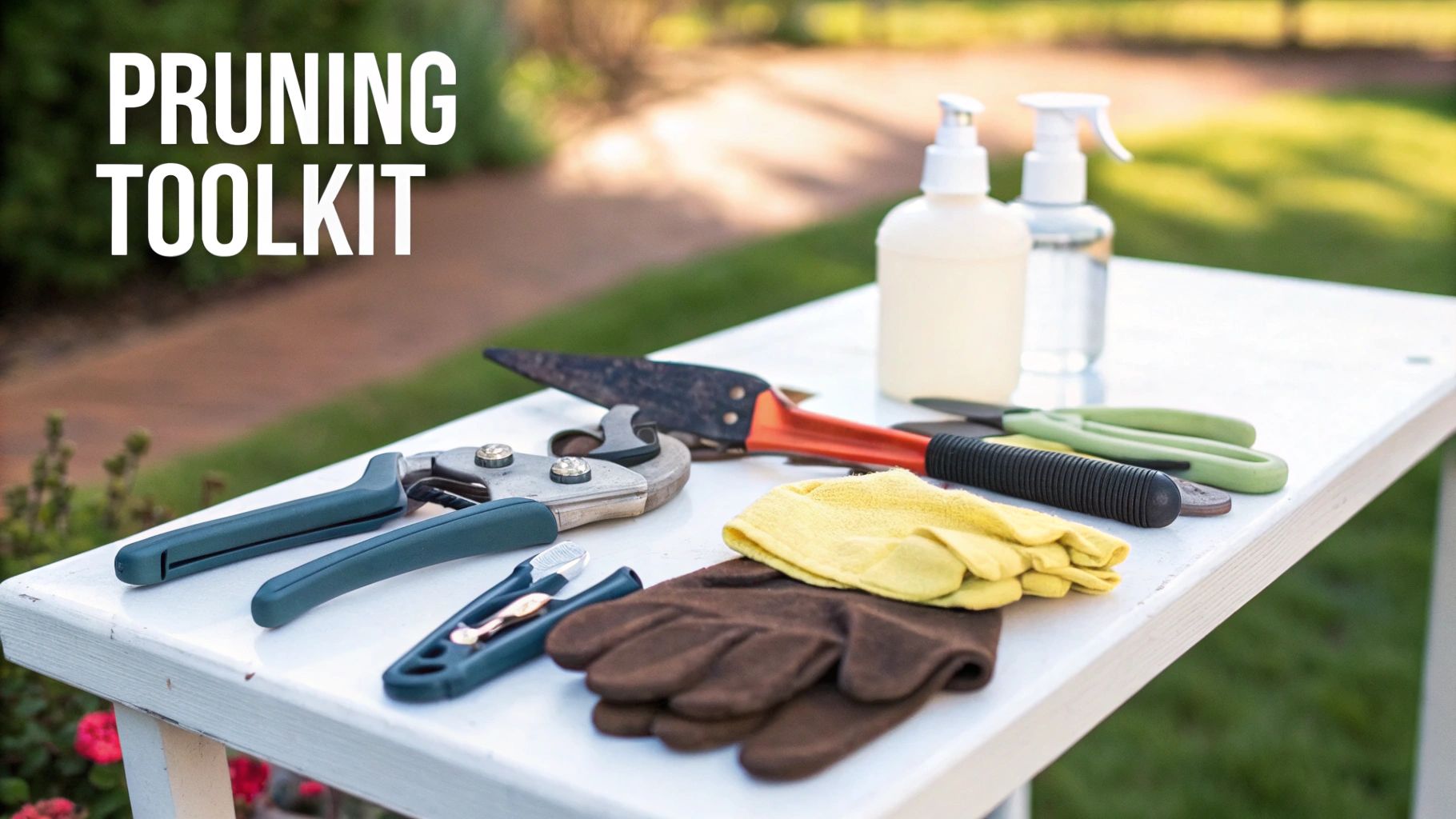
Trying to prune a plum tree with the wrong tools is a recipe for disaster. It’s a bit like attempting to cook a gourmet meal with a butter knife—you might get there in the end, but the results won't be pretty and you’ll cause unnecessary damage.
Having the right gear turns a frustrating chore into a satisfying job. More importantly, it ensures your cuts are clean, precise, and heal quickly, which is a massive win for your tree's long-term health. Think of good tools as an investment.
The heart of any pruning kit is a sharp pair of secateurs. But here’s where a bit of professional insight comes in handy: you absolutely must choose bypass pruners over anvil types for cutting live wood. Anvil pruners crush the branch as they cut, damaging the cells and leaving a wound that’s slow to heal and open to disease.
Bypass pruners, on the other hand, have two curved blades that slice past each other like scissors. This gives you a clean, surgical cut that the tree can easily seal over, minimising stress and the risk of infection.
Choosing the Right Tool for the Branch
Having a small arsenal of tools means you can tackle any branch with confidence and make the perfect cut every time. Here’s a quick rundown of what you’ll need to prune your plum tree properly.
Bypass Secateurs: These are your go-to for the small stuff. Perfect for snipping off twigs and thin branches up to about 1.5 cm in diameter, and ideal for detailed shaping work on young growth.
Loppers: Think of these as beefed-up secateurs with long handles. That extra leverage lets you slice through branches from 1.5 cm up to 5 cm thick without breaking a sweat. They're essential for removing any medium-sized branches.
Pruning Saw: When a branch is too chunky for your loppers, it’s time to bring out the pruning saw. Their sharp, serrated blades are designed to cut on the pull stroke, giving you way more control and a much cleaner finish on larger limbs.
The Non-Negotiable Step: Tool Hygiene
Here’s a tip straight from professional arborists that every home gardener should live by: sterilising your tools is not optional. It’s incredibly easy to spread diseases from one tree to another—or even from one branch to another—on dirty blades.
A quick wipe-down of your blades with a rag soaked in methylated spirits before you start and between each tree is your best line of defence. This simple step is one of the most effective ways to prevent the spread of nasty diseases like bacterial canker.
And finally, don't forget about your own safety. A decent pair of gardening gloves will save your hands from blisters and scratches, while safety glasses are a must to protect your eyes from flying woodchips and sawdust. A safety-first mindset is the mark of a truly skilled gardener.
If you’re looking at large branches and feeling a bit out of your depth, or you simply don't have the right equipment, the safest bet is to call in a professional. The team at Swift Trees Perth has all the gear and experience needed for any tree maintenance job. Contact us for a free, no-obligation quote to keep your trees healthy and looking their best.
Mastering Pruning Cuts for Young and Mature Trees
Knowing how to prune a plum tree is about more than just timing; it's about understanding what to cut based on the tree's age. A young, whippy sapling needs a completely different touch than a mature, fruit-bearing veteran. Each stage has its own goals, and mastering the right cuts is the key to a lifetime of healthy growth and incredible harvests.
For a young tree, the mission is all about structure. In its first one to three years, you’re not pruning for fruit—you're building its future. This is called formative pruning, and it’s where you lay the foundation for a strong, well-balanced tree that can support heavy crops without its limbs snapping.
With a mature tree, the focus shifts to maintenance and productivity. The goal moves from building a frame to keeping it open, healthy, and full of the right kind of fruiting wood.
Shaping Young Trees for a Strong Future
When you plant a young plum tree, those first few cuts are the most important it will ever receive. You're establishing a solid framework, and for most backyard growers here in Perth, the open-vase shape is the gold standard. It creates a beautiful, bowl-like structure that lets sunlight and air right into the centre of the canopy.
To get this shape, you'll be making a couple of specific cuts:
Heading Cuts: This just means shortening a branch rather than removing it completely. Cutting back the main leader and side branches encourages the tree to bush out with new shoots just below the cut, creating a denser structure.
Scaffold Selection: This is the fun part. You get to choose three to five strong, well-spaced branches that radiate out from the trunk. These will become the main 'scaffold' limbs—the primary structure of the tree. Get rid of any that are too close together, growing at weak, narrow angles, or just look a bit flimsy.
For instance, if you have a one-year-old 'whip' (a young tree with no branches), you’d make a heading cut at about 75 cm from the ground. This tells the tree to start developing its first scaffold branches right below that point. The next year, you’d pick the best of those new branches and shorten them by about a third to encourage even more branching.
Maintenance Pruning for Mature Trees
Once your plum tree has its basic framework down (usually after three or four years), your pruning strategy changes. Now, it's all about maintenance. The goal is to keep the tree productive and healthy by removing specific types of wood and holding onto that open, sunny shape you worked so hard to create.
The first rule of thumb is to tackle the 'Three Ds':
Dead: Any branches that are brittle, grey, and lifeless have to go. They're doing nothing for the tree and can become a home for pests.
Diseased: Keep an eye out for branches with cankers, weird growths, or discoloured bark. Cut these back well into healthy wood to stop any infection from spreading.
Damaged: Branches that are broken, cracked, or rubbing against each other are an open invitation for disease. If two branches are crossing, remove the weaker one.
After dealing with the 'Three Ds', you can move on to thinning cuts. This means removing an entire branch right back to where it started. Thinning is absolutely vital for stopping the canopy from becoming a crowded, tangled mess. By taking out competing branches and those annoying 'water sprouts' (the vigorous, bolt-upright shoots), you improve airflow and let sunlight reach the inner fruiting wood. That's what gives you bigger, sweeter plums. For example, if two healthy branches are growing parallel and just a few centimetres apart, creating a dense patch of leaves, you would perform a thinning cut to remove one of them entirely, instantly opening the space up.
When you're pruning a mature tree, 'less is more' should be your mantra. Try not to remove more than 20-30% of the canopy in one year. Hacking it back too hard will just shock the tree, causing it to send up a defensive jungle of unproductive water sprouts.
A Real-World Scenario: Rejuvenating a Neglected Tree
So, what happens if you've inherited a plum tree that hasn't seen a pair of secateurs in years? The biggest mistake people make is trying to fix it all in one go with an aggressive prune. This will only stress the tree, leading to a mess of weak, rampant growth.
The right way to do it is with a gradual rejuvenation over two or three seasons.
Year One: Start simple. Remove all the dead, diseased, and damaged wood. This alone can make a world of difference. Next, identify the main scaffold limbs and take out any major branches that are crossing or growing back towards the centre. Then, stop. That's it for year one.
Year Two: Now that you can see what you're working with, you can focus on thinning out the canopy. Remove about a quarter of the remaining overcrowded branches to let more light and air in. You can also shorten some of the tallest limbs to bring the tree's height down to a manageable level.
Year Three: Time for the final touches. Make your final thinning cuts to refine the shape and make sure the tree has a well-balanced, open structure.
This patient, multi-year approach lets the tree recover and put its energy into producing healthy new growth and, eventually, delicious fruit. The longevity of plum trees in Australia is amazing when they're managed correctly. Data from the Australian prune sector shows that while trees take 4-6 years to produce their first significant harvest, proper pruning ensures they can remain highly productive for about 30 years. You can explore more data on how pruning sustains the Australian plum industry and impacts yield over a tree's lifespan.
Whether you're shaping a young sapling or taming a mature giant, the right cut makes all the difference. If you’re feeling a bit out of your depth, don’t hesitate to get a professional opinion. For expert advice and tree maintenance services in the Perth area, contact Swift Trees Perth today.
Post-Pruning Care and Troubleshooting Common Issues
Once you've made the final cut, it’s tempting to pack up the tools and call it a day, but the job isn't quite finished. What you do immediately after pruning is just as crucial for your plum tree's health and recovery. Think of it as setting the stage for vigorous new growth and heading off common problems before they can take hold.
A key insight from modern arboriculture is to ditch the wound sealant. For decades, gardeners were told to paint over pruning cuts, but we now know this often does more harm than good. Sealing a wound can trap moisture and create an ideal breeding ground for fungal and bacterial diseases. A clean, precise cut on a healthy tree will heal itself far more effectively.
Kickstarting the Recovery Process
Your first task is a thorough clean-up. Don't leave pruned branches and leaves lying around the base of the tree—this debris is an open invitation for pests and diseases to overwinter, only to re-emerge next season. Rake everything up. If the wood was healthy, you can chip it for mulch or save it for kindling. If you removed diseased branches, get them in your green waste bin; don't compost them.
Next, give your tree the support it needs to heal and grow. A good feed and proper watering will help it bounce back from the stress of pruning.
Watering: Give the tree a deep watering at its base to ensure moisture reaches the entire root system. Consistent moisture is key to recovery.
Feeding: Apply a balanced, slow-release fertiliser formulated for fruit trees around the dripline. This replenishes nutrients and supports the development of new, healthy shoots.
Mulching: Spreading a generous layer of organic mulch is one of the best things you can do. It helps retain soil moisture, suppresses weeds, and gradually improves soil structure as it breaks down. Learn more about why mulch is so important for Perth gardens in our detailed guide.
This visual guide shows how your pruning approach should change as a plum tree moves through different life stages.
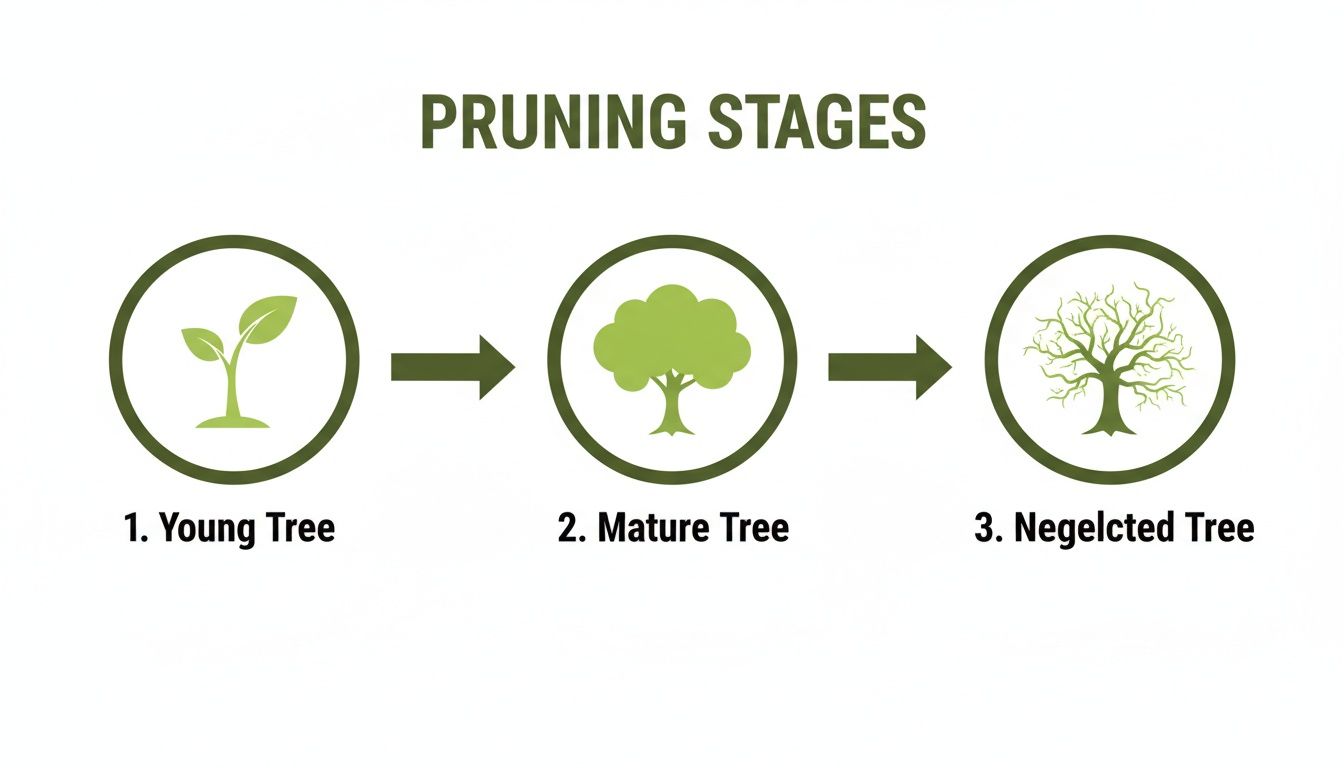
As you can see, pruning evolves from shaping a young tree to maintaining a mature one and, sometimes, to rejuvenating a neglected one.
Managing Common Pruning Problems
Even with the best intentions, issues can pop up. Knowing how to troubleshoot them will keep your plum tree on the right track.
One of the most common reactions to a heavy prune is a sudden burst of 'suckers' or 'water sprouts'. These are the tree’s panicked response to losing a lot of its canopy at once. They grow straight up, are very weak, and won't produce fruit.
If you see these vigorous shoots appearing from the base (suckers) or from branches (water sprouts), just rub them off with your thumb while they're still small and green. If they've had a chance to get woody, you’ll need to snip them off with your secateurs. To ensure your plum tree remains healthy, it's crucial to be vigilant about common issues; learn more about identifying and stopping plant diseases that could affect your garden.
If you step back and realise you’ve accidentally over-pruned, don't panic. The best thing to do is provide excellent aftercare—plenty of water and a good feed—and then leave it alone for the rest of the season to recover. For a tree struggling with complex issues or in need of significant corrective pruning, professional help is the safest option. The experienced team at Swift Trees Perth can assess your tree’s health and develop a plan for its recovery. Contact us today for expert tree maintenance and peace of mind.
When to Call in a Professional Arborist in Perth
Learning to prune your own plum tree is a fantastic, rewarding skill. But knowing when to put the tools down and pick up the phone is the mark of a truly smart gardener. Some jobs just aren't suited for a DIY approach and need the experience of a professional arborist to keep both you and your tree safe.
Knowing the difference is critical. If your tree has gotten to the point where you're climbing a ladder with a saw, the risk of a serious fall becomes very real. And it goes without saying, any branches getting tangled up with power lines are strictly off-limits for anyone but a qualified professional.
Scenarios That Demand Expert Help
Some pruning challenges call for more than just a standard set of tools; they require specialised knowledge and equipment. Tackling these tasks without the right training can easily lead to property damage, serious injury, or doing irreversible harm to your tree.
It's time to call an expert when you're facing:
Large, Mature Trees: Big, established trees often mean dealing with heavy limbs that can fall in unpredictable ways. A pro uses specific rigging techniques to bring down large branches safely, piece by piece.
A Tricky Disease Diagnosis: If you're seeing widespread cankers, a lot of dieback, or strange growths that don't look right, an arborist can properly diagnose what's going on and map out a treatment plan.
Working Close to Structures: Pruning branches that hang over your house, shed, or fence requires a level of precision that's hard to achieve without experience. One wrong cut can be very costly.
Understanding when to call an arborist for your tree is just like knowing when to call any other specialist for your home. These general tips for hiring licensed professionals for property services are a great starting point for ensuring you get quality work in any area of home maintenance.
A qualified arborist doesn't just show up with a bigger chainsaw. They bring a deep understanding of tree biology, local Perth conditions, and Australian safety standards to the job. This expertise means every single cut is made with the tree's long-term health as the top priority. If you want to get into the nitty-gritty, you can learn more about the differences between arborists vs tree surgeons in our guide.
If your plum tree presents a challenge that feels beyond your comfort zone, don't hesitate. For safe, effective, and professional tree care across the Perth metro, the qualified team at Swift Trees Perth is here to help. Contact us today for an expert chat and make sure your trees stay healthy, beautiful, and safe for years to come.
Got Questions About Pruning Plum Trees?
Even with the best guide in hand, it's natural to have questions when you’re standing in front of your tree, secateurs at the ready. Getting these common queries sorted is the best way to build your confidence and make sure you’re giving your plum tree exactly what it needs.
Let's clear up a few things I get asked all the time.
How Much Can I Really Cut Back?
This is probably the number one concern I hear from Perth gardeners: "How much is too much?" It’s a great question because going overboard can seriously shock the tree.
As a golden rule, stick to the one-third principle: never remove more than one-third of the tree’s total canopy in a single season. If you get too aggressive, the tree panics. It throws out a chaotic mess of weak, vertical shoots called water sprouts, which are basically a stress response. They won’t produce fruit and you’ll just have to prune them off later anyway.
A steady, considered approach is always better than a sudden, drastic haircut. This keeps the tree’s energy in balance and encourages it to focus on what you want: delicious plums.
Should I Prune for Shape or for Fruit?
The answer really depends on how old your tree is. The goals are quite different for a young tree versus an established one.
For a young tree in its first 1-3 years, it's all about building a strong foundation. This is called formative pruning. Your main job is to create a solid, open-vase framework by selecting strong scaffold limbs and making heading cuts to encourage good branching. Think of it as creating the perfect skeleton for future growth.
Once the tree is mature, your focus shifts entirely to fruit production. This is maintenance pruning. Now, you're mostly making thinning cuts to get rid of crowded or dead wood, letting that beautiful Perth sun and air circulate through the canopy. You’re preserving the shape you already built, but the main goal is to give the fruiting wood the best possible chance to thrive.
Can I Prune My Plum Tree in a Perth Winter?
While you might see older gardening books recommending winter pruning, we now know that’s not the best advice for our local climate. Perth’s mild, damp winters are the perfect breeding ground for nasty fungal and bacterial diseases, especially silver leaf. A fresh pruning cut in winter heals slowly, leaving the tree wide open to infection.
The modern, much safer approach is to prune in late summer, right after you’ve finished harvesting. The warm, dry air helps the cuts seal over quickly, creating a natural shield against disease. This simple timing tweak is one of the most effective ways to reduce disease risk for your plum trees here in WA.
"Why are there no plums on my tree after I pruned it?" This is a frustrating one, for sure. It usually comes down to a few culprits: you might have accidentally snipped off the one- or two-year-old wood that actually produces the fruit, pruned too heavily and stressed the tree, or you might have a pollination issue.
Sometimes, the problem isn't your pruning at all. A young tree might just need another year or two to mature. Or, your plum variety might need a different variety planted nearby for cross-pollination to happen. Taking a close look at these factors will help you figure out what’s going on and get you back on track for a great harvest.
Navigating the ins and outs of pruning can feel complex, especially if you're dealing with a big, old, or neglected tree. If you're feeling a bit out of your depth or the job just seems too big to handle, the qualified arborists at Swift Trees Perth have the experience to get your plum tree healthy, safe, and productive again.
Whether you need a one-off structural prune or a comprehensive maintenance plan, our team has the skills to help. For professional tree care and complete peace of mind, contact us at Swift Trees Perth for a free consultation and let's get your trees in perfect shape.
Comments