
A Homeowner's Guide to Storm Damaged Tree Removal in Perth

After a storm has ripped through, the first thing on your mind is getting outside to see what’s happened. But before you even think about storm damaged tree removal in Perth, the absolute first priority is making sure the area is safe. This isn't about tidying up; it's a critical damage assessment to spot immediate dangers that could put you and your family at risk.
The Aftermath of the Storm: Your Immediate Safety Checklist
The moments after a severe Perth storm can feel chaotic. The wind and rain have finally stopped, but some of the biggest risks are now lurking in plain sight. Before you grab a rake or start dragging branches, your job is to take a breath, stand back, and get your bearings. This initial safety sweep is the single most important thing you'll do.
The main goal here is to spot and cordon off any immediate threats. The combination of fierce winds and waterlogged soil, a classic scenario from Duncraig down to Morley, can leave trees incredibly unstable. Your backyard can quickly become a genuine hazard zone.
Prioritise Personal Safety Above All Else
The number one rule is simple: stay well back. It’s tempting to rush out and inspect the damage up close, but the area is littered with hidden dangers. The most critical one? Powerlines.
You must assume every single downed line is live. Western Power constantly reminds us that a wire that looks dead can be re-energised without warning, making any contact potentially fatal. A practical example of this danger is a fallen branch resting on a power line; if you touch the damp branch, you could be electrocuted.
Keep a minimum distance of 10 metres from any fallen utility lines. If a tree or a big branch is tangled up in wires, consider that entire area electrified. Don't touch the tree, don't touch a nearby metal fence—don't touch anything. Treat it as an absolute no-go zone.
Identifying Critical Tree Hazards from a Distance
From your safe spot, give your trees a good scan. You’re looking for the big, obvious signs of distress—the kinds of problems that could lead to a tree falling in the next few minutes or hours.
Sudden Leaning: A big old Jarrah that was standing straight yesterday is now tilting on a sharp angle. That’s a massive red flag. Saturated ground can cause the entire root plate to lift, meaning the whole tree could go over without any further warning.
Split Trunks: Look for deep, fresh cracks running up the main trunk. This is a sign of catastrophic failure. The tree is literally tearing itself apart and could collapse at any moment.
Hanging Branches ('Widow-Makers'): These are the classic post-storm threat. Large, heavy branches that have snapped off but are still caught high up in the canopy. They are notoriously unstable and can drop with the slightest gust of wind, posing a lethal threat to anyone underneath.
This simple guide sums up the essential flow of action you need to take right after a storm.
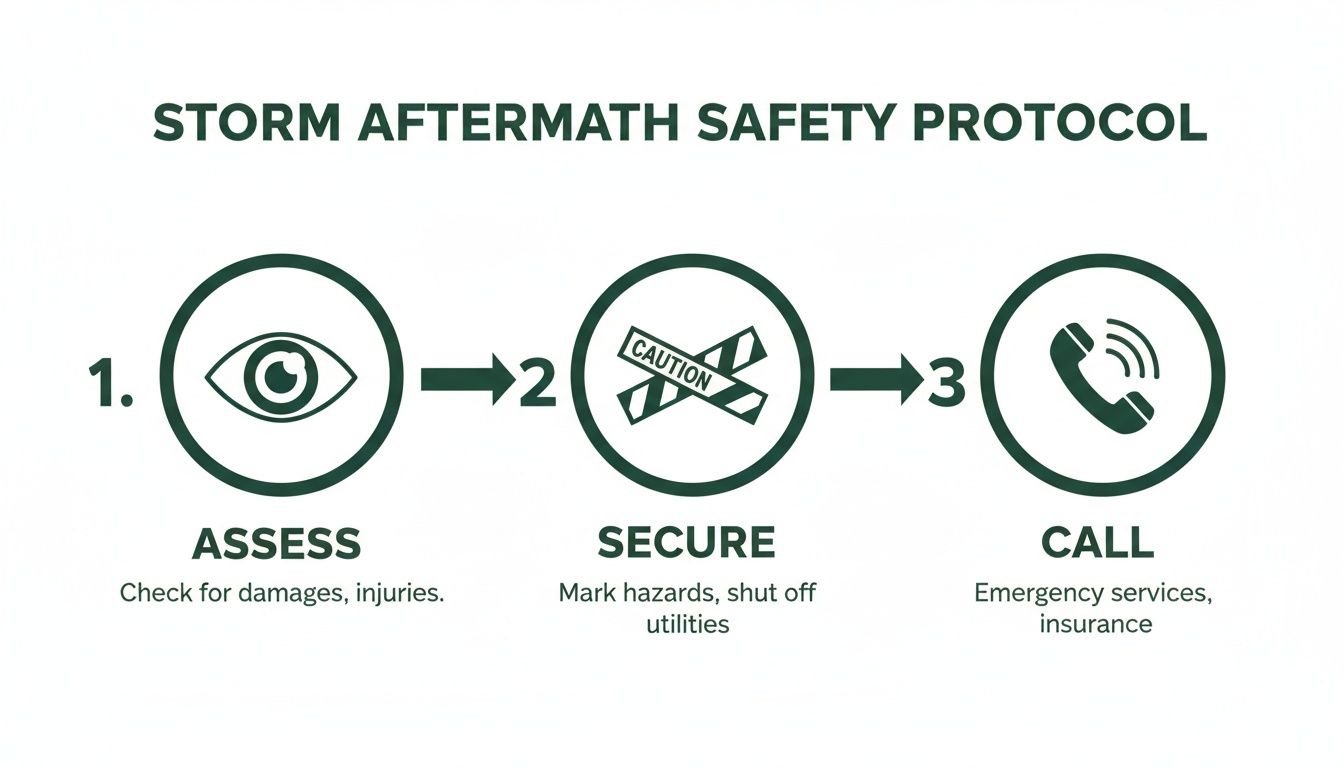
The key takeaway here is a hands-off approach. Your job is observation and calling in the pros, not risky DIY heroics.
Your responsibility in these first moments is not to fix the problem, but to prevent it from getting worse. Securing the area and making the right phone calls are the most powerful actions you can take.
Once you’ve spotted these clear and present dangers, your next move is to secure the area. Grab some rope, garden hose, or whatever you have to create a clear "do not enter" zone to keep family, pets, and even well-meaning neighbours out of harm's way. It’s a small step that can prevent a tragedy. For a deeper dive into what to look for, check out our other storm safety tips.
This is where your part in the physical work ends and the professionals take over. Trying to prop up a leaning tree yourself or cut down a hanging branch is a massive gamble. Storm-damaged timber is under immense and unpredictable tension. It can cause a chainsaw to kick back violently or make a branch swing in a direction you never saw coming.
When it comes to any storm damaged tree removal, your safety is what matters most. Taking these cautious first steps is non-negotiable. Once you've made the area safe, it's time to call in the experts who have the training, insurance, and equipment to handle the mess safely.
Assessing the Damage: When to Call a Professional Arborist
Once you’ve made sure the immediate area is safe, it’s time for a closer look at your trees—from a distance, of course. This is your chance to figure out if you're dealing with a simple cleanup job or a situation that needs an expert eye for storm damaged tree removal. Knowing what to look for is the key difference between saving a valuable tree and facing a much bigger, more dangerous problem down the track.
This initial check isn't about you making the final call. It's about gathering good information to give a qualified arborist. Some damage looks dramatic but is only superficial, while other, less obvious issues can be a death sentence for the tree.
Differentiating Minor from Major Damage
Not all broken branches are created equal. A few small limbs snapped off a mature gum tree is one thing; major structural failure is a whole other ball game.
A good rule of thumb we use in the industry is the 50% rule: if a tree has lost more than half of its main branches or crown, its chances of making a full recovery are pretty slim.
You can usually handle clearing small, fallen twigs and branches yourself, as long as they're well away from any hazards. But bigger problems demand a professional.
Minor Damage: Think small, fallen branches (less than 15 cm in diameter) and some leaves stripped from the canopy. This is typically stuff you can clear from paths and lawns on your own.
Moderate Damage: This is where you see larger broken branches still hanging up in the tree, or significant tears in the bark on the main trunk. This always needs a professional assessment.
Severe Damage: A split trunk, a tree that's now leaning from the base, or the loss of a major limb that throws the whole tree off balance. This is a genuine emergency.
Never underestimate the forces at play within a damaged tree. A cracked branch can hold thousands of kilograms of tension, and a compromised trunk can fail without any further warning. Your safety is paramount.
Critical Signs a Tree Is Unsafe
Some red flags are subtle, but others are impossible to miss. One of the most dangerous situations is a split co-dominant stem. This is where a tree has two or more main trunks growing from the same point, and the storm has forced them apart, creating a deep split. This kind of wound rarely heals properly and makes the tree extremely prone to failure.
It’s also crucial to look down at the base of the tree. Can you see the ground lifting or cracking on one side? That’s a tell-tale sign the root system has failed. The tree is no longer anchored and is a major falling hazard.
The statistics on this are sobering. Research in Australia has shown that 68% of fatalities from tree failures happen during storms or high winds, which is a constant risk here in Perth. Saturated soils after heavy rain contribute to another 18% of tree failures, making these post-storm checks absolutely vital. You can read more about the safety aspects of storm season tree work to understand the risks involved.
Tree Damage Assessment DIY vs Professional
Deciding whether to grab the chainsaw or the phone can be tricky. This table should help you make a quick, safe decision for your Perth property.
Type of Damage | DIY Action (If Safe) | When to Call Swift Trees Perth Immediately |
|---|---|---|
Small Fallen Branches | Clear from paths if under 15 cm diameter. | If they're tangled in power lines or are too heavy to move safely. |
Large Hanging Branches | Stay clear. Do not attempt to pull down. | Always. These are known as 'widow-makers' for a reason. |
Split Trunk | Cordon off the area immediately. | This is an emergency. The tree's structural integrity is compromised. |
Leaning Tree | Evacuate the area in the direction it could fall. | Immediately. The root system has likely failed. |
Torn Bark on Trunk | Leave it. Trying to 'fix' it can cause more harm. | If the tear is large or deep, as it's an entry point for disease. |
More Than 50% Crown Loss | Clear fallen debris on the ground only. | Always. The tree may not be viable and needs expert assessment. |
Ultimately, this table is just a guide. If you're ever in doubt, the safest bet is always to get a professional opinion.
When a Professional Assessment Is Non-Negotiable
A quick walk-around is a good first step, but it won’t reveal hidden dangers like internal decay or hairline stress fractures that only a trained arborist can spot. A fashionable insight in modern arboriculture is the use of non-invasive tools like sonic tomographs, which can create a 3D image of a trunk's interior to detect decay without harming the tree—technology a homeowner simply won't have access to.
Calling an expert isn't just about getting a quote for removal; it’s about getting an accurate diagnosis. A skilled arborist might find that a prized tree can be saved with strategic pruning and cabling, preserving a beautiful feature of your property for years to come.
So, if a tree is large, stands near your house or a neighbour's, or shows any of the major warning signs we've discussed, the decision is simple: call a professional. Don't risk your home or your safety.
For a reliable assessment of your trees after a storm, the expert team at Swift Trees Perth is here to help. Contact us for peace of mind.
The Dangers of DIY Tree Removal: Why It's Not Worth the Risk
After a big storm rolls through, it’s natural to want to get outside and start cleaning up. The sight of a fallen branch or a leaning tree can trigger the impulse to grab the chainsaw and get stuck in. It feels productive, like you’re taking control and saving a bit of cash in the process.
But here’s the hard truth from someone who’s seen it all go wrong: tackling storm damaged tree removal yourself is one of the most dangerous jobs you can attempt around the home. The potential cost of getting it wrong is massive, and it’s a gamble that’s just not worth taking.
The risks go way beyond just slipping off a ladder. Trees that have been thrashed by high winds are loaded with incredible and unpredictable tension. A heavy branch that looks stable can snap and whip back with brutal force. A trunk can suddenly shift or roll the moment you start cutting.
Hidden Hazards Beyond the Obvious
Many people seriously underestimate the raw power of their equipment. Chainsaw kickback, for instance, isn’t some minor jolt. It’s a violent, upward thrust of the saw that happens in a split second, and it’s a leading cause of severe injury even for seasoned professionals, let alone someone working in an unstable, post-storm environment.
But the tree itself is the biggest wildcard. Just think about these all-too-common scenarios we see in Perth suburbs after every storm:
A massive limb has crashed onto a roof in a Scarborough home. You try to cut it into smaller pieces, but that releases the tension. The remaining weight shifts, sending the rest of the branch smashing through the tiles and ceiling, causing thousands more in damage.
A tree is leaning precariously over your neighbour's fence in Joondalup. One poorly planned cut is all it takes to send the whole thing crashing down in the wrong direction. Now you've destroyed their fence and maybe damaged their shed, sparking a costly and stressful dispute.
A tree is partially uprooted but still feels solid. The root plate is actually hanging on by a thread. The vibration from your chainsaw is enough to finish the job, causing the entire tree to fail and come down without any warning at all.
These aren't just hypotheticals; they are cautionary tales that play out time and again.
A professional arborist doesn't just cut a tree down; they dismantle it. They work systematically, controlling the fall of every single piece with specialised rigging and years of training. It’s a calculated process that simply can’t be replicated with a ladder and a Bunnings chainsaw.
The Financial Fallout of a DIY Disaster
Putting aside the very real physical danger, a DIY attempt can quickly spiral into a financial nightmare. One of the biggest things people overlook is how their actions might impact their home insurance.
Most insurance policies contain clauses about taking "reasonable care" to prevent further damage. If your untrained attempt at tree removal leads to a branch falling on your house, the insurer could easily argue that this was a negligent act. That could give them grounds to deny your claim, turning what you thought was a cost-saving measure into a devastating out-of-pocket expense. Your policy might cover the initial "act of God," but it’s far less likely to cover a self-inflicted accident. To learn more, check out these common DIY tree care mistakes and why you should leave it to the professionals.
Hiring a professional service with full insurance coverage isn't just an expense—it's an investment in your safety, your property, and your peace of mind. The specialised gear, the rigorous training, and—most importantly—the comprehensive insurance a team like Swift Trees Perth carries protects you from all of it.
Don't gamble with your safety or your home. For expert advice and the safe, efficient handling of your storm-damaged trees, contact Swift Trees Perth and let us take care of it the right way.
Navigating Insurance and Perth Council Regulations
After a storm rolls through, the physical cleanup is just one part of the puzzle. The next challenge? Dealing with insurance providers and local councils, which can feel just as daunting as the storm damaged tree removal itself. It’s a maze of paperwork, phone calls, and specific rules that can be tricky to handle, but getting it right is the key to a smooth, cost-effective recovery.
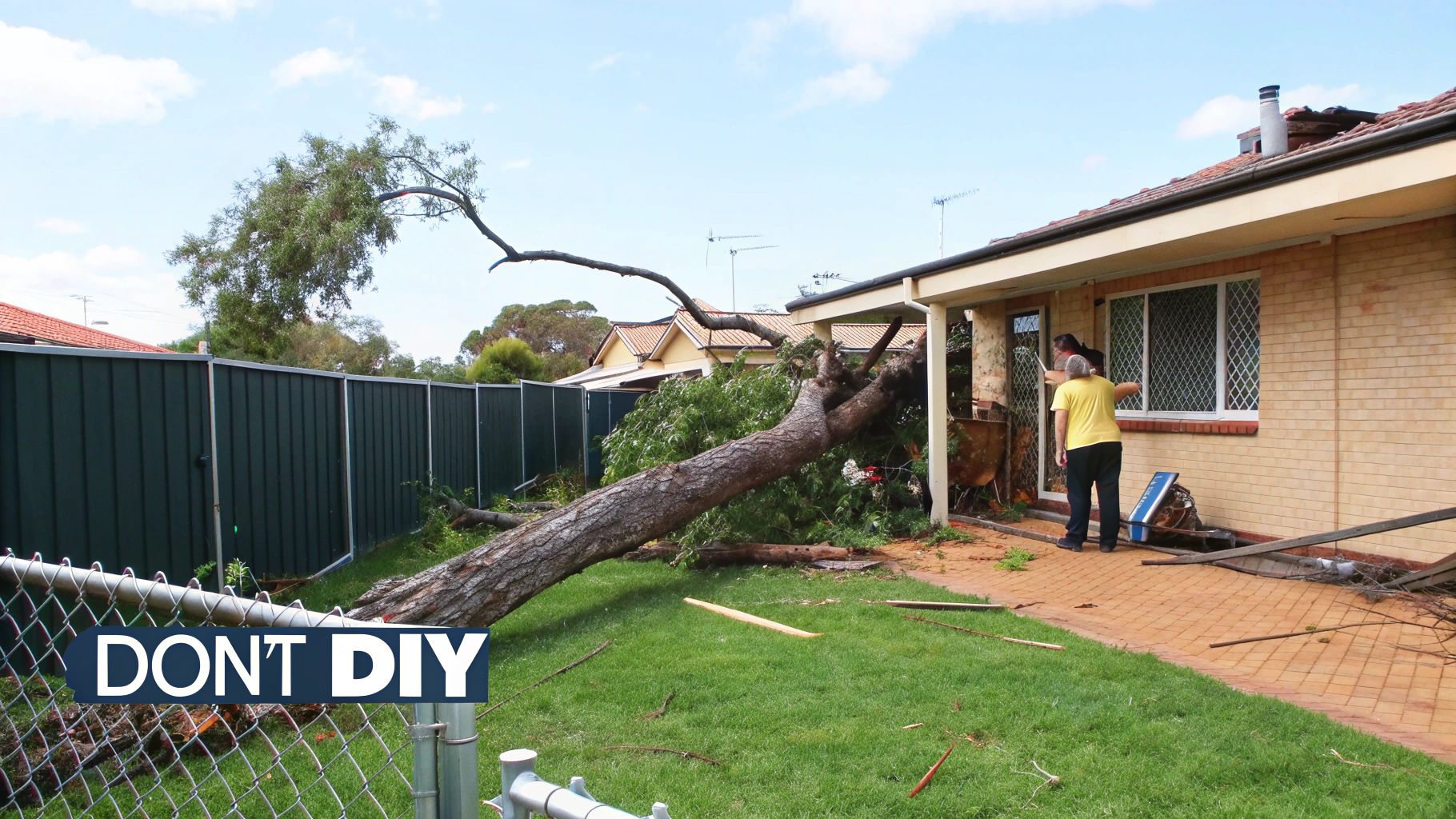
Successfully managing this administrative side starts with clear, methodical action. It’s all about knowing what to document, who to call, and what questions to ask to protect your financial interests and stay on the right side of the law.
Demystifying Your Insurance Claim
Your first instinct might be to get on the phone to your insurance company straight away, but it pays to take a few moments to prepare. A well-documented claim is an easily processed claim.
Before you touch a thing (unless it’s an immediate safety hazard), grab your phone. Take plenty of photos and videos of absolutely everything. You want to capture the damage from multiple angles—get up close to show specific points of impact, then take wider shots to give a clear picture of the whole situation. A common scenario we see after a storm is a fallen tree on house, and understanding your policy’s fine print for such events is vital.
Insurers often won't cover the removal of a tree that simply fell in your yard without hitting anything. However, they are far more likely to cover the costs if that same tree has damaged an insured structure like your house, shed, or driveway. Your photo evidence is the key to proving this.
When you do call your provider, have your policy number ready and be prepared to give a clear, concise description of the damage. They will almost certainly ask for a professional arborist's report to assess the scope of the work. A formal report not only details the necessary removal work but also provides a credible, third-party assessment that can significantly speed up your claim's approval.
Understanding Perth's Council Rules
It's a common misconception that if a tree is on your property and damaged, you can do whatever you want with it. In Perth, that’s far from the truth, especially in suburbs with protected tree canopies like Floreat or Mount Lawley.
Even a tree that looks wrecked might be protected by a Tree Preservation Order (TPO) or fall under significant tree regulations. Trying to remove it without the proper permissions can land you with a massive fine. For instance, a homeowner in Nedlands was recently fined over $10,000 for removing a protected Eucalypt without a permit, even though they claimed it was damaged.
The rules vary between councils, so what applies in Wembley might not be the same for Greenwood or Morley. In many cases, even damaged trees over a certain size require a permit, an arborist report, or a heritage assessment before any work can begin. Ignoring this can lead to fines running into the thousands of dollars.
So, how do you stay compliant? Your first stop should be your local council’s website. Most have a dedicated section for tree regulations where you can often search your address or review maps of protected trees.
City of Stirling: Known for its stringent rules on significant trees, requiring detailed applications even for pruning.
City of Joondalup: Has a clear register of significant trees that are protected under their local planning scheme.
City of Nedlands: Heavily regulates its urban forest, with specific rules for trees of a certain size or species.
Working with a professional arborist who understands these local nuances is your best defence against accidentally breaking the law. For a deeper dive, you can explore our resources on permits for regulated trees.
Of course, the best way to avoid these post-storm headaches is to be proactive. To ensure your trees are healthy, stable, and council-compliant before the next storm season hits, contact Swift Trees Perth for an expert assessment and all your tree maintenance needs.
What to Expect from Professional Tree Removal Services
You’ve made the right call by deciding against a risky DIY job and reaching out to the pros. So, what happens next?
Knowing what goes on during a professional storm-damaged tree removal can give you some real peace of mind. It’s a systematic process that puts safety first, works efficiently, and aims to leave your property in better shape than they found it.
The Initial Site Assessment and Quote
First things first, a qualified arborist will come out to your property for a thorough on-site assessment. They’re not just glancing at the tree that needs to go; they're analysing the entire environment around it.
This involves spotting potential hazards like nearby powerlines, your house, fences, and garden beds. They'll check the tree's stability, the type of wood, and just how bad the damage is to map out the safest and most effective plan of attack.
Based on this detailed look, you'll get a transparent, itemised quote. This should clearly break down every part of the job, from the removal itself to hauling away debris and grinding the stump. There shouldn't be any hidden fees or surprises—that’s the mark of a reputable company.
Planning and Executing the Removal with Precision
With a solid plan locked in, the real work begins. This is where you see professionalism in action.
Safety is the number one priority, without a doubt. The crew will set up a clear exclusion zone to keep everyone on and near the property safe.
Watching a complex removal is like a carefully choreographed performance. It’s not about brute force; it’s all about control and precision.
Rigging Techniques: For big trees or those wedged in tight spots, arborists use a specialised system of ropes, pulleys, and friction devices. This lets them lower huge sections of the tree to the ground with complete control, avoiding any damage to your home or garden.
Specialised Equipment: Depending on the job, the team might bring in an Elevated Work Platform (EWP) or even a crane. A crane is often the safest bet for massive trees or when access is extremely limited—think a tight Subiaco backyard where limbs need to be lifted up and over the house.
Team Communication: A professional crew is in constant communication. You’ll hear them using specific calls and signals to make sure every team member knows exactly what’s happening, which is critical when you’re working with heavy machinery and falling timber.
A professional arborist’s goal is to dismantle the tree, not just knock it down. Each cut is deliberate, and every piece is guided safely to a designated drop zone, ensuring a predictable and damage-free outcome.
The Cleanup Process: From Debris to Stump
Once the tree is safely on the ground, the job is far from over. The crew will process the entire tree, feeding smaller branches into a powerful woodchipper to create mulch. Larger sections of the trunk are cut into manageable logs and loaded onto a truck to be hauled away.
After a major storm, immediate action is often required. The impact of wild winds across Australia has made emergency tree removal a vital service, especially when trees are leaning towards powerlines or blocking driveways. The first steps professionals take on-site often include securing the area and providing documentation for insurance, bypassing the risks of DIY work that could potentially void your policy. Discover more insights about post-storm tree services and their importance.
The last piece of the puzzle is dealing with the stump. You’ll typically be offered stump grinding as part of the service. A specialised machine grinds the stump and its major roots down to well below ground level, letting you reclaim the area for lawn, a new garden bed, or paving. A fashionable trend among eco-conscious homeowners is to request that the resulting wood chips and grindings be used to create habitat piles or 'dead hedges' in a corner of the garden, promoting biodiversity.
A truly professional service doesn't just get the tree out; they leave your property immaculate. This means raking up all the small debris, blowing sawdust off paths and driveways, and making sure the site is cleaner than when they arrived. This attention to detail is what really separates the experts from the amateurs.
When your property is at risk from storm damage, you need a team that offers a complete, professional solution from start to finish. For all your tree maintenance and emergency removal needs, contact Swift Trees Perth for a service that combines expertise with exceptional care.
FAQs About Storm Damaged Tree Removal in Perth
When a storm hits, the last thing you need is more confusion. Knowing what to expect can make a tough situation feel a lot more manageable. We get a lot of questions from Perth homeowners after a big blow, so here are the straightforward answers you’re looking for.
This should give you the clarity you need to move forward with confidence, from figuring out costs to handling the clean-up.
How Much Does Emergency Tree Removal Cost in Perth?
There’s no single price tag for emergency tree removal in Perth, but you can typically expect it to fall somewhere between $750 and $5,000. The final cost really depends on the specifics of the job.
A few key things will influence the quote you get:
Tree Size and Complexity: A massive Marri that’s come down on your roof is a much bigger, more complex job than a smaller bottlebrush that’s just snapped in half on the lawn.
Accessibility: Is the tree easy to get to? A job on an open front lawn in Kingsley is very different from one crammed in a tight backyard in Subiaco. Access for our machinery and crew plays a big role.
Risk and Hazards: If the tree is tangled in powerlines or threatening to do more damage to your home, we need specialised rigging and extra safety measures. That all factors into the price.
Time of Day: An urgent call-out at 2 AM on a Saturday will naturally cost more than a job we can schedule during standard business hours.
Can My Storm-Damaged Tree Be Saved?
This is one of the first things people ask, and it's an important one. While some trees are too far gone, many can be saved with the right expertise. A qualified arborist doesn't just show up with a chainsaw; they assess the tree’s chances of survival.
They’ll look at how much of the canopy has been lost—if more than 50% of the crown is gone, it's often a losing battle. They'll also check the trunk for deep splits and look for signs that the roots have been lifted out of the ground. If the tree’s core structure is still solid, we can often save it with careful pruning to restore its balance and get rid of any dangerous, damaged limbs.
An arborist's goal isn't just to remove trees, but to preserve them whenever safely possible. Their assessment is a crucial step in deciding whether a beloved tree can be rehabilitated or if removal is the only safe option.
What Happens to the Wood and Debris After Removal?
Don't worry, a professional team won’t just leave a mountain of logs and branches on your lawn. A full clean-up is part of the service. Once the tree is safely on the ground, our crew gets to work processing everything.
Smaller branches and leaves go straight into a powerful woodchipper, which turns them into organic mulch. We can haul that away, or if you like, leave it for you to use in your garden beds. The bigger logs are cut into manageable sections and loaded onto our trucks for removal.
Before we leave, we rake and blow the entire area, making sure your property is left tidy and safe.
When you're dealing with the aftermath of a Perth storm, the best offense is a good defense. Proactive tree care is the smartest way to minimise risk before the next storm season arrives. For a professional assessment of your trees or urgent storm damage assistance, don't hesitate.
Contact Swift Trees Perth today for a free, no-obligation quote on all your tree maintenance needs and ensure your property is safe, secure, and ready for whatever the weather brings. Visit us at https://www.swifttreesperth.com.
Comments