
Perth Homeowner's Guide to Storm Damage Tree Removal

The roar of the wind has died down, but the silence that follows a Perth storm can be just as nerve-wracking. Your first instinct might be to rush outside and see what’s happened, but this is often the most dangerous time.
Hidden hazards, like downed power lines tangled in branches or massive trees just waiting to topple, are a serious threat.
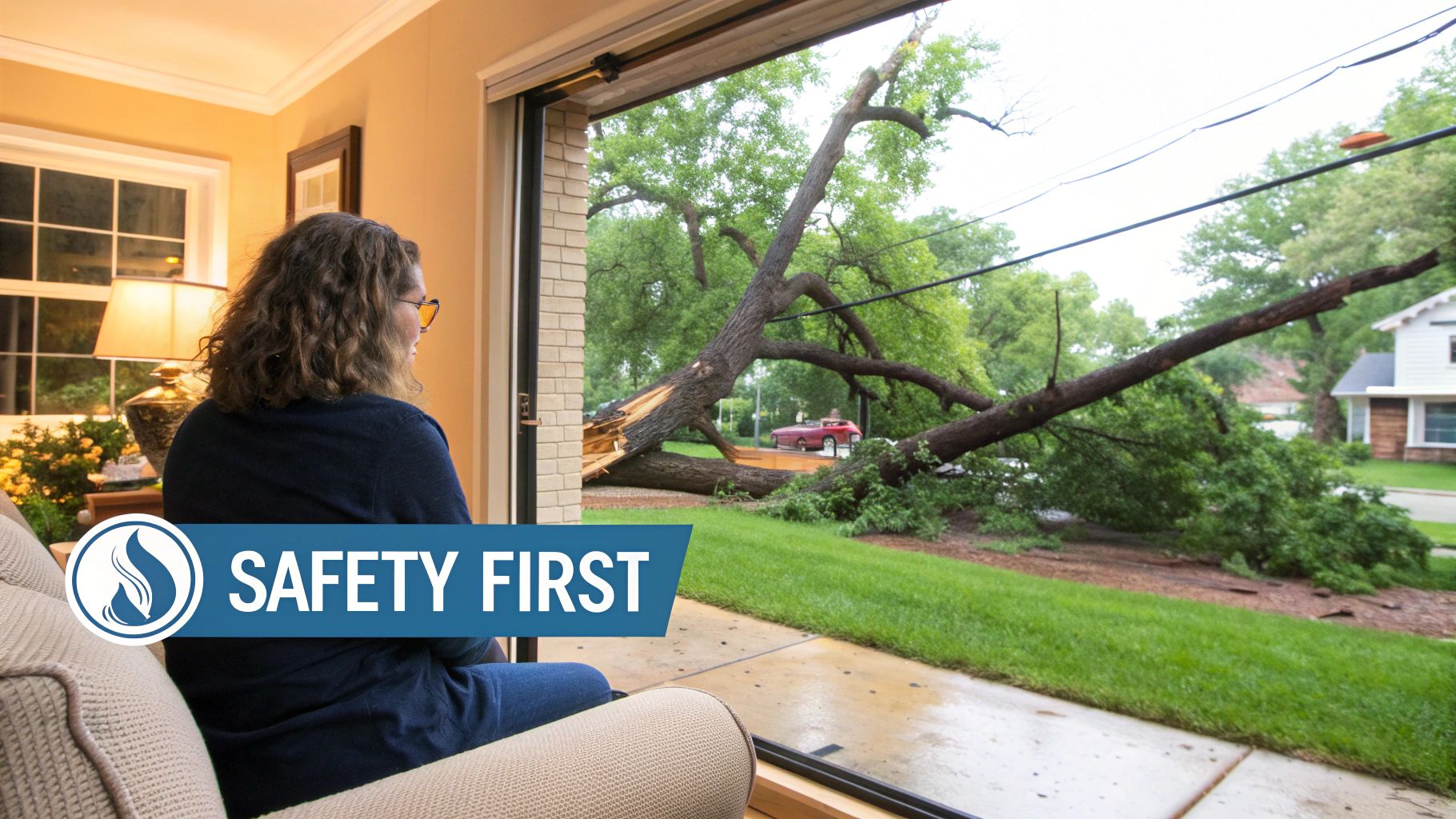
Real safety starts with a bit of patience. Before you do anything else, take a look from a secure spot inside your home. Peering through a window gives you an initial idea of the situation without putting yourself at risk and helps you make calm, clear-headed decisions.
Prioritise Personal Safety Above All
Before you even think about the cleanup, your number one job is to make sure the area is safe for you and your family. Storms leave behind an unpredictable mess of risks that aren't always obvious.
A fallen Eucalypt might look like it’s settled, but it could be hiding live, arcing power lines from Western Power. A big branch hanging precariously from a Jacaranda—what we call a 'widow-maker'—could give way with the slightest breeze.
The aftermath of a storm is a high-risk environment. Never assume a fallen tree or branch is stable. The ground may be saturated, root systems compromised, and unseen electrical hazards can be fatal.
We can’t stress this enough. In Australia, storm damage is a leading cause of fatalities from accidental tree failures. Research shows a huge number of these incidents happen during or right after severe weather, often because strong winds and waterlogged soil have made trees unstable. You can learn more about these tree failure statistics and safety measures.
Before taking any action, a quick visual sweep from a safe distance is essential. This simple checklist helps you spot the most critical hazards first.
Immediate Post-Storm Safety Checklist
Priority Action | What to Look For | Who to Call |
|---|---|---|
Check Power Lines | Any fallen, sagging, or sparking wires. Never assume a line is dead. | Western Power (Emergency Line: 13 13 51) |
Assess Tree Stability | Leaning trees, large cracked branches, or uprooted trunks. | Swift Trees Perth (Emergency Tree Surgeon) |
Inspect Structures | Fallen trees/branches on your roof, car, or threatening your home. | SES (132 500) for emergency assistance; Swift Trees Perth for tree removal |
Look for Gas Leaks | Hissing sounds or the smell of gas near outdoor meters or lines. | ATCO (Gas Leaks: 13 13 52) |
Completing this quick check helps you prioritise who to call and ensures you don't walk into a dangerous situation.
Document Damage From A Safe Distance
Once you're sure there are no immediate, life-threatening dangers, your next step is to document everything for your insurance claim. But you still need to be cautious.
From a safe spot—your doorway, a window, or your veranda—use your phone to take photos and videos. Get wide shots of the whole property and then zoom in on specific damage. For example, if a large Tuart branch has punched a hole in your Colorbond roof, capture a wide shot showing the tree and the house, then a close-up of the branch and the point of impact.
Effective documentation for your insurance provider includes:
Date and Time Stamped Photos: Most smartphones do this automatically, giving a clear timeline.
Multiple Angles: Shoot the damaged tree and any affected property (your roof, fence, car) from different perspectives.
Contextual Shots: Include photos that show where the fallen tree is in relation to your house.
Video Walk-through: A short video gives a much better sense of the scale of the damage than photos alone.
This visual evidence is gold when you file a claim. Resist the temptation to start moving branches or clearing debris before you’ve recorded the scene—it can complicate things with your insurer. When it's time for professional storm damage tree removal, having this initial record is crucial.
The hours after a severe storm are critical. By staying calm, putting safety first, and documenting the situation properly, you’re setting yourself up for a much smoother recovery. Once the immediate risks are assessed and recorded, it's time to call in the professionals.
For an urgent and safe assessment of tree damage, trust the experts. Contact Swift Trees Perth for all your tree maintenance and emergency removal needs.
Assessing The Damage And When To Call An Arborist
Once you’ve dealt with immediate hazards like downed power lines, it's time to turn your attention to the trees. But here’s the thing: not all storm damage is a five-alarm fire. Knowing the difference between a mess you can handle later and a genuine emergency is key—not just for your safety, but for saving you the cost of an unnecessary after-hours call-out.
The trick is to learn how to spot real trouble. This isn’t about counting a few fallen leaves; it's about identifying structural failures that could lead to catastrophic damage or, worse, injury. Getting this right empowers you to make a smart, calm decision when it matters most.
Identifying True Tree Emergencies
Some situations are absolutely non-negotiable. These are the red flags that mean you need to pick up the phone and call a 24/7 emergency arborist, no matter what time it is.
Trees Leaning Towards Structures: If a tree is suddenly tilting towards your house, garage, or even the neighbour's fence, its root system might have failed. The combination of a Perth storm's fierce winds and waterlogged soil can destabilise even the biggest, most established trees. This is a ticking clock.
Deep Splits or Cracks in the Trunk: Get a good look at the main trunk. Do you see deep, vertical cracks? That’s a sign the tree is literally trying to tear itself apart. Also, watch for "included bark"—weak, V-shaped unions where two stems have grown together. These are notorious weak points that often split wide open in a storm.
Large, Suspended Branches: We call these 'widow-makers' for a reason. A huge branch that has snapped but is caught up in the canopy is one of the most unpredictable dangers you can face. It could break free at any moment, without any warning at all.
Uprooted Trees: When you can actually see the root plate lifted out of the ground, that tree is completely unstable. Even if it seems to be leaning away from your property, it's a major hazard that needs to be professionally dismantled.
Think of it this way: an uprooted Marri tree resting on your garage roof isn't just a bit of debris. It's an unstable, multi-tonne weight threatening the structural integrity of your home. That's a clear-cut emergency.
When Cleanup Can Wait For Business Hours
On the flip side, plenty of storm damage looks dramatic but isn't an immediate threat. Recognising these scenarios can save you a lot of stress and money.
Scattered Small Branches: Is your lawn littered with small branches and twigs you could easily pick up by hand? This is just a cleanup job, not an emergency.
Fallen Limbs Away from Structures: If a big branch has fallen cleanly onto an open patch of lawn—well away from buildings, paths, or the driveway—it’s not going anywhere. It can wait.
Minor Cosmetic Damage: Torn leaves and stripped bark are battle scars from the storm, but they don't usually compromise the tree's stability.
A few fallen Jacaranda branches scattered across the garden, for example, are messy but not dangerous. Once you're sure it's not an emergency, you can look into professional debris and removal services to handle the cleanup efficiently during normal hours.
Making The Right Call...
When you do need professional help, it’s vital to call the right person for the job.
An arborist has a deep understanding of tree biology, health, and structure. They can properly assess whether a damaged tree has a chance of survival or if removal is the only safe path forward. You can learn more in our guide on the differences between arborists and tree surgeons. In a post-storm situation, an arborist's diagnostic skill is exactly what you need.
If you're looking at any of the high-risk signs we talked about, please don't wait. The safety of your family and your home comes first. A professional assessment gives you peace of mind and a clear plan to move forward.
For an expert assessment and safe, efficient storm damage tree removal, contact the qualified team at Swift Trees Perth. We’re here to help you navigate the aftermath of any storm with confidence.
The Professional Removal Process From Start To Finish
When a qualified tree surgery team like ours turns up to handle a storm-damaged tree, their work begins long before the first chainsaw roars to life. It’s a highly coordinated effort that puts safety and precision first, going way beyond just simple cutting and hauling. Knowing how this process works should give you confidence that your property is in skilled, experienced hands.
The whole operation follows a systematic flow: first, a careful assessment, then a controlled dismantling, and finally, a thorough cleanup. We use this methodical approach to remove massive hazards without creating new ones, protecting your home, garden, and family throughout the entire job.
This diagram breaks down the key stages of a professional tree removal.
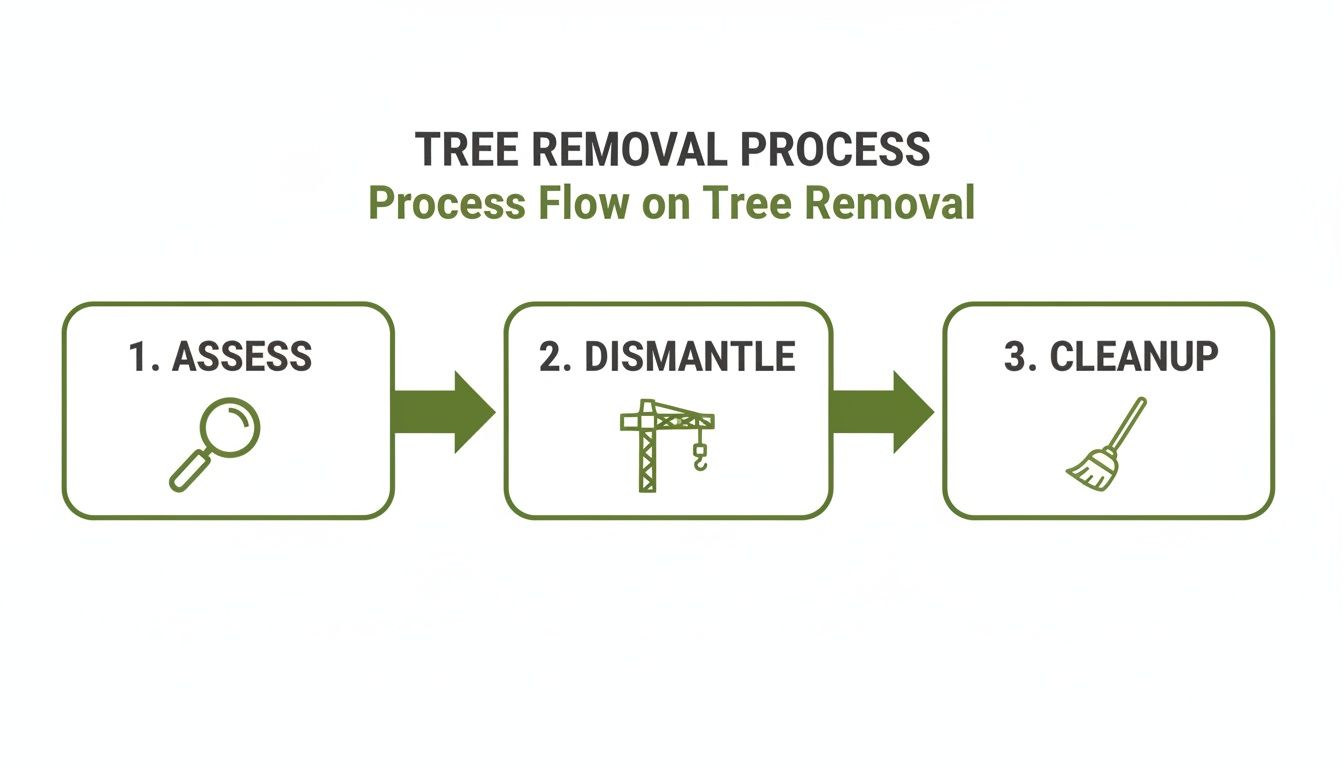
As you can see, it moves logically from a detailed risk assessment right through to the final tidy-up, ensuring every single step is handled with expert care.
The Initial On-Site Assessment
The moment our team arrives, the first job is a detailed on-site risk assessment. This is far more in-depth than the quick look you might have had from your window. The lead arborist will walk the entire site to identify every single potential hazard.
They’re trained to spot dangers the average homeowner would easily miss. For example, they’ll check the stability of the ground, pinpoint any remaining ‘widow-maker’ branches hung up in the canopy, and confirm the exact location of nearby utility lines. This phase is absolutely critical for mapping out the safest and most efficient removal strategy.
Strategic Dismantling With Specialised Equipment
With a solid plan locked in, the dismantling begins. This is where professional expertise and specialised gear really make a difference, showing just how controlled and low-impact modern arboriculture can be.
Instead of just felling the whole tree in one go, a skilled team takes it apart piece by piece. This usually involves:
Advanced Rigging: Using a complex system of ropes, pulleys, and friction devices, our arborists can carefully lower huge sections of the tree to the ground with pinpoint accuracy. This is how we stop heavy logs from crashing down and wrecking your lawn, garden beds, or driveway.

Crane-Assisted Removal: For enormous trees or those in tricky spots (like a tight backyard in Mount Lawley with no access), a crane is essential. It can lift massive sections of the trunk up and over your house, completely removing any risk to your property.
Precision Cutting: Every single cut is planned. Arborists use specific cutting techniques to control how each piece falls, making sure nothing lands where it shouldn't.
This isn’t about brute force; it’s about applying physics and foresight. This controlled approach is the signature of a truly professional storm damage tree removal service. For a deeper dive, feel free to check out our guide on safe and efficient tree removal tips to understand the techniques we use.
Meticulous Cleanup And Debris Management
The final stage is just as important as the removal itself. A professional crew doesn't just leave you with a massive pile of logs and branches to deal with. We handle the complete cleanup, leaving your property tidy and safe.
A job isn't finished until the site is cleaner than when we arrived. Our goal is to remove the hazard and the mess, leaving you with nothing but peace of mind.
This phase typically includes chipping the smaller branches and foliage on-site into mulch, which you can keep for your garden or we can haul away. Larger logs are cut into manageable sections and loaded up for removal. After that, the team will rake, sweep, and even use blowers to clear away all the leftover sawdust and small debris.

This commitment to a thorough cleanup is a hallmark of a quality service. It means that once the dangerous tree is gone, you aren’t left with another weekend-long project of dealing with the aftermath. From the initial safety check to the final rake of the lawn, the entire process is designed to be seamless and stress-free for you.
Navigating Insurance And Council Permits In Perth
Once the immediate threat of a storm-damaged tree is gone, you’re often left facing a different kind of challenge: the paperwork. Juggling insurance claims and council rules can feel like navigating a second storm, but knowing what’s needed ahead of time makes all the difference.
Getting your head around what your insurer expects and when the local council needs to be involved is the key to a much smoother, less stressful recovery process.
Working With Your Insurance Provider
Most Perth home insurance policies will cover damage from fallen trees. The trick is making sure your claim is solid and well-documented from the get-go. Your insurer needs to see a clear, undeniable link between the storm and the damage to your property.
This is where your phone comes in. Before a single branch is moved, those initial photos and videos are your best evidence. They create a "before" snapshot that proves why you needed to call in the professionals.
When you bring in a qualified arborist, they become your biggest ally in strengthening that claim.
A professional tree service should give you:
A Detailed Written Quote: A proper quote breaks down the costs for labour, any specialised gear like cranes or rigging, and getting rid of the green waste.
A Formal Assessment or Report: For a more complicated claim, an arborist’s report is gold. It explains exactly why the tree failed (like from extreme wind) and why removing it was essential to stop more damage.
Tax Invoices: You'll need proof of payment to get reimbursed.
This level of professional paperwork turns a simple request into a well-supported case that’s hard to argue with. For some extra guidance, you can find great info on how to handle a fallen tree insurance claim to help you to be prepared.
Understanding Perth Council Tree Regulations
The permit question causes a lot of confusion, especially in an emergency. The good news is that most councils across the Perth metro area have exemptions for trees that are an immediate and obvious risk to people or property. But it’s not quite a free-for-all.
In an emergency, safety is always the priority. A tree that's already on the ground or is clearly about to fall on a building usually won't need a permit for removal. The key is still to document the danger to justify the urgent action.
Things get a bit murkier with trees that are damaged but still standing. You might see a huge Tuart with a massive cracked limb as a clear hazard, but the council might see it differently—especially if it’s a protected or significant tree. This is where an expert opinion is invaluable. An experienced arborist knows the specific rules for different council areas, from the City of Stirling to Wanneroo.
When To Check For Tree Permits
Even after a storm, you should probably check with your local council if:
The tree is damaged but not an immediate threat: If it's stable and not about to cause harm, the standard tree preservation rules might still be in play.
The tree is on a significant tree register: Many councils have a list of protected trees. Any major work on these, even just pruning, requires special permission.
You're in a designated conservation or bushfire-prone area: These spots often have strict rules about vegetation management that you have to follow.
Trying to figure all this out yourself can be a real headache. That's why working with a professional tree service helps so much. We can assess the tree's health against the local guidelines. For a deeper dive, check out our guide on permits for regulated trees in Perth.
You don't have to manage the administrative mess of a storm aftermath on your own. With the right team behind you, your insurance claim will be solid, your council obligations will be met, and you can get back to focusing on what matters.
If you’re dealing with storm damage and need help with tree removal, contact Swift Trees Perth. Our team provides the quotes you need for a hassle-free insurance process and can guide you through any local council requirements.
Future-Proofing Your Property Against Storms
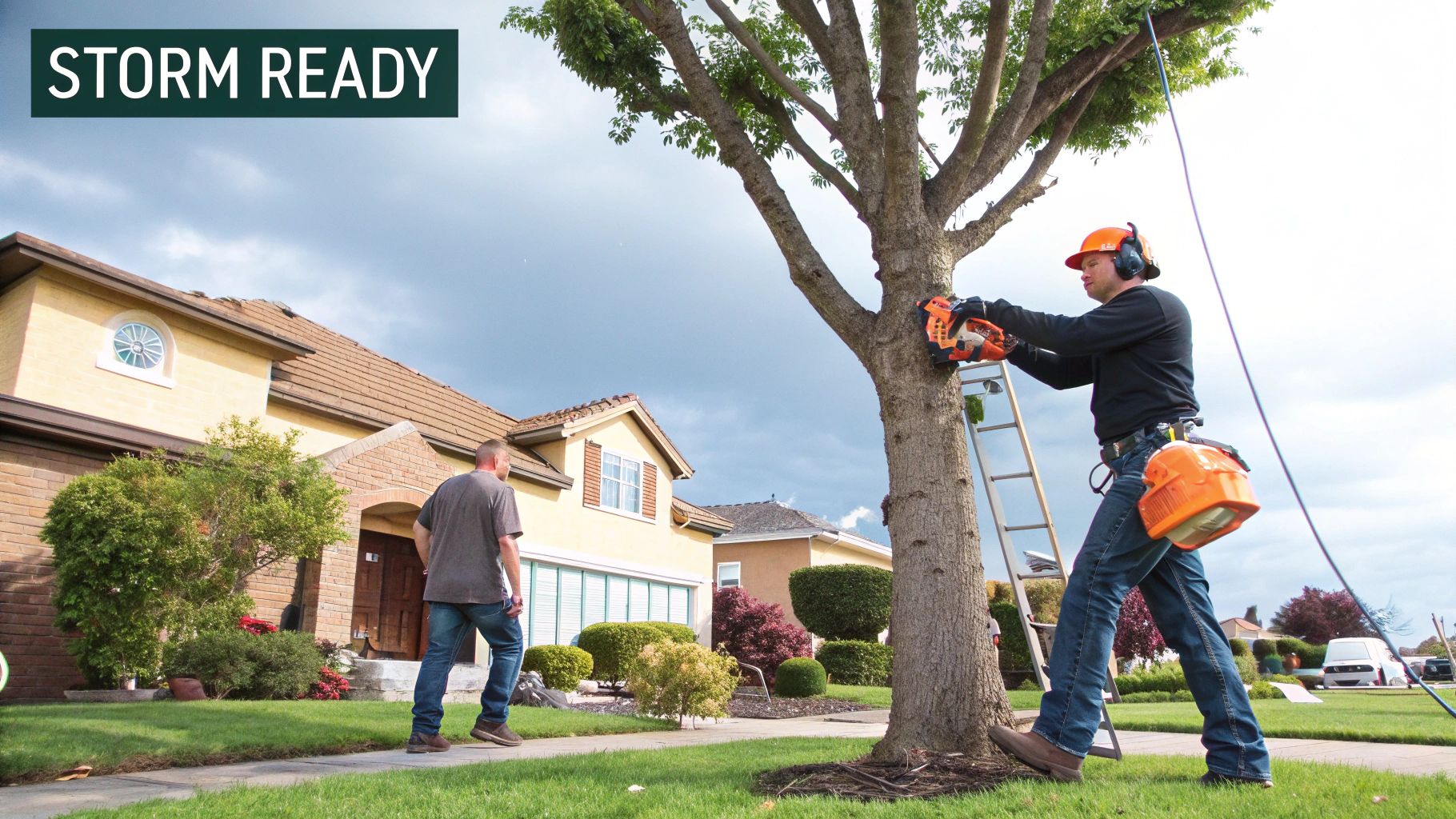
Dealing with the aftermath of a Perth storm is always a scramble. Once the immediate danger is over and the last branch is cleared away, it’s all too easy to put it out of your mind until the next wild weather warning flashes across the news.
But the most effective way to handle storm damage tree removal is to stop it from being an emergency in the first place.
Proactive, long-term tree care is your best line of defence. By shifting your mindset from reactive cleanup to active prevention, you can build a safer, more resilient landscape that’s ready for the high winds and heavy rains we know are a part of life in Western Australia. The trend in modern property management is moving towards resilience—creating outdoor spaces that are not only beautiful but are designed to withstand environmental stress.
Spotting Trouble Before the Next Storm Hits
Many of the trees that come down in a storm were showing warning signs long before the wind picked up. Learning to spot these red flags is the first step in future-proofing your property. You don't need to be an arborist to see the obvious signs of a tree under stress.
Next time you’re in the garden, take a proper look at your trees. You’re looking for:
Deadwood: Big, dead branches in the canopy are one of the first things to come crashing down in high winds. They’re brittle and easy to spot by their lack of leaves and dry, often cracked appearance.
Weak Branch Unions: Check where major branches meet the trunk. Strong connections form a wide, U-shaped union. The ones to worry about are tight, V-shaped angles, often with bark squeezed between them. This creates a structural weak point that can easily split under pressure.
Lopsided Growth: A tree with a heavy, unbalanced canopy is like a boat with a poorly loaded sail—it's far more likely to get pushed over by strong gusts. This often happens after damage from a previous storm or even just bad pruning jobs in the past.
Signs of Decay: Have you noticed any fungus or mushrooms growing at the base of a tree? What about hollow spots in the trunk or big, deep cracks? These are all tell-tale signs that the tree’s internal structure might be compromised and rotting from the inside.
A healthy tree is a strong tree. Identifying and addressing these issues early on is far less stressful and costly than dealing with an emergency removal after a storm has already hit.
The Power of Professional Tree Maintenance
While spotting these issues yourself is a great start, the real solution lies in regular, professional maintenance. An experienced arborist does more than just point out problems; we can put strategies in place to strengthen your trees and seriously reduce their risk of failure. It's all about making your trees more aerodynamic and structurally sound.
Modern arboriculture isn't just about cutting things down. It’s about applying proven techniques designed specifically for storm readiness.
Smart Pruning for Storm Resistance
Strategic pruning is one of the most powerful tools in our proactive care toolkit. It’s not about just hacking off branches—it’s a science that enhances a tree’s natural strength and ability to withstand wild weather.
Our key techniques include:
Canopy Thinning: This involves selectively removing certain branches to let the wind pass through the canopy, rather than pushing against it like a solid wall. A properly thinned canopy reduces the 'wind load' on the entire tree, dramatically lowering the chance of the trunk snapping or the tree being uprooted.
Formative Pruning: This is absolutely vital for younger trees. It’s all about guiding the tree to develop a strong, stable structure as it grows. We prevent the formation of those weak branch unions and poor balance that become major hazards later on.
Deadwooding: The simple act of removing dead and dying branches gets rid of the most obvious hazards before they ever get the chance to fall on your roof, car, or fence.
When you invest in a proactive maintenance plan, you’re not just tidying up your trees—you’re fortifying your entire property. A well-maintained landscape isn't just safer; it's also healthier and looks fantastic. Don’t wait for the next storm warning to start worrying about your trees.
Take control now. For a comprehensive property assessment and a tailored maintenance plan designed to protect your home, contact Swift Trees Perth today. Let our experienced team help you build a safer, more storm-ready landscape for the future.
Got Questions About Storm Tree Removal in Perth? We've Got Answers.
Even after the wind and rain die down, the questions usually start swirling. Homeowners across Perth often find themselves wondering about the same things: the cost, who's responsible for what, and whether they can just tackle some of the mess themselves. Getting straight answers from people who've seen it all before is the best way to move forward with confidence.
Let's clear up some of the most common questions we get from residents after a big storm rolls through.
How Much Will Emergency Storm Damage Tree Removal Cost in Perth?
This is always the first question, and the honest-to-goodness answer is: it really depends. The final price tag for storm damage tree removal is shaped by a few key things that make each job unique.
A straightforward job, like getting a fallen branch off your lawn during business hours, might only run you a few hundred dollars. But the cost can quickly climb into the thousands if we're dealing with a massive, dangerous tree leaning over your house. That kind of job often needs a crane, a full crew working after hours, and a serious amount of cleanup.
To make sure you're never caught off guard, always insist on a detailed, written quote before anyone starts up a chainsaw. It should break everything down for you:
Labour: How many crew members are needed and roughly how long it will take.
Equipment: Any special gear required, like cranes, complex rigging, or stump grinders.
Debris Disposal: The cost to haul away and process all the green waste.
A proper quote from a qualified arborist, like the team here at Swift Trees Perth, means no nasty surprises.
My Neighbour's Tree Fell on My Property. Who's Responsible?
Ah, the classic neighbourhood dilemma. It’s a frequent source of confusion, but in Western Australia, the law generally sees major storms as an 'act of God'.
What that means for you is that the responsibility for removing the tree and fixing any damage usually falls to whoever owns the property where it landed. So, if your neighbour's gum tree is now sitting on your shed, you'll need to contact your own home and contents insurance to ask about removal and repair costs.
Can you prove negligence by your neighbour? If you can prove your neighbour knew their tree was a hazard and did nothing about it—for example, you'd sent them a formal letter about a dead or rotting tree—they could be held liable.
This is why it's always a good idea to keep a paper trail of any communication you have about a neighbour's dodgy-looking trees.
Can I Safely Cut Up Small Fallen Branches Myself?
It’s tempting to grab the chainsaw and start cleaning up the smaller debris yourself. It feels productive, right? But this is where we see a lot of preventable accidents happen.
Even a branch that looks small and manageable can be holding a surprising amount of tension from the way it fell. Make one wrong cut, and that stored energy can release in a split second, causing the wood to whip back violently. We're talking serious cuts, broken bones, or worse.
Then there's the hidden danger of power lines. A live wire can be completely hidden by leaves and branches. Professionals are trained to spot these life-threatening hazards and have the right personal protective equipment (PPE) to handle the situation safely.
Here's the safest rule of thumb: if you can't easily pick up and carry the debris by hand without needing any tools, it's a job for the pros. Let us handle it efficiently and safely—it protects you, your family, and your property from any more drama.
When storms hit Perth, you need a tree service you can rely on for a fast, safe response. From proactive pruning to emergency storm damage tree removal, the experienced team at Swift Trees Perth is ready to help. Don’t wait for the next weather alert to secure your property. A proactive approach to tree maintenance is the smartest investment you can make in your home's safety and value.


Comments