
Why Does Tree Removal Cost So Much in Perth

A typical Perth tree removal costs around $1,763, with simple jobs starting at a few hundred dollars and complex removals climbing into the thousands because the price reflects safety risk, not just tree size. A straightforward removal may sit near the lower end, while powerlines, tight access, protected trees, cranes, or urgent work can push the bill much higher.
You've probably felt the shock already. A tree that looks like it should take a few hours to cut down arrives with a quote that resembles a small construction project. The natural question is, why does tree removal cost so much?
The short answer is that professional removal combines trained labour, specialised equipment, insurance, waste handling, site control, and sometimes council approval. In Perth, a tree near a Western Power line or on a regulated verge isn't merely a gardening task. It's safety-critical infrastructure work carried out around homes, vehicles, pedestrians, fences, roads, and live electrical conductors.
The Quote That Made You Raise Your Eyebrows
Mark had a dead jarrah standing near the front boundary of his property. Its branches reached towards the street, and one large limb sat uncomfortably close to overhead Western Power lines. The tree was also awkwardly positioned beside a steep verge kerb, with narrow side access past a colourbond fence.
His first quote $450. A registered Perth tree surgeon quoted $2,400.
Mark's first reaction was disbelief. The tree was dead, the trunk wasn't enormous, and the crew might only be on site for part of a day. Why did tree removal cost so much when someone he knew was willing to do it for less?
The difference was hidden in everything around the cut itself. The cheaper option appeared to cover felling and perhaps basic cleanup. The professional quote accounted for qualified workers, controlled dismantling, rigging equipment, public protection, waste removal, insurance exposure, and the possibility of council or utility requirements.
The price isn't just for making the tree fall. It's for controlling where every branch, log and piece of equipment goes while protecting people and property.
Near powerlines, the electrical risk changes the job immediately. Western Australian guidance generally requires urban vegetation to remain at least two metres clear of distribution lines, while a three-metre danger zone applies around lines carrying 33,000 volts or less. Workers must treat overhead and underground conductors as potentially fatal and follow formal minimum approach distances, as outlined in Western Australia's electrical safety guidance for pruning near trees.
That can mean written risk controls, trained workers, a spotter, careful sectional dismantling and extra time before cutting begins. Narrow access may prevent a truck or chipper from reaching the tree, so branches and timber must be moved by hand. The steep verge may call for traffic management, while the dead wood itself may be brittle and unpredictable.
The rest of this guide breaks down where the higher quote goes, so you can judge whether the premium reflects real value or an inflated margin.
What Goes Into the Price of Removing a Tree
A legitimate tree removal quote is closer to a small construction estimate than a gardening invoice. The crew is managing a temporary worksite, lifting and lowering heavy material, controlling hazards and restoring the area afterwards.
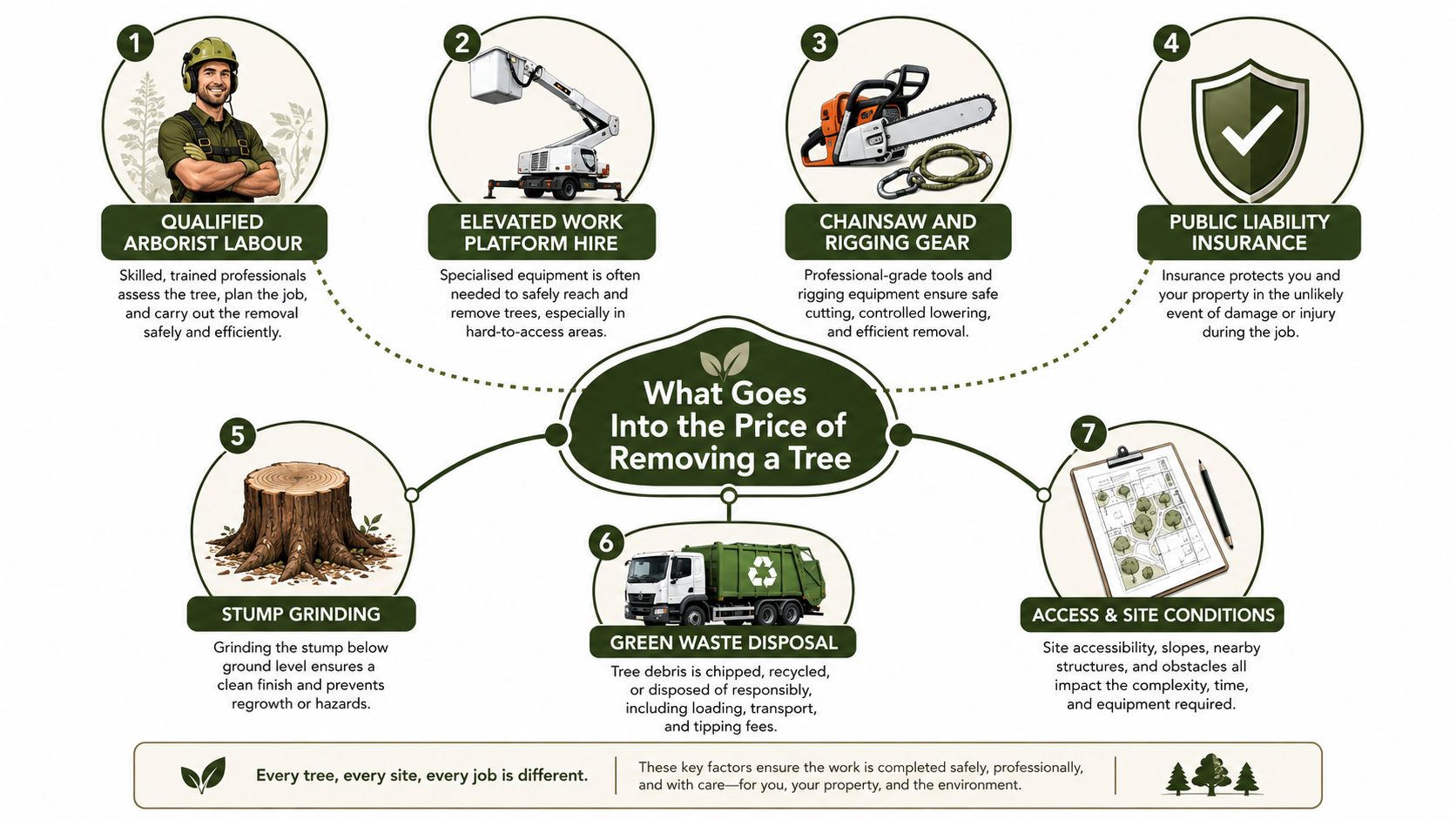
The seven main cost components
Qualified arborist labour covers the people assessing the tree, climbing or operating equipment, cutting safely, lowering sections and managing the ground crew. Skilled labour is usually charged by time, crew size and job complexity.
Climbing equipment or an Elevated Work Platform becomes necessary when the tree is too tall, unstable or difficult to access safely from the ground. Hire costs are often tied to the machine, delivery, operator requirements and the time it remains on site.
Chainsaws, ropes, rigging gear and PPE allow the crew to dismantle sections rather than letting them drop. Rigging is particularly important above roofs, fences, pools, pergolas and driveways.
Public liability and workers compensation insurance protects against property damage and workplace injury. The allocation may not appear as a separate line, but it forms part of the contractor's operating cost.
Council permits and arborist reports apply when local rules protect the tree or when the work affects a verge, road reserve or other public land. The paperwork can involve inspections, reports and waiting time.
Green waste disposal and tipping depends on how much timber, foliage and brush the tree produces. Some operators include removal in the main quote, while others charge separately. One Australian tree-services pricing guide lists light green-waste removal at $70 plus GST per cubic metre, with a $100 plus GST minimum charge covering up to 1.5 cubic metres. Those figures are examples of how cleanup can be priced, not a universal Perth rate, and are detailed in this Australian tree-services pricing breakdown.
Stump grinding or chemical treatment is usually separate because it requires different machinery and adds another stage to the work. If you're planning to pave, replant or develop the area, ask about typical stump grinding costs before accepting a removal quote.
A worked example
Take a hypothetical $1,500 removal in Baldivis. The figures below show how a contractor might allocate the quote:
Cost area | Example allocation |
|---|---|
Labour | $480 |
Equipment | $220 |
Disposal | $180 |
Stump work | $150 |
Insurance allocation | $90 |
Risk, travel and compliance overhead | $380 |
Total | $1,500 |
The allocation won't look identical for every contractor. A tree with clear access may need less equipment but more disposal. A regulated tree may require more administration before the crew arrives. A hazardous removal may use additional workers and rigging.
Every legitimate line can be questioned. Ask what it includes, whether disposal is complete, whether the stump is being ground or only cut low, and who handles permits. Skipping one of those costs doesn't make the work free. It usually transfers the risk onto the homeowner.
What Perth Homeowners Actually Pay in 2026
Australian pricing guides show why there isn't one universal tree removal price. One guide places the typical nationwide job at about $1,150, with a common range of $450 to $4,500, depending on access, height and complexity, as outlined by Canstar's Australian tree removal cost guide. A separate 2026 Australian quote dataset places the national median closer to $1,740, with Perth averaging about $1,763.
That Perth figure is a useful benchmark, not a promise. Larger jobs involving cranes, traffic control or multi-day access issues can reach $7,000 to $22,000, according to the same pricing data. The spread makes sense once a removal moves from open-yard cutting to controlled dismantling around buildings, utilities or public areas.
Job Type | Typical Perth Price Range | Price Drivers |
|---|---|---|
Small tree or uncomplicated shrub removal | A few hundred dollars | Height, trunk size, access and cleanup |
Medium residential tree | Around the local market benchmark | Climbing, rigging, disposal and nearby structures |
Large gum, jarrah or hazardous tree | Several thousand dollars | Weight, height, sectional dismantling and risk |
Crane, traffic-control or multi-day removal | Can reach $7,000 to $22,000 | Crane hire, road management and difficult access |
The national median and Perth average sit relatively close, but that doesn't mean two neighbouring properties should receive similar quotes. A tree in an open front yard may be dismantled efficiently, while the same tree beside a roof, boundary fence and powerline may need a different crew plan entirely.
For a useful local comparison, you can also review Swift Trees Perth's tree removal cost calculator guide. Treat online figures as guardrails. Before signing, ask the contractor to itemise labour, equipment, disposal, stump work, permits and traffic management so you can compare like with like.
Council Rules and Permits That Add to Your Bill
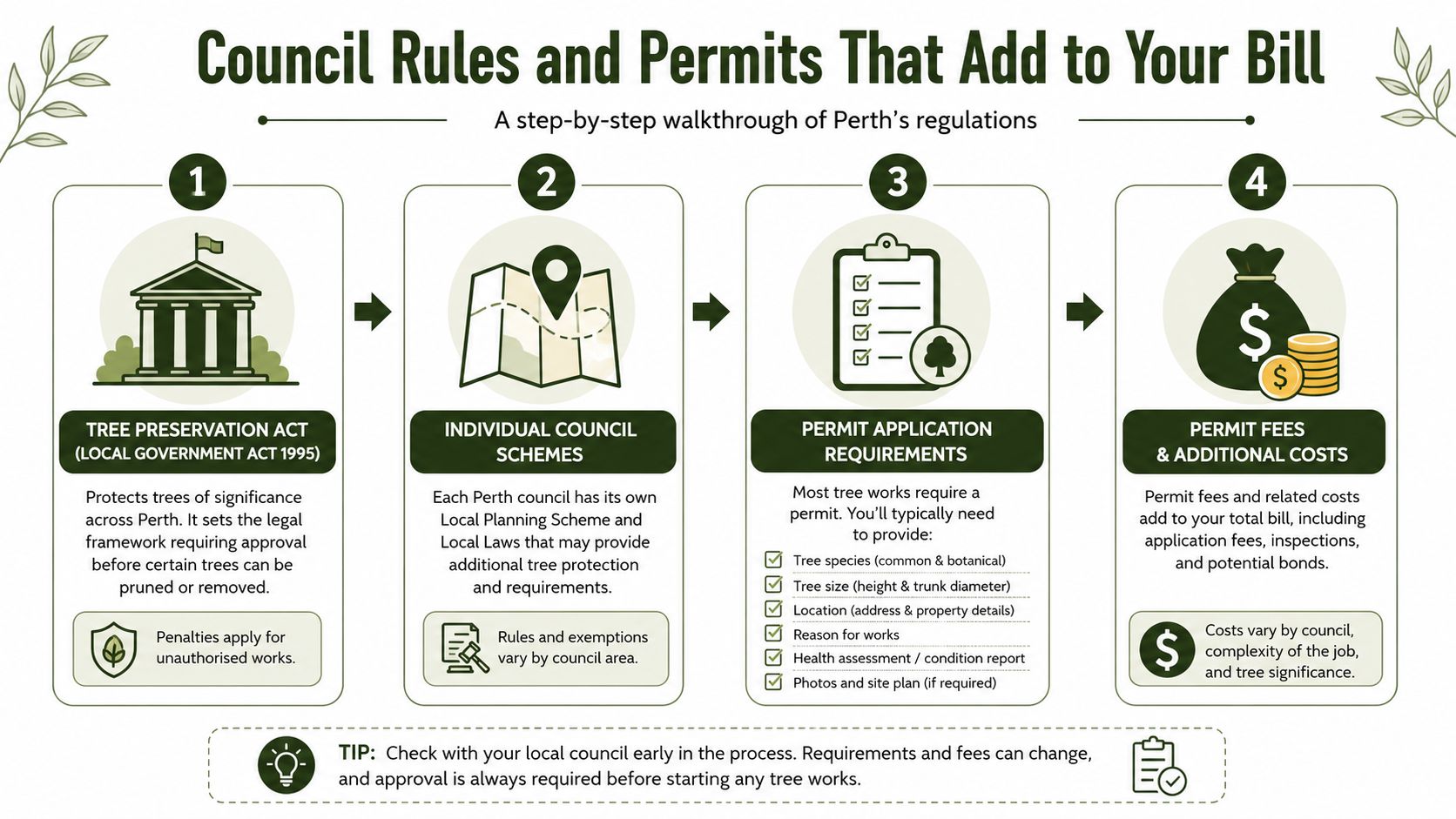
Perth homeowners often assume they can remove any tree on their own land. That isn't always the case. Local-government schemes can protect significant trees, verge vegetation, street trees, heritage trees and trees in conservation areas, while separate rules apply when work affects public land.
A permit may also be needed for vegetation on local-government property. The City of Perth's ABLIS listing says approval is required to plant, remove or interfere with vegetation on thoroughfares, parks and verges. That matters for street trees and verge work, even when the tree appears to sit directly outside your boundary.
A practical compliance checklist
Identify the tree and land position. Confirm whether it's on private land, a verge, road reserve or another council-controlled area.
Check local protection rules. Councils don't all use the same definitions or thresholds, so the rule in one suburb may not apply in the next.
Arrange an arborist report if required. The report may describe species, condition, dimensions, structural concerns and the reasons for removal.
Submit the application and wait for approval. Processing can take weeks, which creates administration and scheduling costs before the chainsaw reaches the tree.
The compliance principle is similar to other property regulations. If you're dealing with boundary work as well as vegetation, it can help to understand the Ottawa fence bylaw as an example of how local rules can govern work that looks private but affects shared or regulated space. The specific bylaw is Canadian, not Perth law, but the broader lesson is relevant: check the authority responsible for the land before work begins.
Perth permit guidance also explains why dead or dangerous trees may still require supporting evidence. You can review the practical process in Swift Trees Perth's tree removal permit guide.
Why Arborist Labour Is Harder to Find Than You Think
Arborists assess tree structure, identify failure points, select anchor systems, control exclusion zones and decide how to lower material without damaging the property. Their work resembles structural rigging on a construction site more than routine garden maintenance.
What the customer is paying for
A qualified crew needs more than cutting ability. It needs judgement developed through formal training and practical work, especially when the tree is dead, leaning or positioned above valuable property.
Workers may need to:
inspect decay, included bark and unstable limbs
establish an exclusion zone around the drop area
set ropes and lowering devices
coordinate a ground crew
protect roofs, fences, gardens and vehicles
manage pedestrians or traffic
separate timber and green waste for disposal
The risk profile explains why contractors cannot treat every tree as a quick job. Safe Work Australia's tree-work guidance records that about 65% of fatalities occurred during tree felling, 20% during trimming or lopping, and 7% during cutting or clearing felled material, based on the incident data cited in its Guide to managing risks of tree work.
That risk requires qualified workers, specialist rigging, PPE, careful dismantling and planning. A crew that finishes quickly may still have spent substantial time assessing, loading equipment, setting up and making the site safe.
For readers curious about the career behind the quote, Swift Trees Perth provides an overview of how to become an arborist in Australia.
A short visit doesn't mean low labour value. You're paying for the years of training and the risk management that make a short, controlled visit possible.
When a Simple Tree Becomes a Complex Job
A tree's height matters, but its surroundings often matter more. A 6-metre lemon tree in an open front yard might attract a quote of $450, while the same tree leaning over a colourbond fence with restricted side access might reach $950. Those figures are illustrative examples of how site conditions change the work, not standard market prices.
The crew must answer practical questions before choosing a method. Can a chipper reach the branches? Can timber be dropped safely? Is there a pool, pergola, roof, driveway or boundary wall underneath? Are powerlines close enough to require formal controls?
Site Feature | Cost Impact | Why It Adds Up |
|---|---|---|
Height above 10 metres | Higher equipment and labour requirement | The crew may need an Elevated Work Platform or more complex climbing and rigging |
Proximity to powerlines | Specialist planning and controlled work | Electrical clearances, spotters and utility coordination slow the job |
Narrow driveway or side access | More manual handling | Large trucks, chippers or stump grinders may not reach the tree |
Colourbond fence or boundary wall | Sectional dismantling | Branches must be lowered rather than dropped |
Pool, pergola or roof below | Precision rigging | Each piece needs a controlled landing area |
Steep verge or roadside position | Possible traffic management | Workers may need to protect pedestrians, vehicles and the public |
A tree over an open lawn can often be dismantled with generous drop space. A tree over a pergola may need ropes, lowering devices and a second worker controlling every section. That extra time protects the structure, but it also increases equipment use, labour and insurance exposure.
Dead trees create another complication. They may look easier because the owner no longer wants to preserve them, but brittle branches and weakened anchor points can make climbing and cutting less predictable. The contractor may need to change the work method rather than increase the saw size.
Access is often the hidden multiplier. A small tree at the back of a narrow block can cost more to remove than a taller tree beside a clear driveway.
Smart Ways to Bring Your Tree Removal Cost Down Safely
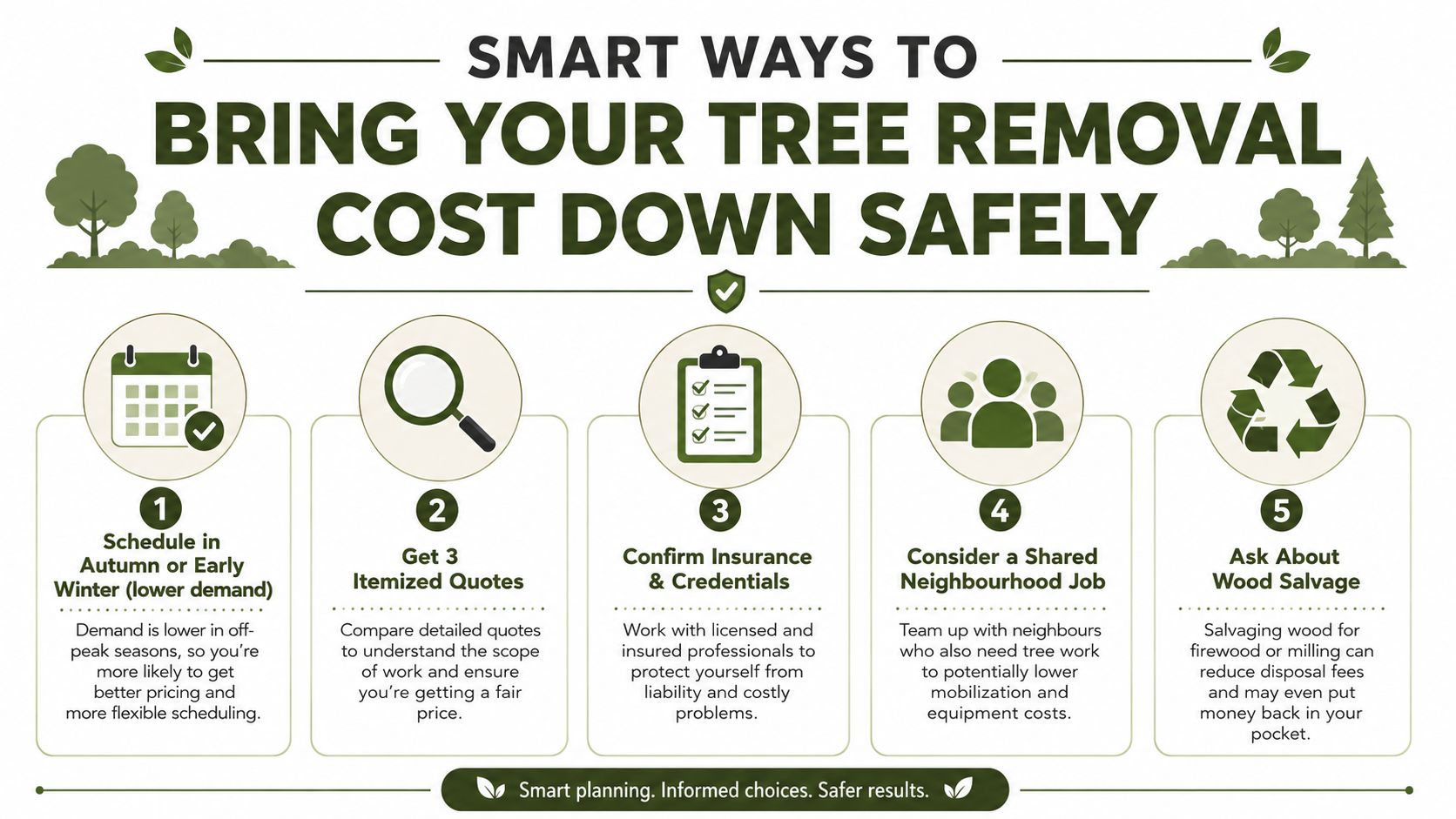
Safe savings come from reducing wasted time and duplicated mobilisation, not from removing the safeguards that protect your property. You can make the job more efficient without asking a crew to ignore powerline clearances, permits or proper rigging.
Reduce avoidable site time
Choose a quieter period where practical. Autumn or early winter may offer firmer ground and lower demand, although weather and tree condition still determine whether the timing is suitable.
Bundle nearby trees. Removing several trees during one visit can share travel, setup and equipment mobilisation across the work.
Clear the route before the crew arrives. Move outdoor furniture, vehicles, children's toys and loose garden items away from the access path and work zone.
Decide what happens to the wood. If you can use manageable logs for firewood, tell the contractor before the quote is finalised. Leaving suitable timber on site may reduce handling and disposal, but only if you want it there.
Question the stump option. Stump grinding makes sense when you're replanting, paving or landscaping. If the area will remain unused, ask whether a different treatment is appropriate.
DIY felling near powerlines is not a sensible saving. Climbing without proper harness training, dropping limbs beside a roof or ignoring a tree-protection rule can turn a modest quote into property damage, an injury claim or a council dispute.
Three quotes can help, but the lowest number isn't automatically the best value. Compare the method and scope, not just the total.
Get a Clear Honest Quote from Swift Trees Perth
A useful estimate starts with the tree and the block, not a generic calculator. Local conditions such as Perth access, Western Australian electrical-safety controls, council requirements, waste volume and workforce availability can change the method and final price.
When you contact a contractor, have the tree species if known, an approximate height, its distance from buildings and powerlines, access details, photographs and any council correspondence ready. Those details help the estimator identify whether the job may need climbing, an Elevated Work Platform, rigging, traffic controls, a permit or an arborist report.
Swift Trees Perth provides free estimates for tree removal, pruning, stump grinding and related maintenance across Perth and the wider metropolitan area.
If a quote has landed higher than expected, ask the contractor to explain each cost in plain language. A professional should be able to show where the labour, equipment, disposal, compliance and site-risk allowances fit.
Swift Trees Perth can assess your tree, explain the safest removal method and provide a free estimate for the work. Visit Swift Trees Perth to arrange a clear quote for tree removal, pruning, stump grinding or other tree maintenance across Perth.
Comments