
Hazardous Tree Removal Cost: Your 2026 Perth Guide

Standard tree removal might sit around $200 to $2,000+ with an average near $750, but a hazardous tree removal cost in Perth often lands far above that and can climb to $10,000 or more when risk controls, restricted access, storm damage, structures, or powerlines are involved. If you're staring at a leaning gum after a wild night of wind, the price isn't just about cutting wood. It's about how safely that tree can be dismantled without damaging your home, fence, driveway, neighbour's property, or nearby services.
A lot of Perth property owners call after hearing a branch crack, seeing fresh movement in the canopy, or noticing a trunk leaning harder than it did last winter. That's usually the moment the question changes from “Can this be trimmed?” to “What's this going to cost me?”
The honest answer is that hazardous tree removal cost is driven less by the tree itself and more by the consequences if something goes wrong. A straightforward backyard removal and a storm-damaged tree hanging over a roof are not the same trade. They don't use the same method, crew setup, equipment, or level of planning.
Understanding the True Cost of a Dangerous Tree
The job often starts with a problem you can hear before you can fully see it. Wind picks up, the tree starts creaking, and one heavy limb shifts over the roofline. By morning, you're not pricing “tree work” anymore. You're pricing controlled risk.
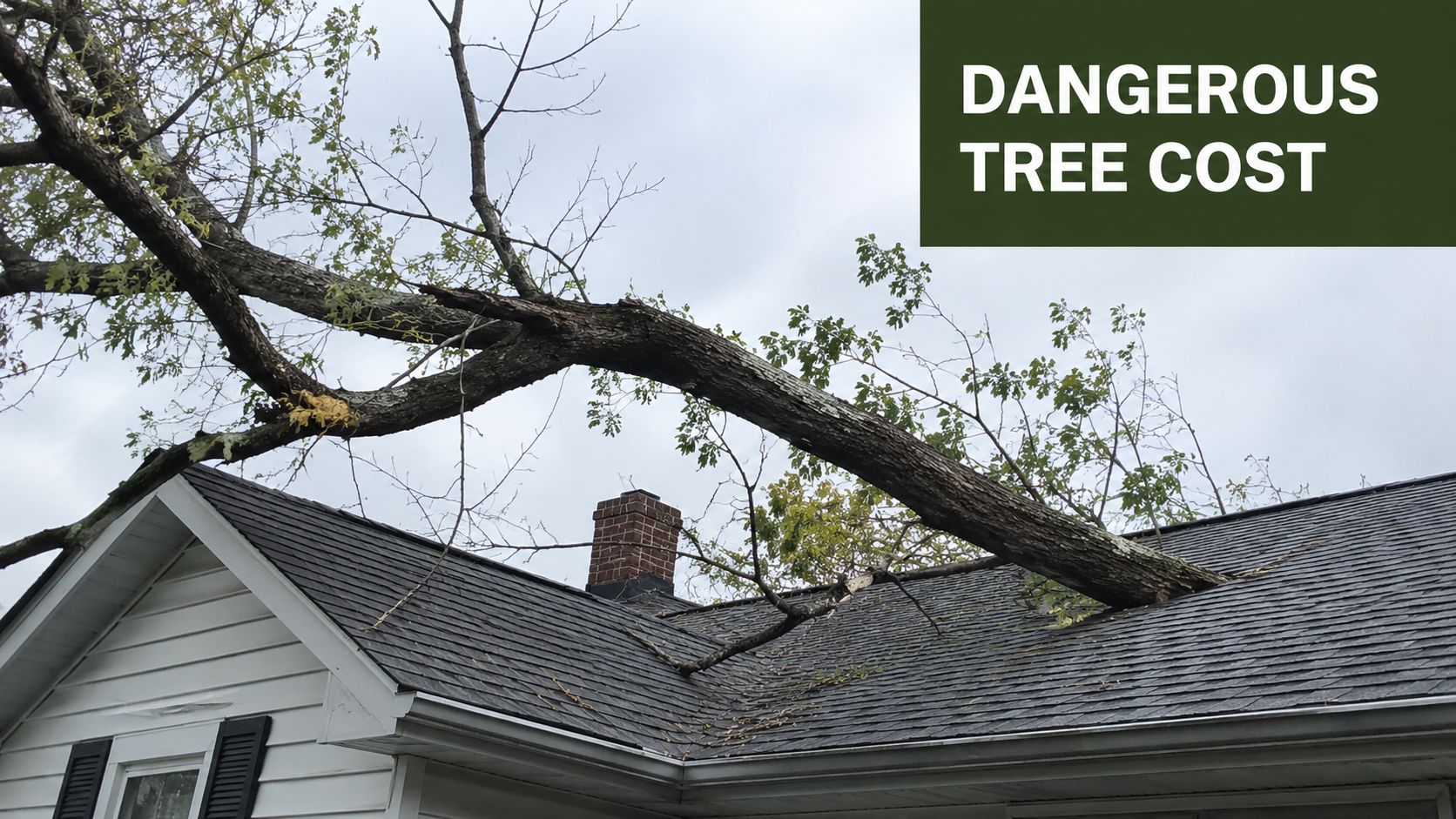
General guides often put tree removal at roughly $200 to $2,000+ with an average near $750, but more complex removals can reach $10,000 or more, and hazard-related conditions commonly add 50% to 100% to the base rate according to NerdWallet's tree removal cost guide. That spread sounds wide because it is wide. It reflects the jump from normal domestic work to specialist dismantling.
Why the average figure misleads
The average number is useful only for simple jobs. If a tree stands in open space with clear drop zones and good access, pricing stays closer to ordinary removal work. Once the tree leans over a house, sits behind a narrow side passage, or requires sections to be lowered by rope instead of dropped, the average stops being relevant.
In Perth suburbs, that difference shows up quickly on site. A neat front-yard removal with truck access is one thing. A mature tree behind retaining walls, patios, sheds, and pool fencing is another.
A fair quote for a dangerous tree usually reflects preparation and control measures more than chainsaw time.
What homeowners are really paying for
The cost usually covers several moving parts, not one action:
Site assessment and method selection so the crew knows whether the tree can be climbed, rigged, lifted, or needs mechanical help
Protection of targets such as roofs, fences, paving, gardens, neighbouring assets, and vehicles
Controlled dismantling where each section is cut and lowered safely
Clean-up and haulage if that's included in the scope
Compliance overhead if the site has council, traffic, or utility complications
That's why two trees of similar height can price very differently. One may be a routine removal. The other may be a hazardous dismantle with no margin for error.
What Exactly Makes a Tree Removal Hazardous
A hazardous removal isn't merely “a big tree”. It's a tree that can't be felled in the normal way because the risk around it is too high. That risk might come from the tree's condition, its position, or the site itself.
A useful comparison is car servicing. Replacing engine oil is routine. Diagnosing a failing brake system on a steep hill is specialist work. Both involve a car, but they're priced differently because one carries far more consequence if handled badly. Tree work is the same.
Hazard comes from the surroundings
Arborist safety guidance notes that proximity to structures, powerlines, and restricted access materially increases labour time, equipment needs, and control measures, and that complex removals often require staged dismantling rather than straight felling, as outlined in this arborist cost and safety guidance. That's the practical dividing line.
A tree becomes hazardous when the crew can't just cut it at the base and drop it into clear space. If the trunk is overhanging a roof, if branches are weighted toward a neighbour's fence, or if the root plate has shifted after a storm, each piece has to be managed deliberately.
Common signs a removal is genuinely hazardous
Some warning signs are obvious. Others are not.
Leaning with movement after heavy wind or rain
Deadwood over targets such as roofs, sheds, play areas, or parked vehicles
Storm damage where a limb has torn and is still suspended
Trunk defects such as splits, cavities, decay pockets, or visible cracking
Utility proximity where branches or stem sections sit close to service lines
Tight site access that prevents normal machinery from getting in
A dead or unstable tree can also behave unpredictably when cut. Timber that looks solid from the ground may be hollow or compromised inside. That changes where a climber can anchor, how sections can be rigged, and whether equipment needs to take more of the load.
Why the method changes the price
In a normal felling job, gravity does most of the work. In a hazardous job, the crew controls gravity. That means more rope work, more setup, more communication, and more time spent making sure each section lands where it should.
The expensive part of hazardous tree work isn't the final cut. It's everything required to make that cut safe.
That's why qualified operators matter. The quote reflects hazard management, not just timber volume. When homeowners understand that, the pricing starts to make sense.
The 5 Key Factors That Determine Your Final Quote
The quote comes from how the tree can be accessed, dismantled, lowered, cleared, and made safe.
1. Size and structure of the tree
Height matters, but so does spread, trunk diameter, weight distribution, and how many heavy leaders need to come down in sections. A tall upright tree in open space can be simpler than a shorter tree with multiple heavy limbs hanging over assets.
Very large trees also create more green waste, more cutting cycles, and longer dismantling time. If the canopy is broad and awkward rather than narrow and upright, labour usually increases.
2. Access to the work area
Access is often the single biggest difference between a manageable quote and an expensive one. If the crew can park close, move gear efficiently, and position equipment where it's needed, the job runs faster and safer.
If access is poor, every branch and log may need to be carried or rigged out by hand through side gates, steps, narrow passages, or over structures.
Practical rule: If your property makes it hard to move people, ropes, saws, and debris, it will make the quote harder too.
3. Proximity to houses, fences, and other targets
A tree in the middle of a vacant block gives a crew options. A tree over a patio, pool fence, carport, or neighbour's shed removes those options. Once there's something valuable underneath, sections usually need to be cut smaller and lowered under control.
That drives up labour time. It may also require extra rigging, more ground crew coordination, and a slower removal sequence.
4. Emergency timing and equipment
Emergency call-outs cost more because they often happen after storms, outside normal scheduling, or when the tree is already compromised. Independent pricing guides put emergency tree removal at about $500 to $2,500, while crane-assisted removals can add about $250 to $600 per day to project cost, and stump grinding is often quoted separately at around $307 to $426, according to GoAmplify's tree removal pricing guide.
That doesn't mean every emergency is severe or every crane job is huge. It means urgency and machinery change the cost structure quickly.
5. What is and isn't included
One quote may include cutting only. Another may include removal, chipping, haulage, site clean-up, and stump work.
Ask whether the scope includes:
Waste removal or whether logs and brush stay on site
Chipping and haulage as part of the quoted work
Stump grinding or stump cut-down only
Final clean-up of sawdust, twig debris, and leaf litter
Traffic or access setup where needed
Hazardous Tree Removal Cost Factors at a Glance
Cost Factor | Low Impact (Lower Cost) | High Impact (Higher Cost) |
|---|---|---|
Tree size and form | Smaller canopy, simpler structure, easier dismantle | Large canopy, heavy leaders, awkward spread |
Access | Good vehicle and equipment access | Tight side access, stairs, rear yard only |
Nearby targets | Open drop zone | House, fence, pool, shed, neighbour's property |
Timing | Scheduled work | Emergency response after storm damage |
Equipment and extras | Ground-based removal, no major extras | Crane use, separate stump grinding, additional clean-up |
Hidden Costs Specific to Tree Removal in Perth
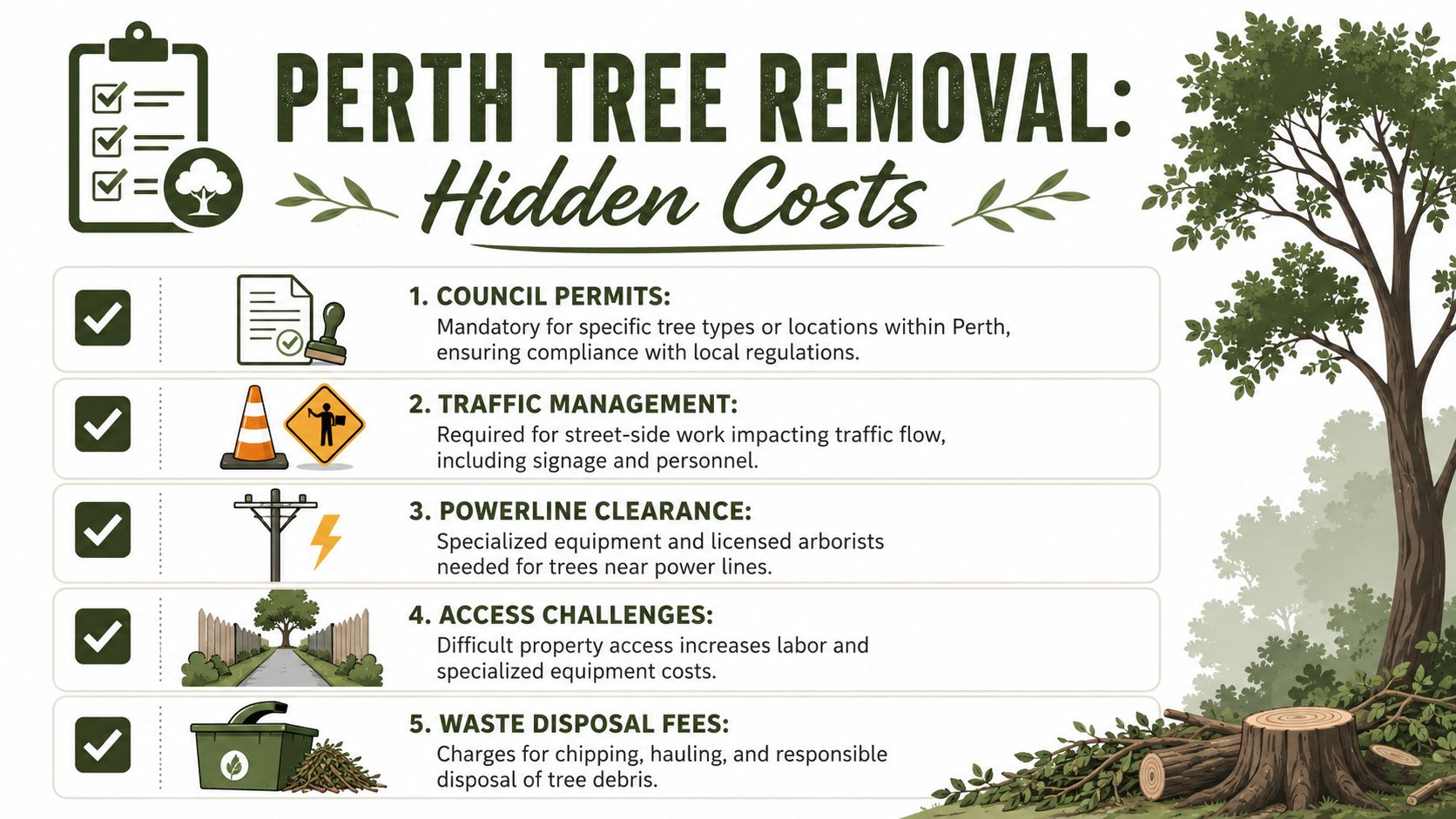
In Perth, local arborist reports, council approvals, traffic control, or powerline safety compliance can materially add to the final bill, as noted in this guide on fallen tree pricing and permit-related gaps.
Council rules can change the whole job
Perth metro councils don't all treat tree work the same way. Depending on the suburb, the species, and the site context, you may need approval or supporting documentation before removal can proceed. If the tree sits in a sensitive location or there's already neighbour concern, a written arborist report can become part of the overall project cost.
If you're unsure where permits fit, this overview of tree removal permit requirements in Perth is a useful starting point.
Street frontage and powerline proximity add real overhead
A tree near the kerb can trigger traffic management. That may mean signage, work-zone setup, and changes to how trucks or chippers are positioned. None of that is visible in a basic “per tree” guide.
Powerline proximity is another category altogether. Once work is close to electrical infrastructure, the removal method has to account for clearances, control zones, and operator qualifications. That doesn't just increase labour. It can alter which tools, access methods, and sequencing are allowed on site.
Disposal is often treated as a separate line item
Another local quoting issue is green waste. Some contractors bundle debris removal. Others price cutting only and leave chipping, log removal, or full site clean-up as extras.
Real-World Quote Scenarios in Perth Suburbs
Real quotes make more sense when you see how the risk profile changes from one suburb to the next. The tree species may differ, but the pricing logic is usually the same. Access, targets, urgency, and disposal shape the final figure.
To make the comparison easier, here's a simple visual first.
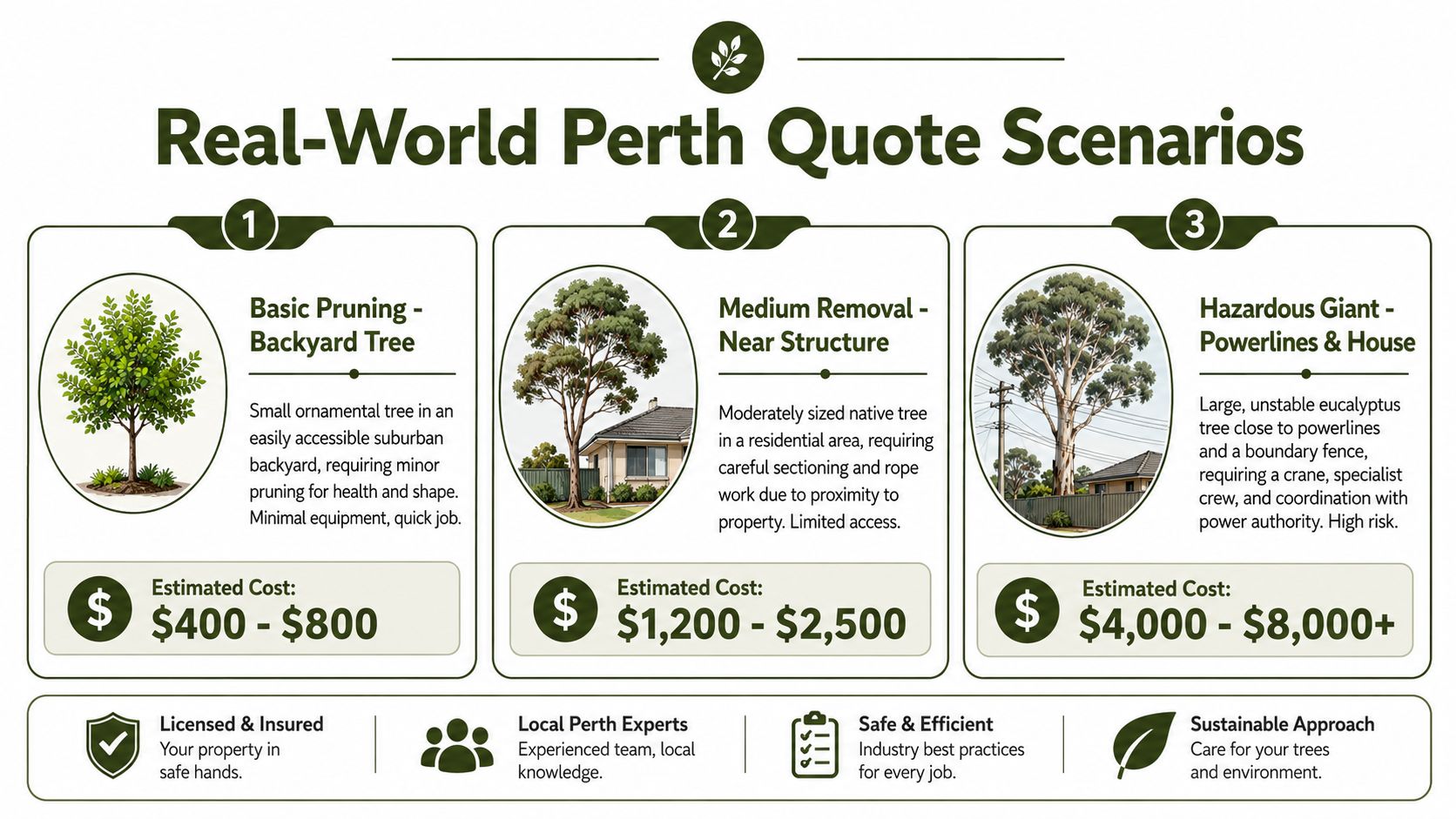
Bassendean backyard with difficult access
A common Perth scenario is a large gum in a rear yard with no direct vehicle access. The tree may not even be storm-damaged, but the hazardous tree removal cost rises because every section must be rigged and every piece of debris carried out through a narrow side path.
In that setup, the work is slower from the first cut. Logs can't easily be dropped and loaded. The crew often needs more controlled lowering and more handling time on the ground. If there's a shed, patio, or boundary fence underneath, section sizes get smaller again.
That's the kind of job where a homeowner wonders why the tree “doesn't look that bad” but the quote still sits well above standard removal pricing. Access and targets are doing the damage to the budget, not just height.
Duncraig storm-damaged tree near services
Urgency significantly alters the job. A storm-damaged tree that has split or partially failed near service lines can't be priced like a routine booking. Qualified operators need to plan for isolation distances, spotters, and fall-exclusion zones, and Australian contractors commonly separate chipping and haulage as line items, according to Thumbtack's overview of tree removal cost variables.
That means the homeowner should look carefully at what the emergency quote includes. One contractor may allow for the dangerous section only, with waste and stump handled later. Another may include full clean-up and disposal.
If the stump remains after the emergency response, this guide to the real cost of removing a tree stump in Perth helps explain why that part is often priced separately.
A short field example helps here. A split tree over a driveway may only need part-removal to make the property safe immediately. The final invoice then depends on whether the owner wants the rest dismantled the same day, the stump ground, and all material hauled.
A practical look at the work process also helps when comparing quotes:
Wembley front yard with better access
Now compare that with a large declining tree in a front yard in Wembley, where the truck can park close and the drop zone is easier to manage. It may still be a technical job, but the workflow is cleaner. Gear moves faster, the crew spends less time on hand-carrying, and waste can be processed more efficiently.
The lesson is simple. Two properties can have trees of similar size, yet one quote will be materially higher because the site forces a slower, more controlled method. That's normal. It's also why “price per tree” is one of the least useful ways to compare hazardous removals.
How to Get the Best Value on Your Tree Removal
Value doesn't mean chasing the cheapest number. It means paying for a quote that actually covers the work required to make the site safe and finish the job properly.
Ask for an itemised scope
Ask the contractor to break out the removal method, waste handling, stump treatment, and any access or compliance allowances. That's the only way to compare like with like.
Check what happens to the debris
One of the most common misunderstandings is whether the contractor is removing everything or cutting the tree down. Clarify if the quote includes chipping, log haulage, leaf and twig clean-up, and final rake-up of the work area.
Use preventative pruning where it makes sense
Not every hazardous situation starts as an emergency. Trees often give warning signs first. Selective reduction, deadwood removal, and canopy management can reduce future risk and make later work simpler than a crisis removal after failure.
Get a Clear and Honest Quote for Your Perth Property
Hazardous tree removal cost isn't arbitrary. It reflects the method needed to remove the tree without causing further damage, injuring someone, or leaving the site half-finished. When a quote is built properly, you're paying for planning, safe dismantling, equipment, crew coordination, and a realistic allowance for site complications.
One practical option in the Perth metro area is Swift Trees Perth. The company provides insured tree removal, pruning, stump grinding, and complex work around structures and powerlines, with on-site assessment used to match the method to the risk rather than relying on generic size-based pricing alone.
If you need a straight answer on a dangerous tree, contact Swift Trees Perth for a clear, no-obligation quote. A proper site inspection can identify the true cost drivers and give you a scope that reflects the actual risk on your property.
Comments