
A Perth Guide to Fig Tree Trimming

Fig tree trimming is easily the most important job you'll do to guarantee a healthy tree and a bumper crop of fruit. A few well-placed cuts during the dormant winter season kickstart new growth—and that new growth is exactly where figs form, leading to a much bigger harvest down the track.
Why Pruning Is Your Secret to a Healthier Fig Tree
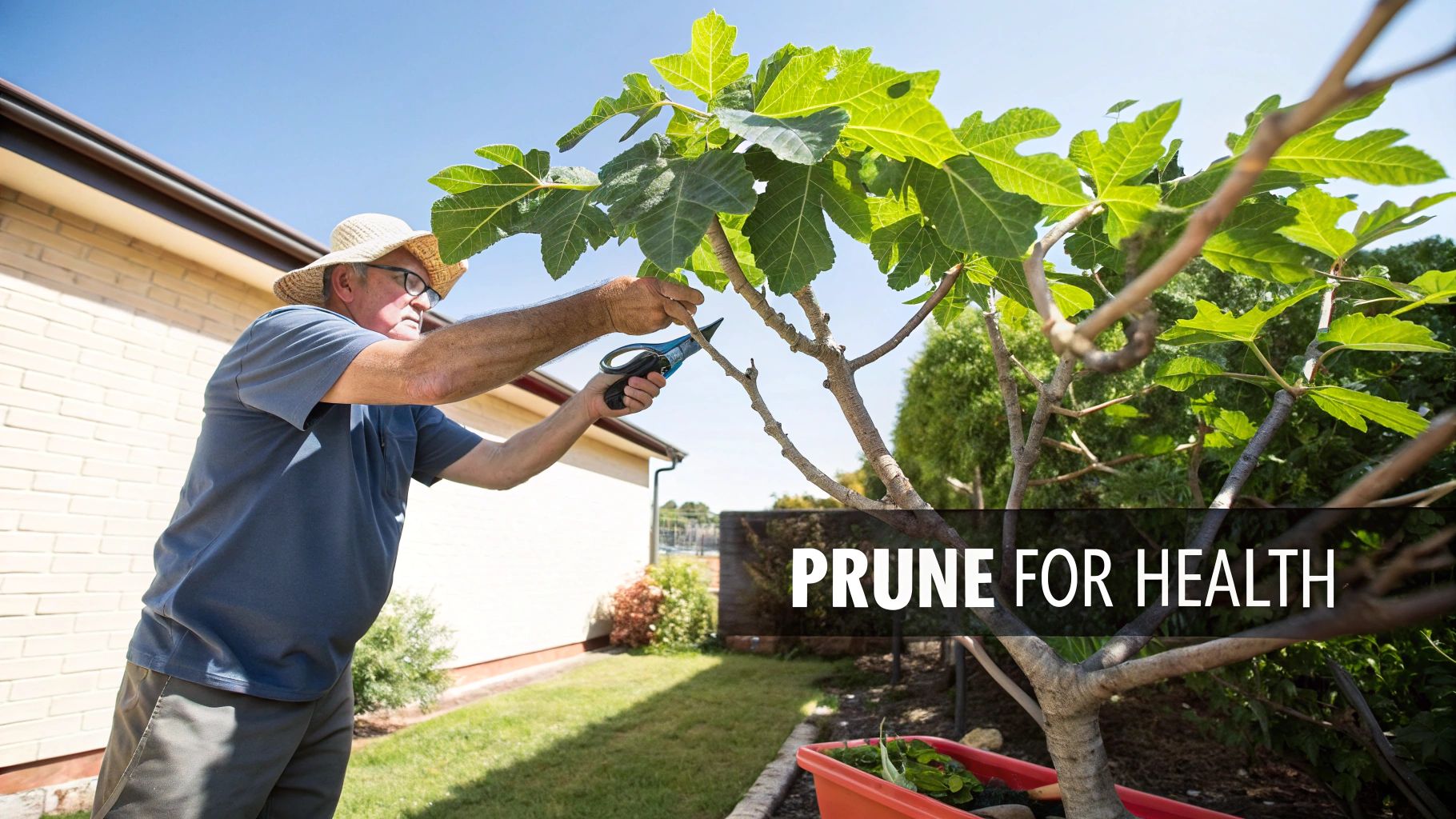
Many Perth homeowners think of pruning as just a way to keep their tree from getting too big, but it's so much more than a simple haircut. Strategic fig tree trimming is really a conversation with your plant. You're guiding its energy towards producing heaps of delicious fruit instead of a tangled mess of unproductive branches. It’s the difference between a purely ornamental tree and a productive, edible feature in your garden.
Think of an unpruned fig tree like a crowded, stuffy room. When branches cross over each other and the canopy gets too dense, air can't circulate properly. This creates a stagnant, humid microclimate—the perfect breeding ground for fungal diseases that love Perth’s sometimes-damp conditions.
Boost Fruit and Enhance Tree Structure
By selectively removing certain branches, you open up the tree, often aiming for a vase-like shape. This simple approach pays off in multiple ways:
Sunlight Penetration: It lets the sun hit the inner branches, which is absolutely vital for ripening fruit evenly all over the tree. No more green, unripe figs hiding in the shade.
Improved Airflow: Better air circulation dramatically cuts down the risk of common problems like fig rust.
Stronger Growth: It gets rid of weak or crossing limbs, forcing the tree to put its resources into developing a strong, stable framework that can support a heavy crop.
This isn’t just garden folklore; the results speak for themselves. Across Australia, regular pruning is directly linked to massive improvements in fruit yield. Data from commercial growers shows that well-pruned fig trees can produce up to 25% more fruit than neglected ones, simply because they fruit on new wood. You can find more on this in a modern guide to fig tree pruning in Australia.
The goal of fig tree trimming isn't just to make the tree smaller, but to make it healthier and way more productive. A few thoughtful cuts can mean the difference between a handful of figs and a basketful.
At the end of the day, a well-pruned fig tree is a masterpiece of both form and function. It has an elegant, open shape that not only looks great in the garden but is also perfectly optimised for a bountiful harvest. A beautifully shaped fig tree can even become a fashionable focal point, elevating the aesthetic of your entire outdoor space. If you're not sure where to start or have a mature tree that needs an expert eye, the team at Swift Trees Perth can give your fig the precise, professional care it needs to truly flourish.
Right then, let's talk about gearing up for the job. Having the right equipment can turn fig tree trimming from a dreaded chore into a seriously satisfying garden project.
You can forget those long, cluttered lists of unnecessary gadgets you see online. Success really just comes down to a few high-quality, well-maintained tools. Think of it as an investment in your garden’s future—good tools make cleaner cuts, which heal faster and keep your tree safe from disease.
The Must-Have Tools for Clean Fig Tree Trimming
The absolute cornerstone of any pruning kit is a solid pair of bypass pruners. These are a non-negotiable. Unlike anvil pruners that crush stems, bypass pruners work just like scissors, delivering a clean slice that’s vital for the health of living fig branches. A sharp pair means you won’t damage the delicate cambium layer just under the bark, which is the superhighway for nutrients.
But what about branches thicker than your thumb? Trying to force your bypass pruners is a classic mistake. This is where a sturdy pruning saw becomes your best friend. A small, curved saw is perfect for getting into the often-awkward angles inside a fig tree’s canopy, letting you take out larger branches without tearing the bark or hurting the main trunk.
Here are the absolute essentials for your toolkit:
Bypass Secateurs: Your go-to for any smaller branches up to about 2cm in diameter. Brands like Felco have a great reputation for a reason—they feel balanced in your hand and are built to last.
Pruning Saw: A must for tackling any branches over 2cm thick. A pull-stroke saw, which cuts on the backward motion, gives you a surprising amount of control and a cleaner finish with a lot less effort.
Loppers: These are brilliant for their extra leverage. The long handles make cutting branches up to 5cm in diameter much easier than wrestling with a saw, especially if they're in a spot that's easy to reach.
Safety and Maintenance Can't Be Skipped
Ever noticed that sticky, white latex sap that oozes from a fig branch?
It can be a real skin irritant for many people, which makes protective gear a must. Always wear a good pair of gardening gloves—leather or a reinforced fabric works best—to protect your hands from both the sap and any sharp twigs.
A quick tip from the field: A lot of modern gardening brands are now focusing heavily on ergonomics. Investing in tools that actually fit your hand size and strength doesn’t just prevent fatigue, it makes the whole process of trimming your fig tree more enjoyable and precise.
Along the same lines, popping on a pair of safety glasses is a simple but crucial step. It’ll protect your eyes from flying bits of wood, whipping branches, and those annoying sap splatters.
Keeping your tools in good nick is just as important as choosing them in the first place. Always give the blades a good clean after you're done to get rid of any sticky sap residue, and make sure to sharpen them at least once a season. It's simple: sharp tools make better cuts, which is kinder to your tree and easier on you.
If your toolkit is looking a bit sparse or you're staring up at branches that seem way out of reach, it might be the perfect time to call for some professional backup. The team at Swift Trees Perth has all the specialised equipment and expertise for any fig tree challenge, big or small. Get in touch today for a safe, clean, and professional service.
Mastering the Most Effective Pruning Cuts
Once you’ve got your tools sorted, it’s time to get into the how of it all—the specific cuts that will shape your fig tree’s future. Proper fig tree trimming isn’t about just hacking away at branches. It’s a series of deliberate, thoughtful cuts designed to steer growth, ramp up your fruit harvest, and keep the tree healthy for years to come.
There are really three main techniques in your toolkit: thinning, heading, and the more drastic rejuvenation pruning.
Getting the right gear is half the battle. This shows the basic progression from small pruners for delicate work, to a saw for bigger limbs, and of course, the safety gear you should never skip.
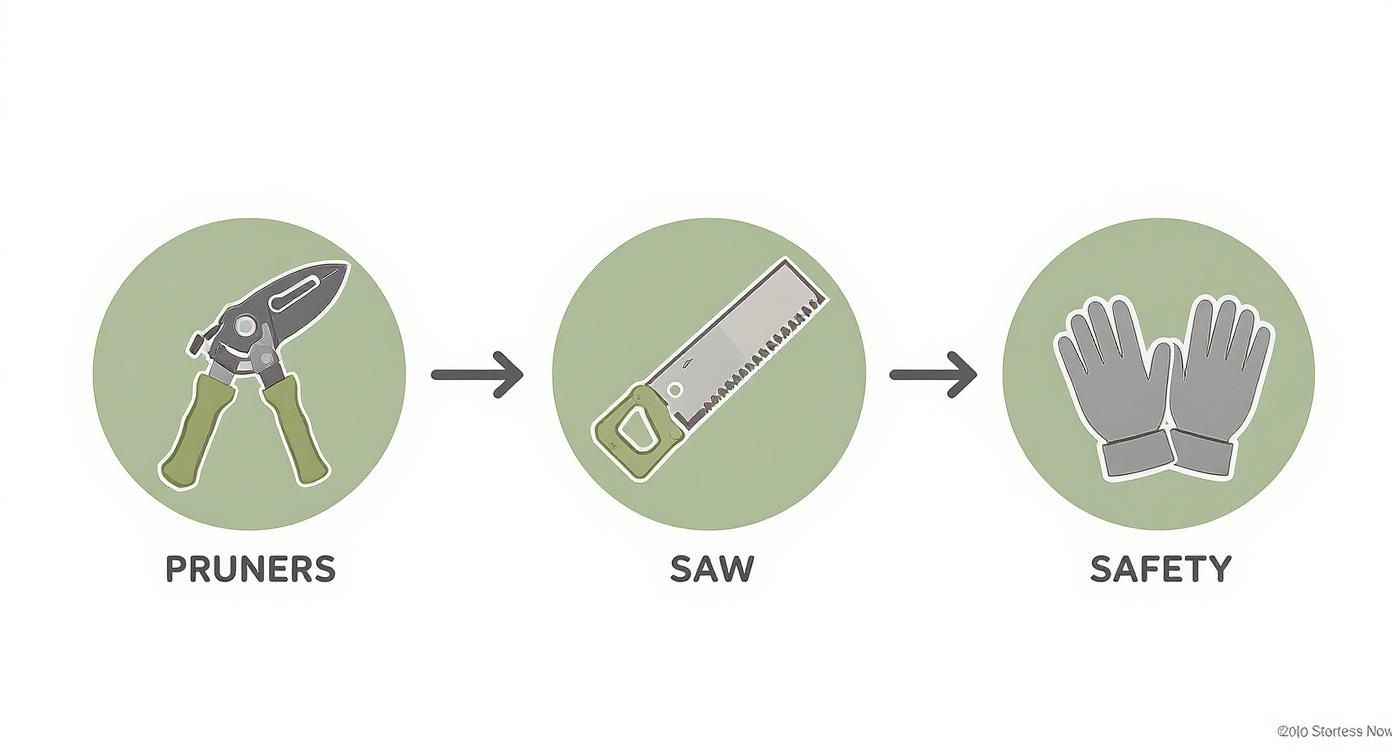
Starting with the right tool for the size of the branch ensures a clean cut, which helps the tree heal faster and protects you in the process. It's a simple principle, but one that’s fundamental to good pruning.
To help you decide which technique to use and when, here’s a quick overview.
Fig Tree Pruning Techniques at a Glance
Technique | Primary Goal | Best For | Perth-Specific Tip |
|---|---|---|---|
Thinning | Improve airflow & sunlight penetration | Overly dense canopies, removing crossing or weak branches. | Essential for Perth gardens where humidity can get trapped in thick foliage, encouraging fungal issues. |
Heading | Encourage bushier growth & control size | Young trees to establish a strong shape or keeping mature trees at a manageable height. | Perfect for backyard figs where you want to keep the fruit within easy picking reach, not 10 metres up. |
Rejuvenation | Revive old, overgrown, or unproductive trees | Neglected trees that have become a tangled mess of woody branches. | A multi-year project. Don't try to do it all at once in our climate, as this can severely stress the tree. |
Now, let's break down what each of these cuts actually involves.
Thinning Cuts for a Healthier Canopy
A thinning cut is your bread and butter. It's the most frequent and beneficial cut you’ll make, and it involves removing an entire branch right back to where it started—either on a bigger limb or the main trunk. The key is to leave no ugly stub behind.
The whole point here is to open things up and let the tree breathe.
For example, if you see two branches rubbing against each other, the constant friction creates a wound—an open invitation for pests. A simple thinning cut removes one of them, instantly solving the problem and boosting airflow.
By thinning out branches that cross over each other, weak little shoots, and any limbs growing back into the centre of the tree, you create a much healthier, open structure. This isn't just about health; it creates a beautiful, sculptural shape that can become a stylish feature in a modern garden design.
Heading Cuts to Encourage Bushiness
A heading cut is different; you're shortening a branch instead of removing it entirely. You simply snip the branch back to just above a healthy, outward-facing bud. This is a brilliant technique for shaping young trees or just keeping an established one from getting out of control.
When you remove that main bud at the very tip of a branch, you're essentially telling the side buds just below the cut to wake up and start growing. This makes the tree grow bushier and more compact, rather than tall and lanky.
For instance, if a young fig sends up a single, whip-like branch, a heading cut about halfway down will encourage it to sprout multiple side branches, forming a strong, balanced framework for future years.
A well-placed heading cut channels the tree's energy into creating a fuller, more productive shape with plenty of fruit-bearing side shoots. It's the secret to stopping your fig from becoming a monster with all the good stuff out of reach.
Rejuvenation Pruning for Older Trees
Did you inherit an old, neglected fig tree that’s more of a tangled mess than a fruit producer? That’s where rejuvenation pruning comes into play. It's a much more aggressive approach, but it’s designed to bring an overgrown tree back from the brink over a few seasons.
This is absolutely not a one-and-done job. The best way to rejuvenate an old fig is to remove about one-third of the oldest, thickest, and least productive main branches in the first winter, cutting them back close to the ground. The next year, you take out another third, and in the third year, you finish with the last third.
This staggered approach gives the tree a massive boost without sending it into shock, encouraging fresh, vigorous growth from the base. This same principle of careful, staged pruning is a winner for many fruit varieties. In fact, our guide on how to prune fruit trees for a better harvest dives deeper into this strategy.
With these techniques understood, you're ready to make cuts that count. Of course, if you're looking at a tree that needs a serious overhaul or you're just not confident where to start, the team at Swift Trees Perth can give your fig the professional touch it needs. Don't hesitate to reach out for any of your tree care needs.
Finding the Perfect Time to Prune in Perth
Figuring out when to trim your fig tree is less about a strict calendar date and more about tuning into its natural cycle here in Perth. If you get the timing right, you’re setting the stage for a year of fantastic growth and a bumper crop of fruit.
The absolute best window for any serious, structural pruning is during the tree's winter dormancy. For those of us in Perth, that sweet spot is usually July and August.
At this point, the tree is basically asleep. Its sap flow has slowed right down, and all its energy is tucked away in the roots, just waiting for that first hint of spring to burst forth.
Why Winter Pruning Is So Important
Pruning a dormant fig tree is like performing surgery while the patient is resting. The tree experiences far less stress and won't "bleed" as much of that classic milky sap.
This means it can channel all its stored energy into healing the cuts and pushing out vigorous new growth as soon as the weather warms up. That new growth is exactly where this season's figs will appear. By making smart cuts in winter, you're essentially telling the tree where to produce its next harvest.
Here in Australia, fig trees can shoot up to heights between 3 and 9 metres, so regular pruning is a must to keep them manageable. Timing that prune for late winter ensures the tree bounces back quickly for strong spring growth.
Expert Tip: Think of winter pruning as the strategic planning phase for your garden. It’s a quiet, contemplative job that pays off massively later on. You’re setting the stage for a spectacular performance in spring and summer.
Lighter Touch-Ups Through the Other Seasons
While the heavy lifting is definitely a winter job, you can still do a bit of light maintenance throughout the year. This helps keep the tree tidy and focused on making fruit, not just more leaves and wood.
Spring (September - November): Keep an eye out for suckers. These are the energetic shoots that pop up from the base of the trunk. For example, if you see a cluster of new shoots sprouting right from the soil line around the main trunk, snip them off as soon as you spot them. They do nothing but steal precious energy from your fruit production.
Autumn (March - May): As the tree starts winding down for the year, it’s a good time for a gentle tidy-up. You can easily remove any small branches that are obviously dead, damaged, or showing signs of disease without stressing the tree.
The Season to Absolutely Avoid
There's one golden rule: do not do any heavy pruning in summer.
Cutting back a fig tree during Perth’s hot, dry summer exposes the sensitive inner bark and branches to the harsh sun. This can lead to severe sunburn, which causes permanent damage to the tree.
Understanding the seasonal needs of different fruit trees can be a bit of a learning curve. Our guide on when to prune fruit trees in Perth offers expert tips that you can apply across your entire garden.
If your fig tree’s pruning needs seem a bit daunting, or if it’s just gotten too big to handle safely, don't hesitate.
For professional advice and tree maintenance tailored to our unique Perth climate, contact Swift Trees Perth today. We’ll make sure your fig tree gets the perfect prune at the perfect time.
Common Fig Tree Trimming Mistakes to Avoid
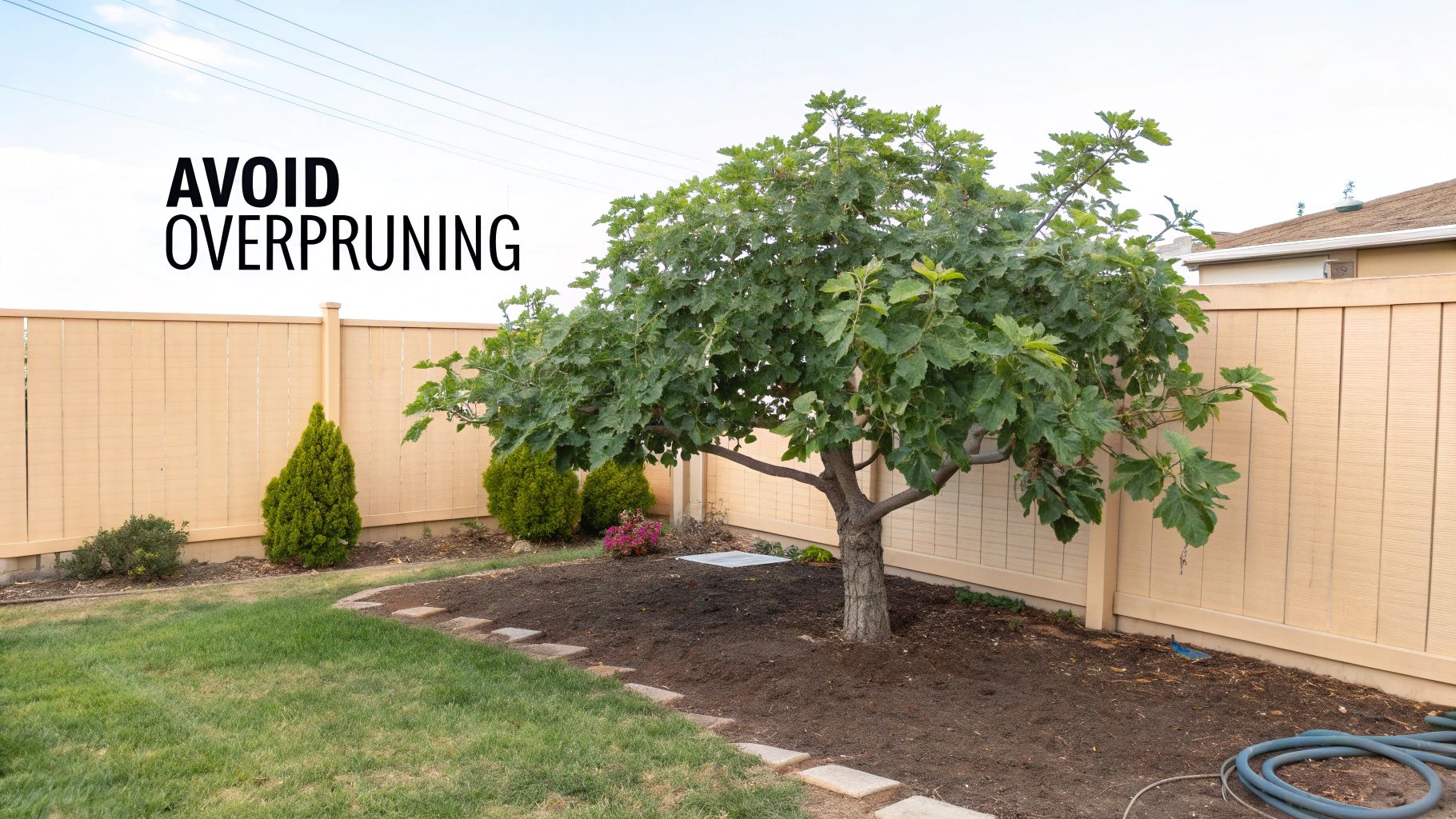
Even with the best of intentions, it’s surprisingly easy to make a few wrong moves when pruning your fig. The good news? Most of these common blunders are entirely preventable once you know what to look for. Think of this as your friendly guide to sidestepping those classic garden mistakes.
One of the biggest temptations we see is "panic pruning." You suddenly realise your fig tree has completely taken over a corner of the yard, and the first instinct is to just cut it back—hard. This aggressive approach almost always does more harm than good, shocking the tree and leaving it vulnerable.
The Problem with Over-Pruning
It’s tempting to be overzealous, but hacking back more than one-third of the canopy in a single season is a massive stressor for the tree. That kind of heavy-handed trimming can expose sensitive bark to Perth’s intense sun, leading to sunburn and permanent damage.
Incorrect timing is another critical error that leads to disappointing results. Pruning too early in autumn or too late in spring can remove the very new wood where your figs were meant to grow, resulting in a tiny harvest. As Australian gardening experts often point out, using clean, sterilised tools is also vital to stop disease from spreading from one cut to the next. You can get more details on how pruning affects fig tree results on t-yard.com.au.
A calmer, more effective long-term solution is to prune moderately each winter. This maintains the tree's size and health without causing the panic that leads to an overgrown, unproductive mess.
Small Mistakes with Big Consequences
Beyond timing and how much you remove, a few smaller technical errors can cause issues down the line. Avoiding them ensures every cut promotes health rather than invites problems.
Leaving Stubs: When you remove a branch, always cut it flush with the main limb or trunk. Leaving a little stub just creates a dead zone where rot and disease can easily take hold.
Ignoring a Plan: Don't just start cutting randomly. Step back and actually look at the tree's overall shape. Decide which branches need to go to improve light and airflow before you make the first cut.
Forgetting the Suckers: Those energetic shoots that pop up around the base of the trunk are pure energy thieves. Letting them grow diverts resources away from the main canopy and, most importantly, your fruit. Snip them off whenever you see them.
Confident fig tree trimming comes from understanding these simple rules. If you're looking at a tree that feels overwhelming or needs more than just a light tidy-up, professional help is the safest bet. The experienced team at Swift Trees Perth can handle any fig tree maintenance, ensuring it’s done correctly and safely. Contact us today for an expert assessment and a free quote.
When to Call in a Professional for Your Fig Tree
While trimming your own fig tree is one of the most rewarding parts of gardening in Perth, there are definitely times when stepping back and calling in an expert is the smartest, safest move. Knowing when to swap your secateurs for the phone isn't about giving up; it’s about protecting your safety, your property, and the long-term vitality of your beloved tree.
Recognising these moments is key. The most obvious sign is when the job involves heights. If trimming your fig tree means getting onto a ladder, it's time to pause. A wobbly ladder is one of the top causes of serious garden injuries, and no amount of figs is worth that risk. A professional arborist has the training and safety gear to work at height efficiently and without danger.
Scenarios That Demand an Expert Eye
Beyond just the height of the tree, several other situations should make you think twice about tackling the job yourself. These are clear indicators that a professional touch is needed to get the job done right.
Proximity to Hazards: If your fig tree has branches growing near or over power lines, do not attempt to trim them. This is an extremely dangerous situation that requires specialised knowledge. Similarly, large branches overhanging your roof, your neighbour’s property, or a public footpath present a significant risk. Professionals are insured and know how to safely dismantle these limbs.
Large, Mature Trees: An old, established fig tree can have branches as thick as your leg. These require a powerful chainsaw and a deep understanding of tree physics to remove safely. A wrong cut can cause a heavy branch to swing unpredictably, damaging property or causing injury.
Tricky Disease or Pest Issues: If you've noticed signs of a serious problem—like large areas of rot, unusual fungal growth, or a persistent pest infestation that isn't responding to home treatments—an arborist can provide a correct diagnosis. They can determine if the tree can be saved and perform the necessary surgical pruning to remove diseased sections without spreading the infection.
Think of a qualified arborist as a tree surgeon. They understand the complex biology of your fig and can perform precise work that promotes healing and vigorous growth, rather than just lopping off branches.
The Value of Professional Pruning Services
Hiring a professional isn't just about safety; it's also about expertise. An experienced arborist can look at a tangled, overgrown fig and see its ideal future shape, making strategic cuts that will improve its health and fruit production for years to come. They bring an artist’s eye combined with a scientist’s knowledge—a unique insight into how to create a tree that is both beautiful and bountiful.
This level of care ensures your tree not only survives but thrives. You can learn more about what to expect from reliable tree pruning services in Perth for healthy trees in our detailed guide. It's about investing in the long-term health and beauty of your garden.
When your fig tree's needs go beyond a simple trim, don't hesitate. For a safe, professional, and beautifully executed job, the friendly and experienced arborists at Swift Trees Perth are ready to help. We have the skills and equipment to handle any challenge, ensuring your tree remains a healthy, productive centrepiece of your garden.
Ready to give your fig tree the expert care it deserves? Contact Swift Trees Perth today for a free, no-obligation quote and let's get your tree looking its best!
Comments