
A Homeowner's Guide to Pollarding a Tree in Perth

Pollarding is a very specific way of pruning a tree. It involves cutting back the upper branches of a young tree to encourage a dense flush of new growth. It's often mistaken for heavy-handed trimming, but when it's done the right way, it's actually a centuries-old technique used to manage a tree's size, keep it healthy, and create a really unique, sculptural look in gardens and urban spaces. Today, this architectural style is becoming a high-fashion statement in modern garden design, creating living sculptures that define a landscape.
What Pollarding a Tree Really Means for Your Garden
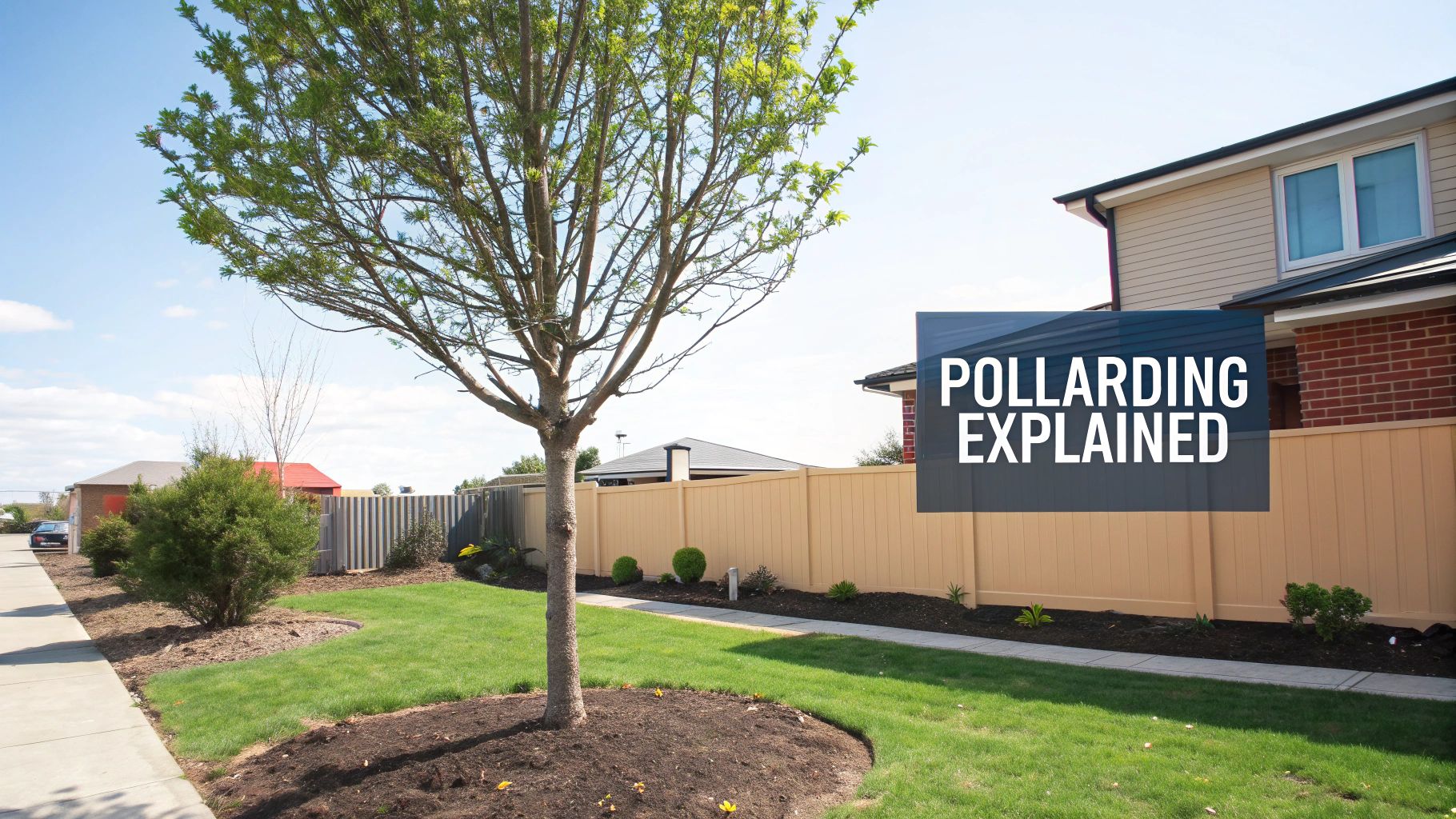
Many homeowners here in Perth see pollarding and think it's just a harsh way to chop back a tree, but it’s far more strategic than that. Don't think of it as a haircut; it's more like hitting a 'reset button' for certain types of trees.
The practice originally started as a way to harvest wood for animal fodder, fencing, or fuel without actually having to fell the entire tree. Today, its purpose has evolved, especially in built-up areas like Perth.
Now, pollarding is a popular method for managing trees in tight spots. It's perfect for stopping them from getting tangled in power lines, blocking a view, or simply outgrowing a small backyard. For example, a row of pollarded London Plane trees can create a stunning formal entrance along a driveway in Subiaco without ever encroaching on the path. When the process is started on a young tree and kept up on a regular cycle, it promotes a dense, vigorous canopy that comes back fresh each season.
The Art and Science of Knuckles
The most recognisable feature of a pollarded tree is its 'knuckles' or 'boles'. These are the gnarled, club-like formations that develop at the ends of the main branches, right where the new shoots sprout from each year. The whole process revolves around removing all the young growth annually or every few years, cutting it right back to these knuckles.
This repeated pruning cycle triggers the tree to produce a burst of new, slender branches. This leads to a few key benefits:
Size Control: The tree is kept at a set height and spread, which is ideal for suburban gardens.
Aesthetic Form: It creates a distinct, architectural shape that adds structure and visual interest, even in winter when the leaves are gone. This minimalist, sculptural look is a trending feature in high-end landscape design.
Longevity: By reducing the tree's overall size and weight, pollarding can lessen the risk of branches failing in a storm, potentially extending its life.
This method is all about working with a tree's natural growth response, not against it. A correctly pollarded tree will develop robust knuckles that become more pronounced and beautiful over time, forming a living sculpture in your garden.
A Technique with Australian Roots
While it has European origins, pollarding isn't new to Australia. Historically, artificial pruning methods like pollarding and coppicing were brought over and adapted here during large-scale tree planting efforts between 1900 and 1935. These techniques were adopted for managing urban trees and in forestry to control tree shape and health, effectively tailoring European traditions to Australian conditions.
Pollarding relies on the tree’s incredible ability to heal and compartmentalise wounds—a fascinating process of natural defence. You can learn more about how trees heal themselves in our detailed article.
Ultimately, understanding what pollarding truly is—a precise, cyclical pruning system—is the first step toward responsible and effective tree care. It’s a commitment to maintaining a tree’s health and form for years to come.
Choosing the Right Trees and Timing for Pollarding in Perth
Getting pollarding right isn't about guesswork. It really boils down to two things: picking the right tree and pruning at the right time. Not every tree can handle such an intense haircut, and in Perth's unique climate, bad timing can stress a tree beyond recovery. Nail these two things, and you're setting yourself up for success.
Some trees are just built for it. They have the natural resilience to bounce back with strong, healthy growth year after year. Others, however, simply don't have what it takes and will likely end up decaying or dying back.
Perth's Prime Candidates for Pollarding
Here in Perth, a few deciduous trees are favourites for pollarding because they're tough and predictable. They respond beautifully to the pruning cycle, forming those classic "knuckles" and pushing out a lush canopy every spring.
These are some of the best choices for local gardens:
London Plane Trees (Platanus × acerifolia): These are the classic pollarding trees for a reason. They're incredibly tough, handle urban pollution like champs, and develop those beautiful, gnarled knuckles over time. You'll see them used to create formal avenues in parks and on older streets.
Crepe Myrtles (Lagerstroemia indica): Everyone in Perth loves them for their stunning summer flowers. Crepe Myrtles take a hard prune really well, and it actually encourages them to produce even more blooms on the new season's growth. Imagine a pair of pollarded Crepe Myrtles framing a modern courtyard, providing a burst of colour all summer long.
Linden Trees (Tilia species): With their neat, pyramidal shape and reliable growth, Lindens are perfect for creating formal rows or a single, striking feature tree in a garden.
Mulberry Trees (Morus species): Known for growing like crazy, mulberries can be pollarded to keep their size in check, which also makes harvesting the fruit a whole lot easier.
To make it easier, here’s a quick guide to some common trees you’ll find around Perth and how they stack up for pollarding.
Pollarding Suitability for Common Perth Trees
Tree Species | Pollarding Suitability | Key Considerations |
|---|---|---|
London Plane Tree | Excellent | The classic choice. Forms strong knuckles and is very resilient. |
Crepe Myrtle | Excellent | Promotes heavy flowering on new wood. Very common in Perth. |
Jacaranda | Poor to Fair | Can be done, but regrowth is often weak and prone to snapping. |
Eucalyptus (most) | Not Recommended | Does not form knuckles; regrowth is often structurally weak and hazardous. |
Linden Tree | Good | Responds well and maintains a formal shape. |
Mulberry Tree | Good | Manages vigorous growth and makes fruit harvesting simpler. |
Ficus (Fig Trees) | Fair | Can tolerate it, but prone to bleeding sap and needs careful management. |
This table is just a starting point, of course. If your tree isn't on this list, it’s always best to get a professional opinion before you start cutting.
The Critical Importance of Timing
When it comes to pollarding, timing is absolutely everything. You want to make the cuts when the tree is dormant, so all its stored energy is ready to burst into new growth once the weather warms up. This minimises the shock and lowers the risk of diseases getting into the fresh wounds.
For Perth’s climate, the sweet spot for pollarding is during the tree's dormancy in late winter or very early spring. Think late July or August, right before you see the first buds starting to swell. Pruning then allows the cuts to heal quickly as the tree kicks into its spring growth spurt.
This isn't just a local tip; it's a standard practice in Australian arboriculture. Arborists across the country use pollarding on species like plane trees and willows to manage their size, always recommending a winter prune to reduce stress and the chance of infection.
Let's put it into a real-world context. Imagine you have a big London Plane tree in your Morley backyard. An arborist would pick a cool, dry day in late July to do the work. This timing ensures the tree is fully dormant, which stops sap from 'bleeding' out of the cuts and gives it the best possible start for the growing season ahead.
Knowing exactly when your tree is dormant is key. For more detailed advice, check out our guide on the best time to prune trees in Australia.
Getting the species and timing right is the foundation for a healthy, beautifully shaped tree. If you're ever in doubt about your tree's suitability or the perfect time to act, getting professional advice is the smartest move.
The Professional Approach to Pollarding a Tree
Watching a certified arborist pollard a tree is a bit like seeing a sculptor at work. It’s a craft that demands precision, foresight, and a deep understanding of the tree's biology. This isn't just about random cutting; it’s a methodical practice that starts with setting a solid framework and continues with regular, cyclical maintenance. Knowing how the pros do it helps you appreciate the skill involved—and why it’s a job best left to them.
The journey starts when the tree is still young. An arborist will carefully select the main structural branches that will become the permanent "bones" of the tree, cutting them back to a specific height. These first cuts are the most important part of the process, as they establish the foundation for the classic 'knuckles' or 'boles' that define a pollarded tree.
Establishing the Framework The Right Way
The whole point of these initial cuts is to encourage the tree to form those gnarled, club-like knuckles at the end of its main limbs. From these points, all future growth will sprout.
A professional approach involves:
Strategic Selection: Picking branches that will create a balanced and appealing shape once the new canopy grows in.
Precise Height: Cutting all the main branches to a uniform height. This ensures a level, well-formed canopy down the track.
Clean Cuts: Using razor-sharp tools to make clean cuts just outside the branch collar, which helps the tree compartmentalise and heal the wound effectively.
This foundational work sets the tree up for its entire life. Think of it as a long-term investment in the tree’s health and structure.
The Cyclical Pruning Process
Once the knuckles are established, pollarding becomes a routine maintenance job. Typically, this is done every one to three years during the tree's dormant season. The arborist comes back and removes all the slender new shoots that have grown from the knuckles since the last prune.
The real key is consistency. By removing the new growth back to the same points each cycle, the knuckles become more pronounced and robust over time. This regular pruning keeps the tree in a sort of juvenile state, which can reduce physical stress and even extend its lifespan.
Sticking to the cycle is vital for the tree's health. If you skip a cycle, the new branches can get too thick, making the next prune much harder and more stressful for the tree.
This visual guide breaks down the critical timing decisions an arborist makes before even thinking about making a cut.
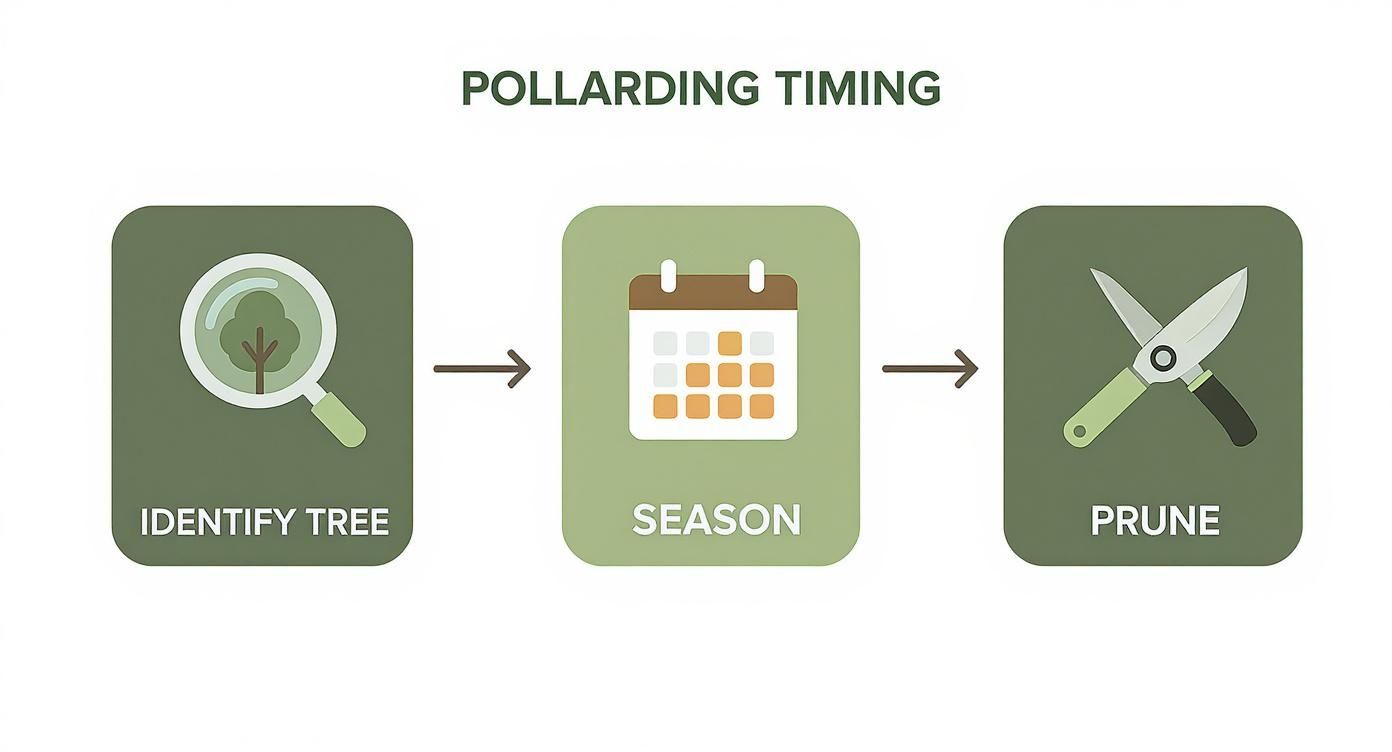
As you can see, it’s a deliberate sequence: first identification, then seasonal assessment, and finally, precise action. The tree's health is always the number one priority.
The Tools and Techniques of the Trade
Proper pollarding takes more than just a saw. Professionals rely on a specific set of tools and techniques to ensure every cut is perfect and the job is done safely. An arborist’s pollarding kit will almost always include razor-sharp pruning saws, bypass secateurs for smaller shoots, and maybe a telescoping pole saw for those hard-to-reach branches.
The cutting technique itself is an art. Each cut is made flush with the knuckle but never into it. Slicing into that established knuckle creates a wound that lets decay creep deep into the tree’s main structure, compromising its health for good. An arborist knows that a clean cut just outside the old wood is the difference between a thriving tree and a dying one.
For larger trees, safety becomes paramount. This means harnesses, ropes, and a ground crew to manage falling branches and protect the property and public below. The level of planning and risk assessment is something only a trained professional can bring to the job. It’s this deep understanding that separates a qualified arborist from other tree workers.
Ultimately, the professional approach to pollarding is a long-term commitment. It’s a partnership between the arborist and the tree, ensuring it remains a safe, healthy, and beautiful feature of your landscape for decades to come.
The Dangers of DIY Pollarding and Why to Call an Expert
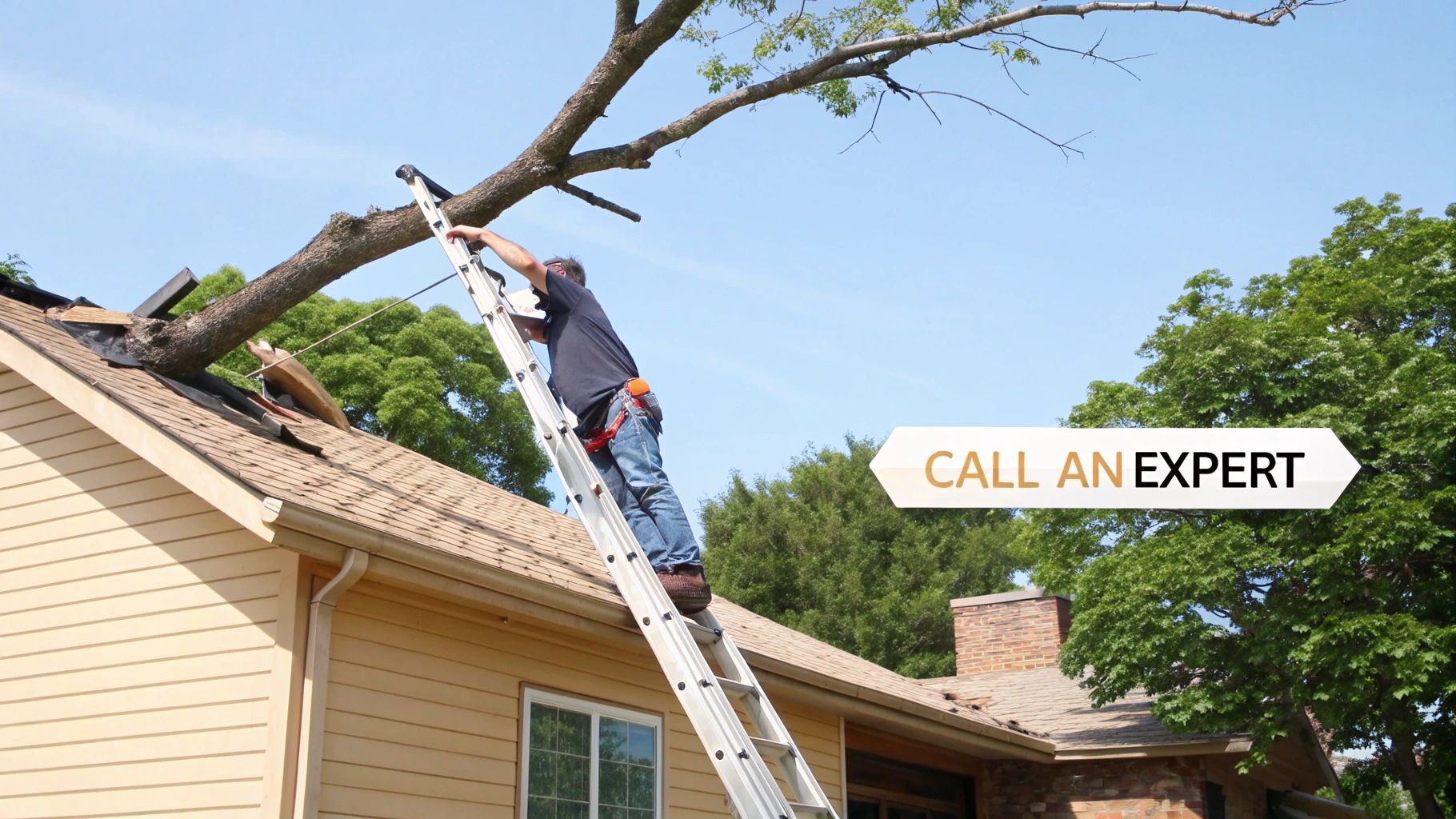
It can be tempting to tackle pollarding yourself. You watch a few online videos, grab the ladder and chainsaw, and figure it’s a manageable weekend project. But this is one of those jobs where a little bit of knowledge can be a very dangerous thing.
What seems straightforward from the ground is actually loaded with hidden risks—for you, your property, and the tree itself. Professional arboriculture is as much about managing risk as it is about making the right cuts.
Your Safety Comes First
Let's not beat around the bush: working at height with power tools is incredibly dangerous. Ladders can easily become unstable on uneven Perth ground, and the physics of falling branches are notoriously hard to predict. A limb that looks manageable can weigh hundreds of kilos, and one bad cut can send it crashing down where you least expect it.
This isn't just a hypothetical warning. The statistics are grim. A study looking at trauma admissions between 2013 and 2021 revealed that while tree maintenance injuries were rare, they were often severe. A staggering 37.5% of those injured ended up in the ICU. These numbers really highlight the serious hazards of amateur tree work. You can read more about the findings on tree maintenance injuries from this research.
When DIY Goes Wrong: Property at Risk
The danger doesn't stop with personal injury. Imagine a heavy branch smashing onto your roof, your car, or even your neighbour’s property. The financial fallout from an accident like that can be massive, easily dwarfing the cost of hiring a professional in the first place.
And don't assume your insurance will cover it. Many standard home policies won't pay out for damage caused by unqualified and uninsured tree work, leaving you to foot the entire bill.
Then there are the unseen hazards. Are there power lines running through the canopy? Hitting a live wire can be fatal. A professional arborist is trained to spot these critical dangers. They use specialised, non-conductive equipment and coordinate with utility companies when necessary, assessing the entire work area for risks you might not even think to look for.
Doing Irreversible Damage to Your Tree
Even if you manage to avoid injury and property damage, a clumsy attempt at pollarding can permanently harm your tree. The health of a pollarded tree depends entirely on the precision of the cuts.
Here are some common DIY mistakes we see all the time:
Cutting into the Knuckle: Slicing into the established knuckle bypasses the tree's natural defence mechanisms. It creates a huge wound that invites decay and disease right into the core of the tree.
Leaving Stubs: If you cut too far from the knuckle, you leave a "stub" that the tree can't heal over. This dead wood becomes a gateway for pests and rot.
Creating Jagged Cuts: Using dull or improper tools tears the bark. These ragged wounds heal poorly and put the tree under unnecessary stress.
These mistakes don't just leave you with an ugly tree; they can weaken it so badly that it fails years later, turning a beautiful garden asset into a serious liability.
As one professional arborist told us, "A professional doesn't just cut branches; they manage risk for the homeowner, the public, and the tree." This single insight captures the core value of hiring an expert.
Bringing in a qualified, insured tree professional isn’t just an expense—it’s an investment in your safety, your peace of mind, and the long-term health of your trees. They have the right training, the right gear, and the crucial insurance to protect you from every angle. When it comes to something as specialised as pollarding, the risks of going it alone are simply too high.
For professional tree maintenance that puts your safety and your tree's health first, it’s time to call in the experts. Contact Swift Trees Perth for a consultation and let our qualified team manage your trees with the skill and care they deserve.
Looking After Your Tree Post-Pollard (And What Not to Do)
Once the tools are packed away, the job's not quite done. The most important work—the tree's recovery—is just beginning. Think of proper aftercare as the crucial follow-through to a good pollarding job. It's all about giving the tree the support it needs to bounce back strong and push out healthy new growth instead of struggling with stress and disease.
A freshly pollarded tree is in a vulnerable state. It’s lost a huge part of its canopy and is now running on stored energy to grow new shoots. Your role is to make its recovery as smooth as possible.
Nurturing New Growth
That burst of new shoots you see after pollarding is exactly what you want—it’s a sign of a healthy, vigorous response. But all that new growth takes a lot of energy, water, and nutrients. Here’s how you can help.
Watering Wisely: After a heavy prune, especially heading into Perth’s dry season, consistent watering is vital. Give the tree a deep, slow soak once a week. This helps the moisture get right down to the root zone, encouraging a strong recovery without waterlogging the soil. A practical example would be setting up a soaker hose in a circle around the tree's drip line and letting it run for an hour.
The Magic of Mulch: Spreading a generous layer of organic mulch around the tree's base is one of the best things you can do. Just make sure to keep it from touching the trunk itself. Mulch is a triple threat: it holds in soil moisture, keeps weeds down, and slowly feeds the soil as it breaks down.
Keep an Eye on Things: Watch your tree for any signs of stress. Are the new leaves wilting? Is the bark discoloured? Do you see any pests moving in? Catching these problems early means you can deal with them before they become serious.
When you see a flush of vigorous, slender shoots sprouting from the knuckles, you know the pollarding was a success. That’s the classic, healthy response we aim for
Common Pruning Blunders to Avoid
Even with the best intentions, a few simple technical errors can cause massive problems down the line. A professional arborist is trained to sidestep these common pitfalls:
Cutting Into the Knuckle: That swollen knuckle is the tree's life-support system for all future growth. Slicing into this woody tissue creates a major wound that bypasses the tree’s natural defences, essentially opening a door for rot and disease to march straight into the main branches.
Leaving Jagged Stubs: If a cut is made too far from the knuckle, it leaves a little stub of wood that will just die off. The tree can't seal over this dead tissue, making it the perfect entry point for wood-boring insects and fungal spores.
Using Dull or Dirty Tools: A dull saw blade doesn't cut—it tears and crushes wood fibres. These ragged wounds heal much more slowly and are far more likely to get infected. Similarly, using dirty tools can spread pathogens from an infected tree to a healthy one.
Each of these mistakes undermines the tree’s health and structural integrity. The whole point of pollarding is to create a strong, stable, and healthy tree, and avoiding these blunders is key to getting it right.
For homeowners across Perth, ensuring your tree gets expert care, from the first cut to the final aftercare, is the best way to protect your investment. Contact us for your tree maintenance needs and let our professionals handle the job with the precision and care it deserves.
Thinking of Pollarding? Let's Talk First.
As we've walked through in this guide, pollarding is a serious bit of tree surgery. It’s a delicate balance of art and science, demanding a deep respect for how a tree works, precise cuts, and a non-negotiable focus on safety. This is definitely not a job for a Sunday afternoon whim or a bit of guesswork.
For Perth homeowners and property managers who love the striking, architectural look of a pollarded tree but want to sidestep the huge risks of getting it wrong, Swift Trees Perth is your local expert. We bring professional know-how right to your property, ensuring the job is done properly and safely from the first cut.
Why Bring in a Professional Arborist?
Getting a certified tree professional involved isn't just about ticking a job off the list; it's an investment in the future health of your trees and the safety of your property. Our team has spent years on the ground, working with Perth’s unique tree species and navigating the specific council regulations that come with them.
We get the challenges our local climate and soils present, which means our advice is practical and proven to work. We know which trees will respond beautifully to pollarding and, just as importantly, which ones should never be touched.
Hiring a professional turns pollarding from a high-stakes gamble into a smart, strategic decision. It protects you from the risk of injury, property damage, and the genuine heartbreak of losing a magnificent tree to a few wrong cuts.
Our entire service is built on trust and safety. As a fully insured company, we make sure you, your home, and your neighbours are completely covered while we're on site. That kind of peace of mind is priceless when you're dealing with the risks inherent in tree work.
Whether it’s making those critical first cuts on a young tree or carrying out precise cyclical maintenance, our goal is always the same: to enhance the health, structure, and beauty of your garden.
If you’re ready to shape your trees into stunning, manageable features, don't leave it to chance. The friendly, knowledgeable team at Swift Trees Perth is here to help.
Got Questions About Pollarding?
Even after walking through the process, it’s completely normal to have a few more specific questions pop up. Here are some of the most common queries we get from homeowners around Perth, with straight-to-the-point answers.
What's the Cost to Pollard a Tree in Perth?
The price for pollarding can vary quite a bit, as no two trees are the same. Key factors include the tree’s size, its species, how easy it is for our crew to access, and its overall condition. A small, young tree that’s straightforward to work on might only set you back a few hundred dollars.
On the other hand, a large, mature tree needing specialised equipment for working at height or navigating around structures will naturally cost more. The only way to get a firm price is with an on-site quote, where a qualified arborist can properly assess everything involved.
Is There a Risk Pollarding Will Kill My Tree?
When it's done right by a professional on a suitable species, starting from a young age, pollarding is a perfectly sustainable practice that will not kill the tree. In fact, it's designed to work in harmony with the tree's natural growth patterns.
This is exactly why getting a pro is non-negotiable if you care about your tree’s long-term health.
Do I Need Council Permission to Pollard a Tree?
That really depends. Your local council in Perth, the species of the tree (especially if it's a protected native), and its size and location are all critical pieces of the puzzle. Many councils have Tree Preservation Orders (TPOs) or significant tree registers that regulate major pruning work.
Before you think about starting, we always recommend a quick check with your local council.
Ready to transform your garden with a stunning, professionally maintained tree?
The expert team at Swift Trees Perth has the skills and experience to handle all your tree surgery needs safely and effectively. For a beautiful result that enhances your property and ensures the long-term health of your trees, don't hesitate. Contact Swift Trees Perth today for a friendly chat and a no-obligation quote for all your tree maintenance needs.

Comments